
Ch. 8 - Hypothesis Testing
Triola - Elementary Statistics 14th Edition
Triola14th EditionElementary StatisticsISBN: 9780137366446Not the one you use?Change textbook
Chapter 8, Problem 8.CQQ.10

Robust Explain what is meant by the statements that the t test for a claim about μ is robust, but the (chi)^2 test for a claim about σ is not robust.

Verified step by step guidance
1
Understand the term 'robust': In statistics, a test is considered robust if it remains valid and reliable even when certain assumptions (like normality of the data) are violated to some extent.
Explain the t-test for a claim about μ: The t-test is used to test hypotheses about the population mean (μ). It assumes that the data is approximately normally distributed, but it is robust because it can still perform well even if the normality assumption is slightly violated, especially with larger sample sizes due to the Central Limit Theorem.
Explain the (chi)^2 test for a claim about σ: The chi-squared test is used to test hypotheses about the population variance (σ²). It assumes that the data is normally distributed. However, it is not robust because even small deviations from normality can significantly affect the validity of the test results.
Compare robustness: The t-test's robustness comes from its reliance on sample means, which are less sensitive to deviations from normality. In contrast, the chi-squared test is highly sensitive to the shape of the data distribution, making it less robust.
Conclude the explanation: The statement highlights that the t-test for μ is more forgiving of assumption violations, while the chi-squared test for σ is not, emphasizing the importance of verifying assumptions before using the chi-squared test.

Verified video answer for a similar problem:

This video solution was recommended by our tutors as helpful for the problem above.
Video duration:
2m
Was this helpful?

Key Concepts

Here are the essential concepts you must grasp in order to answer the question correctly.

Robustness in Statistical Tests

Robustness refers to the ability of a statistical test to remain valid under violations of its assumptions. A robust test can provide reliable results even when the data does not perfectly meet the conditions required for the test, such as normality or equal variances. This is particularly important in real-world data analysis, where ideal conditions are often not met.
Recommended video:
Guided course
06:34
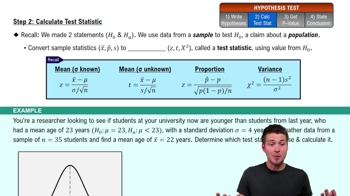
Step 2: Calculate Test Statistic

t-Test for Mean (μ)

The t-test is a statistical method used to determine if there is a significant difference between the means of two groups. It is considered robust because it can still yield valid results even when the data is not normally distributed, especially with larger sample sizes. This flexibility makes the t-test a popular choice in various research scenarios.
Recommended video:
Guided course
08:24
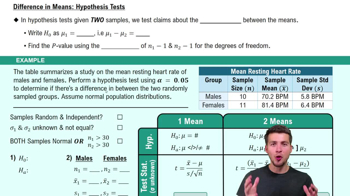
Difference in Means: Hypothesis Tests

Chi-Squared Test for Variance (σ)

The chi-squared test is used to assess the goodness of fit or to test hypotheses about the variance of a population. Unlike the t-test, the chi-squared test is not robust; it requires the data to be normally distributed for the results to be valid. If this assumption is violated, the test can produce misleading conclusions, making it less reliable in certain situations.
Recommended video:
Guided course
06:34
Step 2: Calculate Test Statistic
Related Practice
Textbook Question

Hypothesis Test for Lightning Deaths Refer to the sample data given in Cumulative Review Exercise 1 and consider those data to be a random sample of annual lightning deaths from recent years. Use those data with a 0.01 significance level to test the claim that the mean number of annual lightning deaths is less than the mean of 72.6 deaths from the 1980s. If the mean is now lower than in the past, identify one of the several factors that could explain the decline.

95
views
Textbook Question

Discarded Plastic Find the test statistic used for the hypothesis test described in Exercise 1.

95
views
Textbook Question

Discarded Plastic


What distribution is used for the hypothesis test described in Exercise 1?

For the hypothesis test described in Exercise 1, is it necessary to determine whether the 62 weights appear to be from a population having a normal distribution? Why or why not?

111
views
Textbook Question

Lightning Deaths The graph in Cumulative Review Exercise 5 was created by using data consisting of 242 male deaths from lightning strikes and 64 female deaths from lightning strikes. Assume that these data are randomly selected lightning deaths and proceed to test the claim that the proportion of male deaths is greater than . Use a 0.01 significance level. Any explanation for the result?

90
views
Textbook Question

Discarded Plastic Data Set 42 “Garbage Weight” includes weights (pounds) of discarded plastic from 62 different households. Those 62 weights have a mean of 1.911 pounds and a standard deviation of 1.065 pounds. We want to use a 0.05 level of significance to test the claim that this sample is from a population with a mean less than 2.000 pounds. Identify the null hypothesis and alternative hypothesis.

111
views
Textbook Question

Discarded Plastic The P-value for the hypothesis test described in Exercise 1 is 0.2565.


What should be concluded about the null hypothesis?

What is the final conclusion that addresses the original claim?

82
views