
Ch. 8 - Hypothesis Testing with Two Samples
Larson - Elementary Statistics: Picturing the World 8th Edition
Larson8th EditionElementary Statistics: Picturing the WorldISBN: 9780137493470Not the one you use?Change textbook
Chapter 8, Problem 8.RE.4

In Exercises 1–4, classify the two samples as independent or dependent and justify your answer.


Sample 1: The fuel efficiencies of 12 cars
Sample 2: The fuel efficiencies of the same 12 cars using an alternative fuel


Verified step by step guidance
1
Identify the key characteristic of the two samples: Sample 1 contains the fuel efficiencies of 12 cars, and Sample 2 contains the fuel efficiencies of the same 12 cars but using an alternative fuel.
Understand the definition of independent samples: Two samples are independent if the data in one sample does not influence or is not paired with the data in the other sample.
Understand the definition of dependent samples: Two samples are dependent (or paired) if each data point in one sample is directly related to a data point in the other sample, such as measurements taken on the same subjects under different conditions.
Analyze the relationship between the two samples: Since the fuel efficiencies in Sample 2 are measured on the same cars as in Sample 1, the data points are paired. Each car's fuel efficiency in Sample 1 corresponds to its fuel efficiency in Sample 2 under the alternative fuel condition.
Conclude that the two samples are dependent because the measurements in Sample 2 are directly related to the measurements in Sample 1, as they are taken from the same set of cars under different conditions.

Verified video answer for a similar problem:

This video solution was recommended by our tutors as helpful for the problem above.
Video duration:
2m
Was this helpful?

Key Concepts

Here are the essential concepts you must grasp in order to answer the question correctly.

Independent Samples

Independent samples refer to two or more groups that are not related or influenced by each other. In statistical analysis, this means that the selection or outcome of one sample does not affect the other. For example, if you were comparing the test scores of two different classes, the scores of one class would not impact the scores of the other.
Recommended video:
Guided course
06:28
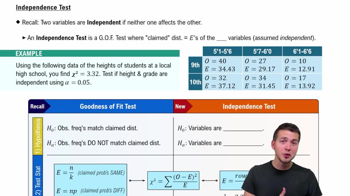
Independence Test

Dependent Samples

Dependent samples, also known as paired samples, occur when the samples are related or matched in some way. This typically involves measuring the same subjects under different conditions or at different times. An example is measuring the weight of individuals before and after a diet program, where the same subjects are involved in both measurements.
Recommended video:
05:11
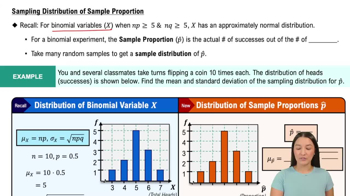
Sampling Distribution of Sample Proportion

Justification in Statistical Analysis

Justification in statistical analysis involves providing reasoning for classifying samples as independent or dependent based on their relationship. This is crucial for selecting the appropriate statistical tests, as different tests are used for independent versus dependent samples. Clear justification helps ensure the validity of the analysis and the conclusions drawn from the data.
Recommended video:
Guided course
05:53
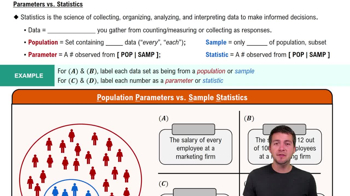
Parameters vs. Statistics
Related Practice
Textbook Question

In Exercises 11–16, test the claim about the difference between two population means μ1 and μ2 at the level of significance α. Assume the samples are random and independent, and the populations are normally distributed.


Claim: μ1>= μ2; α=0.01. Assume (σ1)^2 = (σ2)^2


Sample statistics: x̅1= 44.5, s1= 5.85, n1= 17 and x̅2= 49.1, s2= 5.25, n2= 18

55
views
Textbook Question

In Exercises 17 and 18, (c) find the standardized test statistic t, Assume the samples are random and independent, and the populations are normally distributed.


A real estate agent claims that there is no difference between the mean household incomes of two neighborhoods. The mean income of 12 randomly selected households from the first neighborhood is \$52,750 with a standard deviation of \$2900. In the second neighborhood, 10 randomly selected households have a mean income of \$51,200 with a standard deviation of \$2225. At α=0.01, can you reject the real estate agent’s claim? Assume the population variances are equal.

38
views
Textbook Question

"In Exercises 17 and 18, (b) find the critical value(s) and identify the rejection region(s), Assume the samples are random and independent, and the populations are normally distributed.


A real estate agent claims that there is no difference between the mean household incomes of two neighborhoods. The mean income of 12 randomly selected households from the first neighborhood is \$52,750 with a standard deviation of \$2900. In the second neighborhood, 10 randomly selected households have a mean income of \$51,200 with a standard deviation of \$2225. At α=0.01, can you reject the real estate agent’s claim? Assume the population variances are equal."

36
views
Textbook Question

In Exercises 11–16, test the claim about the difference between two population means μ1 and μ2 at the level of significance α. Assume the samples are random and independent, and the populations are normally distributed.


Claim: μ1= μ2; α=0.05. Assume (σ1)^2 = (σ2)^2


Sample statistics: x̅1=228, s1=27, n1= 20 and x̅2=207, s2=25, n2= 13

42
views
Textbook Question

In Exercises 5–8, test the claim about the difference between two population means μ1 and μ2 at the level of significance α. Assume the samples are random and independent, and the populations are normally distributed.


Claim: μ1≠μ2; α=0.05


Population statistics: σ1= 14 and σ2= 15


Sample statistics: x̅1 = 87, n1 = 410, and x̅2= 85, n2= 340

42
views
Textbook Question

In Exercises 1–4, classify the two samples as independent or dependent and justify your answer.


Sample 1: The weights of 45 oranges

Sample 2: The weights of 40 grapefruits


71
views