
Textbook Question
Finding Area
In Exercises 23–36, find the indicated area under the standard normal curve. If convenient, use technology to find the area.
Between z=0 and z=2.86
84
views

 Verified step by step guidance
 06:23
06:23
 06:31
06:31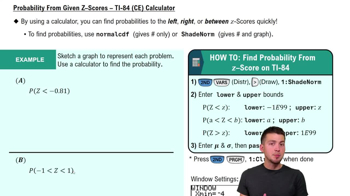 07:09
07:09Finding Area
In Exercises 23–36, find the indicated area under the standard normal curve. If convenient, use technology to find the area.
Between z=0 and z=2.86
Graphical Analysis In Exercises 17–22, find the indicated z-score(s) shown in the graph.
" style="" width="260">
Finding Probabilities In Exercises 15–18, the population mean and standard deviation are given. Find the indicated probability and determine whether the given sample mean would be considered unusual.
For a random sample of n=36, find the probability of a sample mean being less than 12,750 or greater than 12,753 when mu=12750 and 1.7.
Finding Probability In Exercises 47–56, find the indicated probability using the standard normal distribution. If convenient, use technology to find the probability.
P(- 1.54 < z < 1.54)
Interpreting the Central Limit Theorem In Exercises 19–26, find the mean and standard deviation of the indicated sampling distribution of sample means. Then sketch a graph of the sampling distribution.
Renewable Energy During a recent period of two years, the day-ahead prices for renewable energy in Germany (in euros per mega-watt hour) have a mean of 31.58 and a standard deviation of 12.293. Random samples of size 75 are drawn from this population, and the mean of each sample is determined.
In Exercises 9–14, write the binomial probability in words. Then, use a continuity correction to convert the binomial probability to a normal distribution probability.
P(x ≤ 150)