
Given a normal distribution with mean = and standard deviation = , what are the z-scores that correspond to the boundaries of the middle 95% of the distribution as shown in a standard normal curve graph?
Table of contents
- 1. Intro to Stats and Collecting Data1h 14m
- 2. Describing Data with Tables and Graphs1h 55m
- 3. Describing Data Numerically2h 5m
- 4. Probability2h 16m
- 5. Binomial Distribution & Discrete Random Variables3h 6m
- 6. Normal Distribution and Continuous Random Variables2h 11m
- 7. Sampling Distributions & Confidence Intervals: Mean3h 23m
- Sampling Distribution of the Sample Mean and Central Limit Theorem19m
- Distribution of Sample Mean - Excel23m
- Introduction to Confidence Intervals15m
- Confidence Intervals for Population Mean1h 18m
- Determining the Minimum Sample Size Required12m
- Finding Probabilities and T Critical Values - Excel28m
- Confidence Intervals for Population Means - Excel25m
- 8. Sampling Distributions & Confidence Intervals: Proportion1h 25m
- 9. Hypothesis Testing for One Sample3h 29m
- 10. Hypothesis Testing for Two Samples4h 50m
- Two Proportions1h 13m
- Two Proportions Hypothesis Test - Excel28m
- Two Means - Unknown, Unequal Variance1h 3m
- Two Means - Unknown Variances Hypothesis Test - Excel12m
- Two Means - Unknown, Equal Variance15m
- Two Means - Unknown, Equal Variances Hypothesis Test - Excel9m
- Two Means - Known Variance12m
- Two Means - Sigma Known Hypothesis Test - Excel21m
- Two Means - Matched Pairs (Dependent Samples)42m
- Matched Pairs Hypothesis Test - Excel12m
- 11. Correlation1h 24m
- 12. Regression1h 50m
- 13. Chi-Square Tests & Goodness of Fit2h 21m
- 14. ANOVA1h 57m
6. Normal Distribution and Continuous Random Variables
Probabilities & Z-Scores w/ Graphing Calculator
Problem 6.1.13
Textbook Question
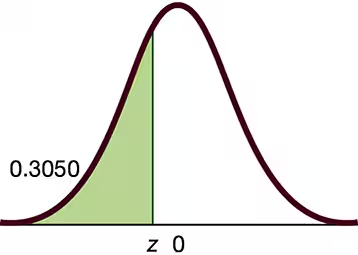
Standard Normal Distribution. In Exercises 13–16, find the indicated z score. The graph depicts the standard normal distribution of bone density scores with mean 0 and standard deviation 1.

Verified step by step guidance1
Step 1: Understand the problem. The graph represents a standard normal distribution with a mean of 0 and a standard deviation of 1. The shaded area to the left of the z-score corresponds to a cumulative probability of 0.3050.
Step 2: Recall the relationship between z-scores and cumulative probabilities. The z-score is the value on the horizontal axis of the standard normal distribution that corresponds to a given cumulative probability.
Step 3: Use a standard normal distribution table or a statistical software/tool to find the z-score that corresponds to a cumulative probability of 0.3050. This involves looking up the cumulative probability in the table and identifying the associated z-score.
Step 4: Note that the cumulative probability represents the area under the curve to the left of the z-score. Ensure that the table or tool you use is designed for the standard normal distribution.
Step 5: Verify your result by checking that the cumulative probability for the identified z-score matches 0.3050. This ensures accuracy in your calculation.
Verified video answer for a similar problem:This video solution was recommended by our tutors as helpful for the problem above
Video duration:
1mPlay a video:
Was this helpful?
Key Concepts
Here are the essential concepts you must grasp in order to answer the question correctly.
Standard Normal Distribution
The standard normal distribution is a special case of the normal distribution where the mean is 0 and the standard deviation is 1. It is represented by the bell-shaped curve, which is symmetric about the mean. This distribution is crucial for statistical analysis as it allows for the calculation of probabilities and z-scores, which indicate how many standard deviations an element is from the mean.
Recommended video:
Guided course
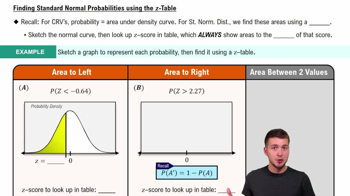
Finding Standard Normal Probabilities using z-Table
Z-Score
A z-score is a statistical measurement that describes a value's relationship to the mean of a group of values. It is calculated by subtracting the mean from the value and then dividing by the standard deviation. Z-scores are essential for understanding how far away a particular score is from the average, allowing for comparisons across different datasets.
Recommended video:
Guided course
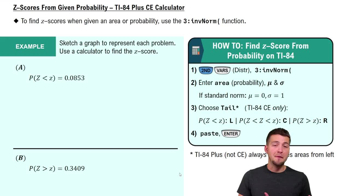
Z-Scores From Given Probability - TI-84 (CE) Calculator
Area Under the Curve
In the context of the normal distribution, the area under the curve represents the probability of a random variable falling within a particular range. The total area under the curve equals 1, and specific areas correspond to probabilities associated with z-scores. For example, the shaded area in the provided graph indicates the probability of obtaining a z-score less than 0, which is 0.3050.
Recommended video:
Guided course
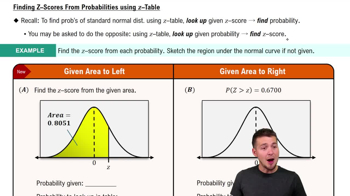
Z-Scores from Probabilities
Watch next
Master Probability From Given Z-Scores - TI-84 (CE) Calculator with a bite sized video explanation from Patrick
Start learningRelated Videos
Related Practice
Multiple Choice
10
views
