Ch. 6 - Confidence Intervals
Larson - Elementary Statistics: Picturing the World 8th Edition
Larson8th EditionElementary Statistics: Picturing the WorldISBN: 9780137493470Not the one you use?Change textbook
Chapter 6, Problem 6.2.36

In Exercises 35–40, use the standard normal distribution or the t-distribution to construct a 95% confidence interval for the population mean. Justify your decision. If neither distribution can be used, explain why. Interpret the results.
In a random sample of 18 months from January 2011 through December 2020, the mean interest rate for 30-year fixed rate home mortgages was 3.95% and the standard deviation was 0.49%. Assume the interest rates are normally distributed. (Source: Freddie Mac)

Verified step by step guidance
1
Step 1: Determine which distribution to use. Since the sample size is small (n = 18, which is less than 30) and the population standard deviation is not provided, use the t-distribution. Additionally, the problem states that the interest rates are normally distributed, which satisfies the normality assumption required for the t-distribution.
Step 2: Identify the given values. The sample mean (x̄) is 3.95%, the sample standard deviation (s) is 0.49%, the sample size (n) is 18, and the confidence level is 95%. The degrees of freedom (df) for the t-distribution is calculated as df = n - 1 = 18 - 1 = 17.
Step 3: Find the critical t-value (t*) for a 95% confidence level and 17 degrees of freedom. Use a t-distribution table or statistical software to find t* corresponding to a two-tailed test with α = 0.05 (since 95% confidence implies 5% significance level).
Step 4: Calculate the margin of error (ME) using the formula: ME = t* × (s / √n), where s is the sample standard deviation and n is the sample size. Substitute the values into the formula to compute the margin of error.
Step 5: Construct the confidence interval for the population mean using the formula: Confidence Interval = x̄ ± ME. Substitute the sample mean (x̄) and the margin of error (ME) into the formula to find the lower and upper bounds of the interval. Interpret the results by stating that you are 95% confident the true population mean interest rate lies within this interval.

Verified video answer for a similar problem:

This video solution was recommended by our tutors as helpful for the problem above.
Video duration:
4m
Was this helpful?

Key Concepts

Here are the essential concepts you must grasp in order to answer the question correctly.

Confidence Interval

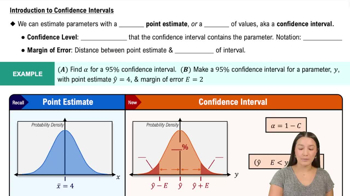
A confidence interval is a range of values, derived from a data set, that is likely to contain the population parameter with a specified level of confidence, typically 95%. It is calculated using the sample mean and standard deviation, providing an estimate of uncertainty around the sample statistic. For normally distributed data, the interval can be constructed using the z-score or t-score, depending on the sample size.
Recommended video:
06:33
Introduction to Confidence Intervals

Normal Distribution

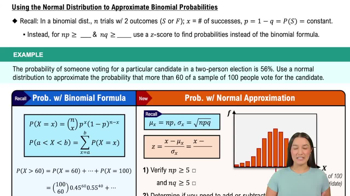
The normal distribution is a continuous probability distribution characterized by its bell-shaped curve, where most observations cluster around the mean. It is defined by two parameters: the mean (average) and the standard deviation (spread). In this context, the assumption of normality allows for the use of the standard normal distribution to construct confidence intervals when the sample size is large or the population standard deviation is known.
Recommended video:
06:23
Using the Normal Distribution to Approximate Binomial Probabilities

t-Distribution

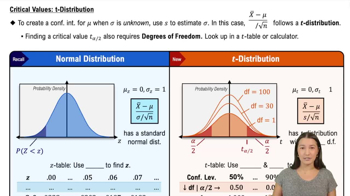
The t-distribution is a type of probability distribution that is used when the sample size is small (typically n < 30) and the population standard deviation is unknown. It is similar to the normal distribution but has heavier tails, which provides a more accurate estimate of the confidence interval in such cases. As the sample size increases, the t-distribution approaches the normal distribution, making it essential for small sample analyses.
Recommended video:
05:50
Critical Values: t-Distribution