Create a confidence interval with for the difference between the 2 population means to see if there's evidence that .
Table of contents
- 1. Intro to Stats and Collecting Data1h 14m
- 2. Describing Data with Tables and Graphs1h 55m
- 3. Describing Data Numerically2h 5m
- 4. Probability2h 16m
- 5. Binomial Distribution & Discrete Random Variables3h 6m
- 6. Normal Distribution and Continuous Random Variables2h 11m
- 7. Sampling Distributions & Confidence Intervals: Mean3h 23m
- Sampling Distribution of the Sample Mean and Central Limit Theorem19m
- Distribution of Sample Mean - Excel23m
- Introduction to Confidence Intervals15m
- Confidence Intervals for Population Mean1h 18m
- Determining the Minimum Sample Size Required12m
- Finding Probabilities and T Critical Values - Excel28m
- Confidence Intervals for Population Means - Excel25m
- 8. Sampling Distributions & Confidence Intervals: Proportion1h 25m
- 9. Hypothesis Testing for One Sample3h 29m
- 10. Hypothesis Testing for Two Samples4h 50m
- Two Proportions1h 13m
- Two Proportions Hypothesis Test - Excel28m
- Two Means - Unknown, Unequal Variance1h 3m
- Two Means - Unknown Variances Hypothesis Test - Excel12m
- Two Means - Unknown, Equal Variance15m
- Two Means - Unknown, Equal Variances Hypothesis Test - Excel9m
- Two Means - Known Variance12m
- Two Means - Sigma Known Hypothesis Test - Excel21m
- Two Means - Matched Pairs (Dependent Samples)42m
- Matched Pairs Hypothesis Test - Excel12m
- 11. Correlation1h 24m
- 12. Regression1h 50m
- 13. Chi-Square Tests & Goodness of Fit2h 21m
- 14. ANOVA1h 57m
10. Hypothesis Testing for Two Samples
Two Means - Unknown, Unequal Variance
Problem 11.3.9b
Textbook Question
"Walking in the Airport, Part I Do people walk faster in the airport when they are departing (getting on a plane) or when they are arriving (getting off a plane)? Researcher Seth B. Young measured the walking speed of travelers in San Francisco International Airport and Cleveland Hopkins International Airport. His findings are summarized in the table.
b. Explain why it is reasonable to use Welch’s t-test.
"
Verified step by step guidance1
Identify the key characteristics of the data: Welch's t-test is used when comparing the means of two independent groups, especially when the variances of the two groups are not assumed to be equal.
Check if the two groups (departing and arriving travelers) are independent samples, which is typically the case since the walking speeds of departing travelers are separate from those of arriving travelers.
Consider the sample sizes and variances: if the variances of walking speeds in the two groups appear to be different or the sample sizes are unequal, this supports the use of Welch's t-test over the standard Student's t-test.
Recall that Welch's t-test does not assume equal population variances, making it more robust when this assumption is violated, which is often the case in real-world data like walking speeds in different airport contexts.
Therefore, it is reasonable to use Welch's t-test here because it accounts for unequal variances and possibly unequal sample sizes between the departing and arriving traveler groups, providing a more reliable comparison of their mean walking speeds.
Verified video answer for a similar problem:This video solution was recommended by our tutors as helpful for the problem above
Video duration:
4mPlay a video:
Was this helpful?
Key Concepts
Here are the essential concepts you must grasp in order to answer the question correctly.
Welch’s t-test
Welch’s t-test is a statistical method used to compare the means of two groups when the variances are unequal and/or sample sizes differ. Unlike the standard t-test, it does not assume equal population variances, making it more robust for real-world data where this assumption often fails.
Recommended video:
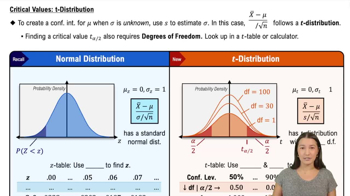
Critical Values: t-Distribution
Assumption of Unequal Variances
In many practical situations, the variability in two groups being compared is not the same. Recognizing unequal variances is important because it affects the choice of statistical test; Welch’s t-test adjusts the degrees of freedom to account for this inequality, providing more accurate results.
Recommended video:
Guided course
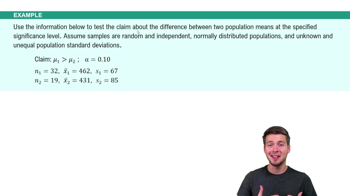
Difference in Means: Hypothesis Tests Example 1
Independent Samples
Welch’s t-test requires that the two groups being compared are independent, meaning the data points in one group do not influence those in the other. This is essential to ensure the validity of the test results when comparing walking speeds of departing versus arriving travelers.
Recommended video:
Guided course
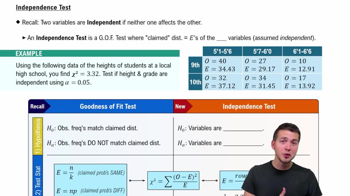
Independence Test
Watch next
Master Difference in Means: Hypothesis Tests with a bite sized video explanation from Patrick
Start learningRelated Videos
Related Practice
Multiple Choice
15
views