Explain why quadrupling the sample size causes the margin of error to be cut in half.
Table of contents
- 1. Intro to Stats and Collecting Data1h 14m
- 2. Describing Data with Tables and Graphs1h 55m
- 3. Describing Data Numerically2h 5m
- 4. Probability2h 16m
- 5. Binomial Distribution & Discrete Random Variables3h 6m
- 6. Normal Distribution and Continuous Random Variables2h 11m
- 7. Sampling Distributions & Confidence Intervals: Mean3h 23m
- Sampling Distribution of the Sample Mean and Central Limit Theorem19m
- Distribution of Sample Mean - Excel23m
- Introduction to Confidence Intervals15m
- Confidence Intervals for Population Mean1h 18m
- Determining the Minimum Sample Size Required12m
- Finding Probabilities and T Critical Values - Excel28m
- Confidence Intervals for Population Means - Excel25m
- 8. Sampling Distributions & Confidence Intervals: Proportion1h 25m
- 9. Hypothesis Testing for One Sample3h 29m
- 10. Hypothesis Testing for Two Samples4h 50m
- Two Proportions1h 13m
- Two Proportions Hypothesis Test - Excel28m
- Two Means - Unknown, Unequal Variance1h 3m
- Two Means - Unknown Variances Hypothesis Test - Excel12m
- Two Means - Unknown, Equal Variance15m
- Two Means - Unknown, Equal Variances Hypothesis Test - Excel9m
- Two Means - Known Variance12m
- Two Means - Sigma Known Hypothesis Test - Excel21m
- Two Means - Matched Pairs (Dependent Samples)42m
- Matched Pairs Hypothesis Test - Excel12m
- 11. Correlation1h 24m
- 12. Regression1h 50m
- 13. Chi-Square Tests & Goodness of Fit2h 21m
- 14. ANOVA1h 57m
8. Sampling Distributions & Confidence Intervals: Proportion
Confidence Intervals for Population Proportion
Problem 9.1.49
Textbook Question
What type of variable is required to construct a confidence interval for a population proportion?
Verified step by step guidance1
Understand that a population proportion refers to the fraction or percentage of the population that has a particular characteristic or attribute.
Recognize that to construct a confidence interval for a population proportion, the variable of interest must be categorical, specifically a binary (dichotomous) variable.
A binary variable means it has only two possible outcomes, such as 'success' or 'failure', 'yes' or 'no', 'present' or 'absent'.
This binary nature allows us to count the number of successes in a sample and estimate the proportion of successes in the population.
Therefore, the variable required is a categorical variable with two categories, often called a Bernoulli or binomial variable.
Verified video answer for a similar problem:This video solution was recommended by our tutors as helpful for the problem above
Video duration:
1mPlay a video:
Was this helpful?
Key Concepts
Here are the essential concepts you must grasp in order to answer the question correctly.
Population Proportion
A population proportion represents the fraction or percentage of individuals in a population that have a particular characteristic. It is a parameter often denoted by p and is estimated using sample data. Understanding this helps in constructing confidence intervals to estimate the true proportion.
Recommended video:
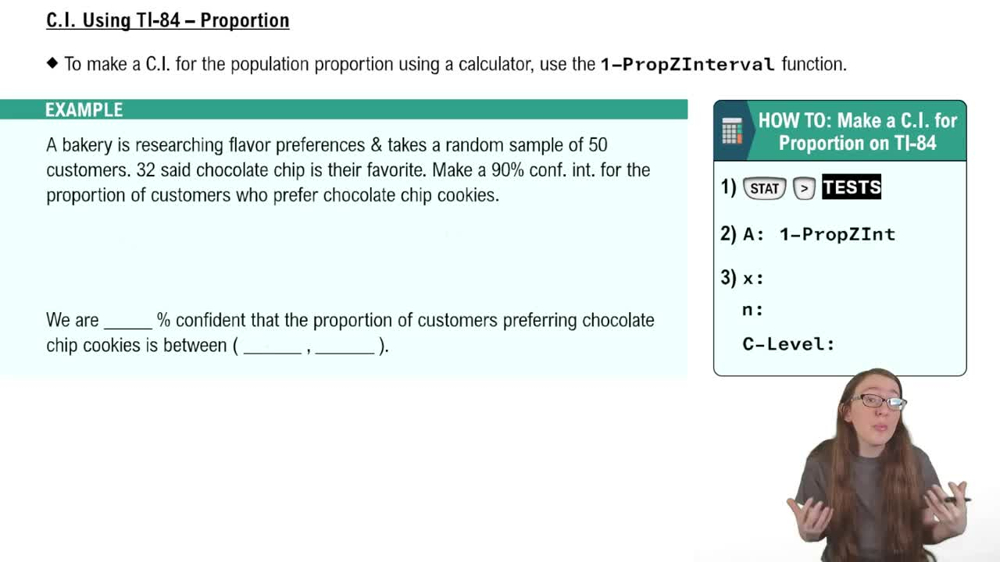
Finding a Confidence Interval for a Population Proportion Using a TI84
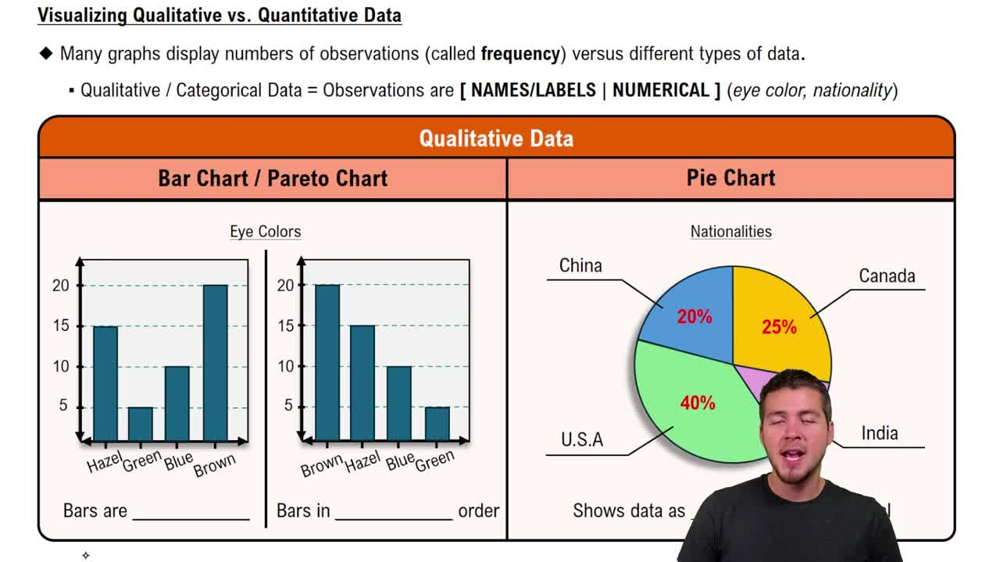
Categorical (Qualitative) Variable
A categorical variable classifies data into distinct groups or categories, such as yes/no or success/failure. To construct a confidence interval for a population proportion, the variable must be categorical because proportions measure the relative frequency of categories.
Recommended video:
Guided course
Visualizing Qualitative vs. Quantitative Data
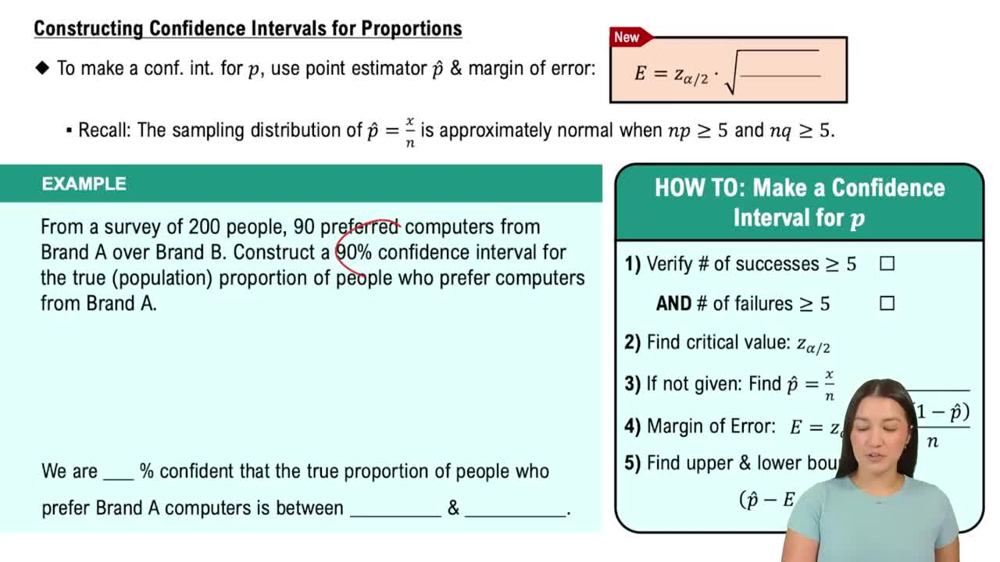
Confidence Interval for a Proportion
A confidence interval for a population proportion estimates the range within which the true proportion lies with a certain level of confidence (e.g., 95%). It requires sample data from a categorical variable and uses formulas based on the sample proportion and sample size.
Recommended video:
Constructing Confidence Intervals for Proportions
Watch next
Master Constructing Confidence Intervals for Proportions with a bite sized video explanation from Patrick
Start learningRelated Videos
Related Practice
Textbook Question
3
views