Ch. 4 - Probability
Triola - Elementary Statistics 14th Edition
Triola14th EditionElementary StatisticsISBN: 9780137366446Not the one you use?Change textbook
Chapter 4, Problem 4.r.13b

National Statistics Day


b. If a person is randomly selected, find the probability that his or her birthday is in October. Ignore leap years.

Verified step by step guidance
1
Step 1: Understand the problem. We are tasked with finding the probability that a randomly selected person's birthday falls in the month of October. Assume there are no leap years, so the year has 365 days.
Step 2: Determine the total number of days in a year. Since we are ignoring leap years, the total number of days in a year is 365.
Step 3: Determine the number of days in October. October has 31 days.
Step 4: Use the formula for probability. The probability of an event is given by the formula: \( P(A) = \frac{\text{Number of favorable outcomes}}{\text{Total number of outcomes}} \). Here, the favorable outcomes are the 31 days in October, and the total outcomes are the 365 days in a year.
Step 5: Substitute the values into the formula. Replace the numerator with 31 (days in October) and the denominator with 365 (total days in a year). Simplify the fraction if needed to express the probability in its simplest form.

Verified video answer for a similar problem:

This video solution was recommended by our tutors as helpful for the problem above.
Video duration:
1m
Was this helpful?

Key Concepts

Here are the essential concepts you must grasp in order to answer the question correctly.

Probability

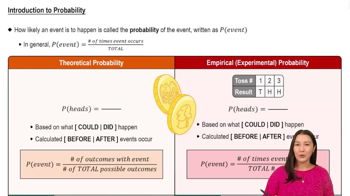
Probability is a measure of the likelihood that a particular event will occur, expressed as a number between 0 and 1. In this context, it quantifies the chance of randomly selecting a person whose birthday falls in October. The formula for probability is the number of favorable outcomes divided by the total number of possible outcomes.
Recommended video:
5:37
Introduction to Probability

Sample Space

The sample space is the set of all possible outcomes in a probability experiment. For the birthday problem, the sample space consists of the 12 months of the year. Understanding the sample space is crucial for calculating probabilities, as it provides the total number of outcomes against which favorable outcomes are compared.
Recommended video:
05:11
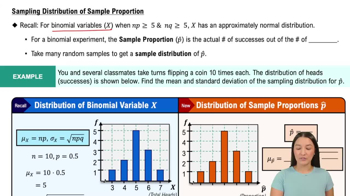
Sampling Distribution of Sample Proportion

Favorable Outcomes

Favorable outcomes refer to the specific outcomes in the sample space that satisfy the condition of interest. In this case, the favorable outcomes are the days in October, which total 31. Identifying favorable outcomes is essential for calculating the probability of an event, as they directly influence the numerator in the probability formula.
Recommended video:
Guided course
06:00
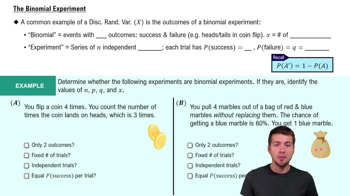
The Binomial Experiment
Related Practice
Textbook Question

ESP A psychologist tells you that in an ESP (extrasensory perception) experiment, there is a 20% chance of answering a question correctly. What is the probability of answering a question correctly?

173
views
Textbook Question

Standard Tests Standard tests, such as the SAT or ACT or MCAT, tend to make extensive use of multiple-choice questions because they are easy to grade using software. If one such multiple choice question has possible correct answers of a, b, c, d, e, what is the probability of a wrong answer if the answer is a random guess?

200
views
Textbook Question

Vision Correction About 75% of the U.S. population uses some type of vision correction (such as glasses or contact lenses).


d. If you randomly select four people, is a result of all four using vision correction significantly high? Why or why not?

143
views
Textbook Question

In Exercises 6–10, use the following results from tests of an experiment to test the effectiveness of an experimental vaccine for children (based on data from USA Today). Express all probabilities in decimal form.


If 1 of the 1602 subjects is randomly selected, find the probability of getting 1 that developed flu.


126
views
Textbook Question

In Exercises 1–10, use the data in the accompanying table and express all results in decimal form. (The data are from “The Left-Handed: Their Sinister History,” by Elaine Fowler Costas, Education Resources Information Center, Paper 399519.)


Complement If L represents the event of randomly selecting one of the study subjects and getting someone who writes with their left hand, what does L represent? Find the value of P(L)

171
views