
List the two conditions that must be met in order to use the paired-sample sign test.
Table of contents
- 1. Intro to Stats and Collecting Data1h 14m
- 2. Describing Data with Tables and Graphs1h 55m
- 3. Describing Data Numerically2h 5m
- 4. Probability2h 16m
- 5. Binomial Distribution & Discrete Random Variables3h 6m
- 6. Normal Distribution and Continuous Random Variables2h 11m
- 7. Sampling Distributions & Confidence Intervals: Mean3h 23m
- Sampling Distribution of the Sample Mean and Central Limit Theorem19m
- Distribution of Sample Mean - Excel23m
- Introduction to Confidence Intervals15m
- Confidence Intervals for Population Mean1h 18m
- Determining the Minimum Sample Size Required12m
- Finding Probabilities and T Critical Values - Excel28m
- Confidence Intervals for Population Means - Excel25m
- 8. Sampling Distributions & Confidence Intervals: Proportion1h 25m
- 9. Hypothesis Testing for One Sample3h 29m
- 10. Hypothesis Testing for Two Samples4h 50m
- Two Proportions1h 13m
- Two Proportions Hypothesis Test - Excel28m
- Two Means - Unknown, Unequal Variance1h 3m
- Two Means - Unknown Variances Hypothesis Test - Excel12m
- Two Means - Unknown, Equal Variance15m
- Two Means - Unknown, Equal Variances Hypothesis Test - Excel9m
- Two Means - Known Variance12m
- Two Means - Sigma Known Hypothesis Test - Excel21m
- Two Means - Matched Pairs (Dependent Samples)42m
- Matched Pairs Hypothesis Test - Excel12m
- 11. Correlation1h 24m
- 12. Regression1h 50m
- 13. Chi-Square Tests & Goodness of Fit2h 21m
- 14. ANOVA1h 57m
10. Hypothesis Testing for Two Samples
Two Means - Matched Pairs (Dependent Samples)
Problem 8.2.23
Textbook Question
Constructing Confidence Intervals for μ1-μ2, When the sampling distribution for x̅1-x̅2 is approximated by a t-distribution and the population variances are not equal, you can construct a confidence interval for μ1-μ2 , as shown below.
construct the indicated confidence interval for μ1-μ2 . Assume the populations are approximately normal with unequal variances.
10K Race
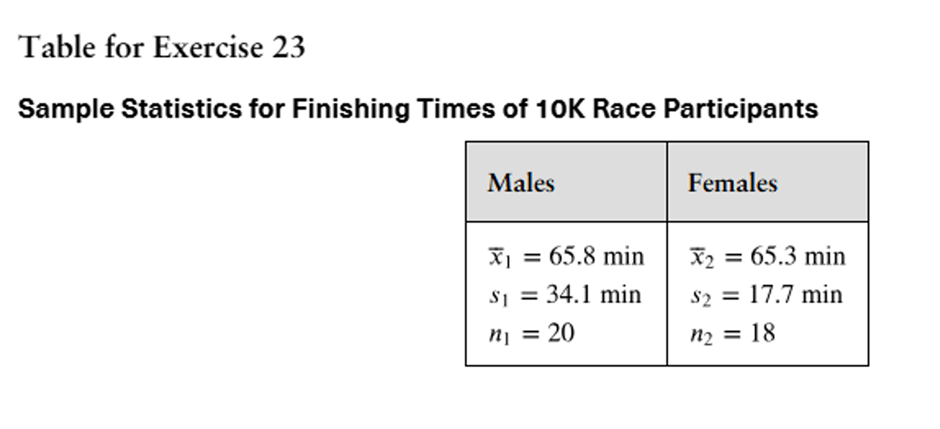
To compare the mean finishing times of male and female participants in a 10K race, you randomly select several finishing times from both sexes. The results are shown at the left. Construct an 80% confidence interval for the difference in mean finishing times of male and female participants in the race. (Adapted from Great Race)

Verified step by step guidance1
Step 1: Identify the given statistics for both groups. For males: sample mean (x̄₁) = 65.8, sample standard deviation (s₁) = 34.1, and sample size (n₁) = 20. For females: sample mean (x̄₂) = 65.3, sample standard deviation (s₂) = 17.7, and sample size (n₂) = 18.
Step 2: Write the formula for the confidence interval for μ₁ - μ₂ when population variances are unequal. The formula is: CI = (x̄₁ - x̄₂) ± t* × √((s₁²/n₁) + (s₂²/n₂)), where t* is the critical t-value for the given confidence level and degrees of freedom.
Step 3: Calculate the degrees of freedom using the formula for unequal variances: df = ((s₁²/n₁ + s₂²/n₂)²) / (((s₁²/n₁)² / (n₁ - 1)) + ((s₂²/n₂)² / (n₂ - 1))). This will help determine the appropriate t* value for the 80% confidence level.
Step 4: Look up the critical t-value (t*) for the calculated degrees of freedom and the 80% confidence level. Use a t-distribution table or statistical software to find this value.
Step 5: Substitute the values for x̄₁, x̄₂, s₁, s₂, n₁, n₂, and t* into the confidence interval formula to compute the interval bounds. Ensure all calculations are performed step by step to avoid errors.
Verified video answer for a similar problem:This video solution was recommended by our tutors as helpful for the problem above
Video duration:
5mPlay a video:
Was this helpful?
Key Concepts
Here are the essential concepts you must grasp in order to answer the question correctly.
Confidence Interval
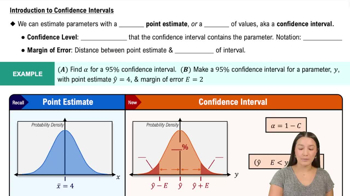
A confidence interval is a range of values, derived from sample statistics, that is likely to contain the true population parameter. It is expressed with a certain level of confidence, such as 80%, indicating the probability that the interval includes the parameter. In this case, it will estimate the difference in mean finishing times between male and female participants in the 10K race.
Recommended video:
Introduction to Confidence Intervals
t-Distribution
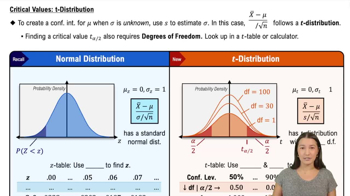
The t-distribution is a type of probability distribution that is symmetric and bell-shaped, similar to the normal distribution but with heavier tails. It is used when estimating population parameters when the sample size is small or when the population variance is unknown. In this scenario, the t-distribution is appropriate due to the unequal variances of the two groups being compared.
Recommended video:
Critical Values: t-Distribution
Unequal Variances
Unequal variances, also known as heteroscedasticity, occur when two or more groups have different levels of variability in their data. This is important in statistical analysis because it affects the validity of certain tests and confidence intervals. In this case, the sample variances of male and female finishing times differ significantly, necessitating the use of specific formulas for constructing the confidence interval.
Recommended video:
Guided course
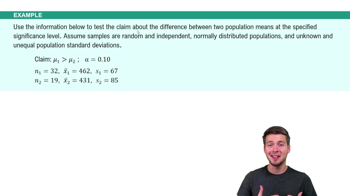
Difference in Means: Hypothesis Tests Example 1
Watch next
Master Introduction to Matched Pairs with a bite sized video explanation from Patrick
Start learningRelated Videos
Related Practice
Textbook Question
23
views
