HIC Measurements Listed below are head injury criterion (HIC) measurements from crash tests of small, midsize, large, and SUV vehicles. In using the Kruskal-Wallis test, we must rank all of the data combined, and then we must find the sum of the ranks for each sample. Find the sum of the ranks for each of the four samples.
Table of contents
- 1. Intro to Stats and Collecting Data1h 14m
- 2. Describing Data with Tables and Graphs1h 55m
- 3. Describing Data Numerically2h 5m
- 4. Probability2h 16m
- 5. Binomial Distribution & Discrete Random Variables3h 6m
- 6. Normal Distribution and Continuous Random Variables2h 11m
- 7. Sampling Distributions & Confidence Intervals: Mean3h 23m
- Sampling Distribution of the Sample Mean and Central Limit Theorem19m
- Distribution of Sample Mean - Excel23m
- Introduction to Confidence Intervals15m
- Confidence Intervals for Population Mean1h 18m
- Determining the Minimum Sample Size Required12m
- Finding Probabilities and T Critical Values - Excel28m
- Confidence Intervals for Population Means - Excel25m
- 8. Sampling Distributions & Confidence Intervals: Proportion1h 25m
- 9. Hypothesis Testing for One Sample3h 29m
- 10. Hypothesis Testing for Two Samples4h 50m
- Two Proportions1h 13m
- Two Proportions Hypothesis Test - Excel28m
- Two Means - Unknown, Unequal Variance1h 3m
- Two Means - Unknown Variances Hypothesis Test - Excel12m
- Two Means - Unknown, Equal Variance15m
- Two Means - Unknown, Equal Variances Hypothesis Test - Excel9m
- Two Means - Known Variance12m
- Two Means - Sigma Known Hypothesis Test - Excel21m
- Two Means - Matched Pairs (Dependent Samples)42m
- Matched Pairs Hypothesis Test - Excel12m
- 11. Correlation1h 24m
- 12. Regression1h 50m
- 13. Chi-Square Tests & Goodness of Fit2h 21m
- 14. ANOVA1h 57m
9. Hypothesis Testing for One Sample
Steps in Hypothesis Testing
Problem 12.CQ.1
Textbook Question
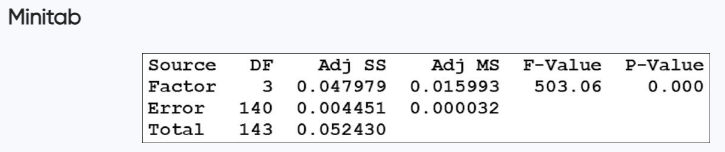
Cola Weights Data Set 37 “Cola Weights and Volumes” in Appendix B lists the weights (lb) of the contents of cans of cola from four different samples: (1) regular Coke, (2) Diet Coke, (3) regular Pepsi, and (4) Diet Pepsi. The results from analysis of variance are shown in the Minitab display below. What is the null hypothesis for this analysis of variance test? Based on the displayed results, what should you conclude about H_knot. What do you conclude about equality of the mean weights from the four samples?

Verified step by step guidance1
Step 1: Understand the null hypothesis (H₀) for an analysis of variance (ANOVA) test. The null hypothesis states that the mean weights of the contents of the cans from the four samples (regular Coke, Diet Coke, regular Pepsi, Diet Pepsi) are equal. Mathematically, H₀: μ₁ = μ₂ = μ₃ = μ₄, where μ represents the mean weight for each sample.
Step 2: Examine the Minitab output provided. Focus on the P-Value column, which is used to test the null hypothesis. The P-Value for the 'Factor' source is 0.000, which is significantly less than the common significance level of 0.05.
Step 3: Interpret the P-Value. Since the P-Value is less than 0.05, we reject the null hypothesis (H₀). This indicates that there is sufficient evidence to conclude that at least one of the mean weights is different from the others.
Step 4: Analyze the F-Value. The F-Value is 503.06, which is very large. A high F-Value further supports the conclusion that the variation between the group means is significant compared to the variation within the groups.
Step 5: Conclude about the equality of mean weights. Based on the results, we conclude that the mean weights of the contents of the cans from the four samples are not equal. There is a statistically significant difference in the mean weights among the four groups.
Verified video answer for a similar problem:This video solution was recommended by our tutors as helpful for the problem above
Video duration:
3mPlay a video:
Was this helpful?
Key Concepts
Here are the essential concepts you must grasp in order to answer the question correctly.
Null Hypothesis (H0)
The null hypothesis (H0) is a statement that there is no effect or no difference, and it serves as a starting point for statistical testing. In the context of the ANOVA test for the cola weights, H0 posits that the mean weights of the four cola samples (regular Coke, Diet Coke, regular Pepsi, and Diet Pepsi) are equal. Rejecting H0 suggests that at least one sample mean is different from the others.
Recommended video:
Guided course
Step 1: Write Hypotheses
Analysis of Variance (ANOVA)
ANOVA is a statistical method used to compare the means of three or more groups to determine if at least one group mean is significantly different from the others. It assesses the variance within each group and between groups, providing an F-value that indicates the ratio of these variances. A significant F-value, as shown in the Minitab output, suggests that the group means are not all equal.
Recommended video:
Guided course
Variance & Standard Deviation of Discrete Random Variables
P-Value
The P-value is a statistical measure that helps determine the significance of the results obtained from a hypothesis test. It represents the probability of observing the data, or something more extreme, assuming the null hypothesis is true. In the provided Minitab output, a P-value of 0.000 indicates strong evidence against the null hypothesis, leading to the conclusion that there are significant differences in the mean weights of the cola samples.
Recommended video:
Guided course
Step 3: Get P-Value
Watch next
Master Step 1: Write Hypotheses with a bite sized video explanation from Patrick
Start learningRelated Videos
Related Practice
Textbook Question
64
views
