A study showed an association between intentional weight loss and a decreased risk of high blood pressure. Is it appropriate to infer from this study that weight loss causes a decreased risk of high blood pressure? Explain. (Source: European Association for the Study of Obesity)
Table of contents
- 1. Intro to Stats and Collecting Data1h 14m
- 2. Describing Data with Tables and Graphs1h 55m
- 3. Describing Data Numerically2h 5m
- 4. Probability2h 16m
- 5. Binomial Distribution & Discrete Random Variables3h 6m
- 6. Normal Distribution and Continuous Random Variables2h 11m
- 7. Sampling Distributions & Confidence Intervals: Mean3h 23m
- Sampling Distribution of the Sample Mean and Central Limit Theorem19m
- Distribution of Sample Mean - Excel23m
- Introduction to Confidence Intervals15m
- Confidence Intervals for Population Mean1h 18m
- Determining the Minimum Sample Size Required12m
- Finding Probabilities and T Critical Values - Excel28m
- Confidence Intervals for Population Means - Excel25m
- 8. Sampling Distributions & Confidence Intervals: Proportion1h 25m
- 9. Hypothesis Testing for One Sample3h 29m
- 10. Hypothesis Testing for Two Samples4h 50m
- Two Proportions1h 13m
- Two Proportions Hypothesis Test - Excel28m
- Two Means - Unknown, Unequal Variance1h 3m
- Two Means - Unknown Variances Hypothesis Test - Excel12m
- Two Means - Unknown, Equal Variance15m
- Two Means - Unknown, Equal Variances Hypothesis Test - Excel9m
- Two Means - Known Variance12m
- Two Means - Sigma Known Hypothesis Test - Excel21m
- Two Means - Matched Pairs (Dependent Samples)42m
- Matched Pairs Hypothesis Test - Excel12m
- 11. Correlation1h 24m
- 12. Regression1h 50m
- 13. Chi-Square Tests & Goodness of Fit2h 21m
- 14. ANOVA1h 57m
1. Intro to Stats and Collecting Data
Intro to Stats
Problem 4.1.30a
Textbook Question
[DATA] American Black Bears The American black bear (Ursus americanus) is one of eight bear species in the world. It is the smallest North American bear and the most common bear species on the planet. In 1969, Dr. Michael R. Pelton of the University of Tennessee initiated a long-term study of the population in the Great Smoky Mountains National Park. One aspect of the study was to develop a model that could be used to predict a bear’s weight (since it is not practical to weigh bears in the field). One variable thought to be related to weight is the length of the bear. The following data represent the lengths and weights of 12 American black bears.
a. Which variable is the explanatory variable based on the goals of the research?
b. Draw a scatter diagram of the data.
Verified step by step guidance1
Step 1: Identify the variables involved in the study. Here, the two variables are the length of the bear and the weight of the bear.
Step 2: Determine the explanatory (independent) variable and the response (dependent) variable based on the research goal. Since the goal is to predict the bear's weight from its length, the length is the explanatory variable, and the weight is the response variable.
Step 3: To draw a scatter diagram, label the horizontal axis (x-axis) with the explanatory variable, which is the bear's length.
Step 4: Label the vertical axis (y-axis) with the response variable, which is the bear's weight.
Step 5: Plot each pair of data points (length, weight) on the graph by placing a point where the length value on the x-axis corresponds to the weight value on the y-axis.
Verified video answer for a similar problem:This video solution was recommended by our tutors as helpful for the problem above
Video duration:
1mPlay a video:
Was this helpful?
Key Concepts
Here are the essential concepts you must grasp in order to answer the question correctly.
Explanatory and Response Variables
In statistical modeling, the explanatory variable (independent variable) is the one used to predict or explain changes in another variable, called the response variable (dependent variable). Here, since the goal is to predict bear weight, length is the explanatory variable, and weight is the response variable.
Recommended video:
Guided course
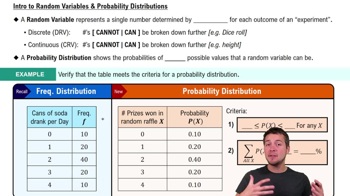
Intro to Random Variables & Probability Distributions
Scatter Diagram
A scatter diagram is a graphical representation that plots paired data points on a coordinate plane, showing the relationship between two quantitative variables. It helps visualize patterns, trends, or correlations, such as how bear length might relate to weight.
Recommended video:
Probability of Mutually Exclusive Events
Correlation and Relationship Between Variables
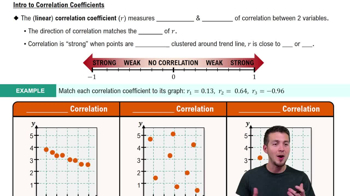
Correlation measures the strength and direction of a linear relationship between two variables. Understanding this helps determine if length is a good predictor of weight, which is essential before building a predictive model.
Recommended video:
Guided course
Correlation Coefficient
Watch next
Master Introduction to Statistics Channel with a bite sized video explanation from Patrick
Start learningRelated Videos
Related Practice
Textbook Question
14
views