Forty-nine percent of U.S. adults think that human activity such as burning fossil fuels contributes a great deal to climate change. You randomly select 25 U.S. adults. Find the probability that the number who think that human activity contributes a great deal to climate change is (a) exactly 12,
Table of contents
- 1. Intro to Stats and Collecting Data1h 14m
- 2. Describing Data with Tables and Graphs1h 55m
- 3. Describing Data Numerically2h 5m
- 4. Probability2h 16m
- 5. Binomial Distribution & Discrete Random Variables3h 6m
- 6. Normal Distribution and Continuous Random Variables2h 11m
- 7. Sampling Distributions & Confidence Intervals: Mean3h 23m
- Sampling Distribution of the Sample Mean and Central Limit Theorem19m
- Distribution of Sample Mean - Excel23m
- Introduction to Confidence Intervals15m
- Confidence Intervals for Population Mean1h 18m
- Determining the Minimum Sample Size Required12m
- Finding Probabilities and T Critical Values - Excel28m
- Confidence Intervals for Population Means - Excel25m
- 8. Sampling Distributions & Confidence Intervals: Proportion1h 25m
- 9. Hypothesis Testing for One Sample3h 29m
- 10. Hypothesis Testing for Two Samples4h 50m
- Two Proportions1h 13m
- Two Proportions Hypothesis Test - Excel28m
- Two Means - Unknown, Unequal Variance1h 3m
- Two Means - Unknown Variances Hypothesis Test - Excel12m
- Two Means - Unknown, Equal Variance15m
- Two Means - Unknown, Equal Variances Hypothesis Test - Excel9m
- Two Means - Known Variance12m
- Two Means - Sigma Known Hypothesis Test - Excel21m
- Two Means - Matched Pairs (Dependent Samples)42m
- Matched Pairs Hypothesis Test - Excel12m
- 11. Correlation1h 24m
- 12. Regression1h 50m
- 13. Chi-Square Tests & Goodness of Fit2h 21m
- 14. ANOVA1h 57m
5. Binomial Distribution & Discrete Random Variables
Binomial Distribution
Problem 4.1.21a
Textbook Question
Finding Probabilities Use the probability distribution you made in Exercise 19 to find the probability of randomly selecting a household that has (a) one or two HD televisions
Verified step by step guidance1
Step 1: Recall the probability distribution created in Exercise 19. A probability distribution lists all possible outcomes (e.g., the number of HD televisions in a household) and their corresponding probabilities. Ensure that the probabilities sum to 1.
Step 2: Identify the outcomes of interest. In this case, we are looking for households with either one or two HD televisions. These correspond to the outcomes '1' and '2' in the probability distribution.
Step 3: Locate the probabilities associated with the outcomes '1' and '2' in the probability distribution. These probabilities are denoted as P(X=1) and P(X=2), where X represents the number of HD televisions.
Step 4: Add the probabilities of the outcomes '1' and '2' together to find the total probability. Use the formula: P(X=1 or X=2) = P(X=1) + P(X=2).
Step 5: Verify that the result is valid by ensuring it falls within the range of 0 to 1, as probabilities cannot exceed these bounds.
Verified video answer for a similar problem:This video solution was recommended by our tutors as helpful for the problem above
Video duration:
1mPlay a video:
Was this helpful?
Key Concepts
Here are the essential concepts you must grasp in order to answer the question correctly.
Probability Distribution
A probability distribution is a mathematical function that provides the probabilities of occurrence of different possible outcomes in an experiment. It can be discrete, where outcomes are distinct and countable, or continuous, where outcomes can take any value within a range. Understanding how to construct and interpret a probability distribution is essential for calculating probabilities related to specific events.
Recommended video:
Guided course
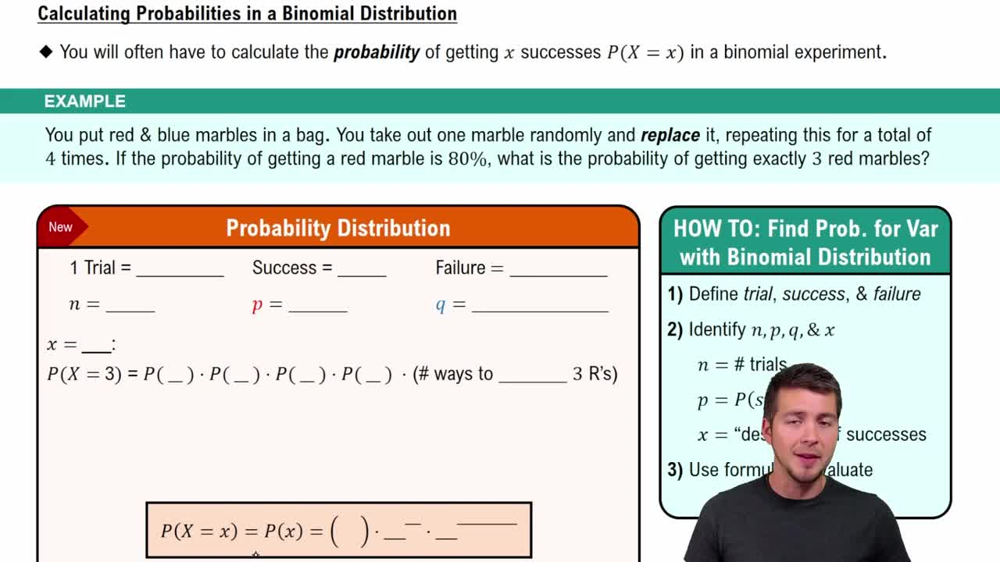
Calculating Probabilities in a Binomial Distribution
Random Selection
Random selection refers to the process of choosing individuals or items from a population in such a way that each member has an equal chance of being selected. This concept is crucial in statistics as it helps ensure that the sample is representative of the population, allowing for valid inferences and conclusions. In the context of the question, it implies that each household has an equal opportunity to be chosen when assessing the number of HD televisions.
Recommended video:
Guided course
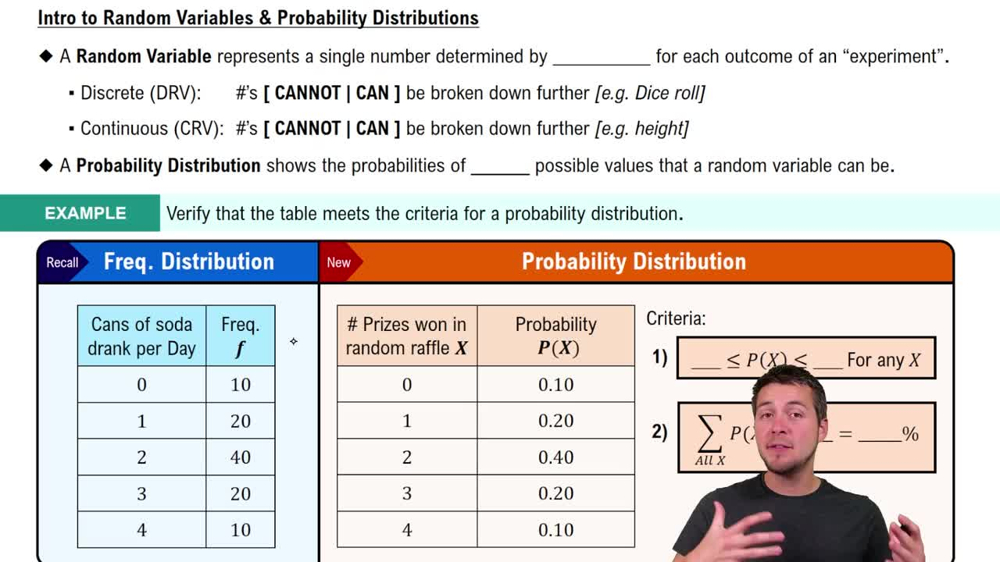
Intro to Random Variables & Probability Distributions
Event Probability
Event probability is the measure of the likelihood that a specific event will occur, expressed as a number between 0 and 1. In this case, it involves calculating the probability of selecting a household with one or two HD televisions based on the provided distribution. Understanding how to compute event probabilities is fundamental for making predictions and informed decisions based on statistical data.
Recommended video:
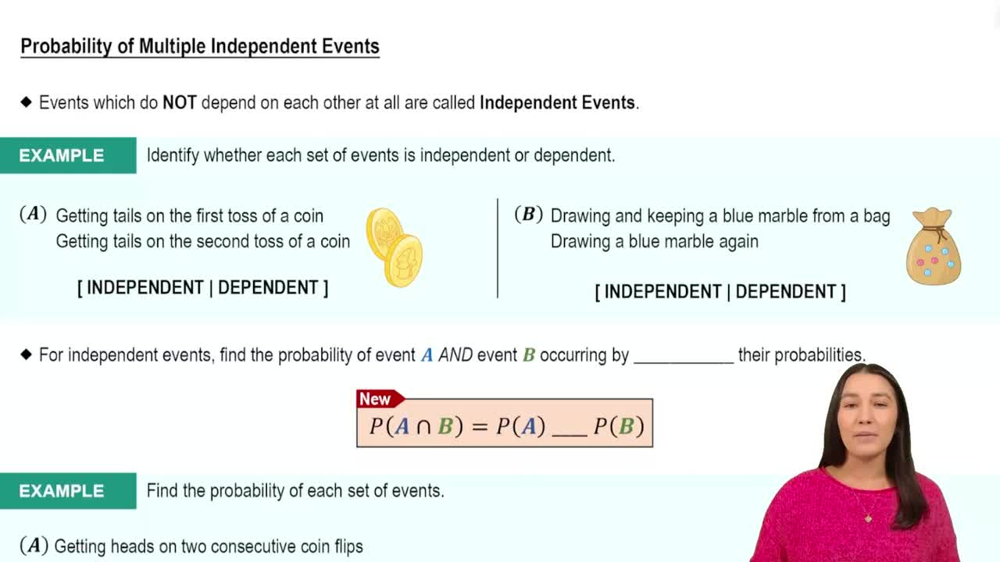
Probability of Multiple Independent Events
Watch next
Master The Binomial Experiment with a bite sized video explanation from Patrick
Start learningRelated Videos
Related Practice
Textbook Question
48
views