

Ch. 7 - Estimating Parameters and Determining Sample Sizes
Triola - Elementary Statistics 14th Edition
Triola14th EditionElementary StatisticsISBN: 9780137366446Not the one you use?Change textbook
Chapter 7, Problem 7.2.14

Minting Quarters Listed below are weights (grams) of quarters minted after 1964 (based on Data Set 40 “Coin Weights” in Appendix B). Construct a 95% confidence interval estimate of the mean weight of all quarters minted after 1964. Specifications require that the quarters have a weight of 5.670 g. What does the confidence interval suggest about that specification?


Verified step by step guidance
1
Step 1: Calculate the sample mean (\( \bar{x} \)) of the given weights. Add all the weights together and divide by the total number of weights. Use the formula \( \bar{x} = \frac{\sum x_i}{n} \), where \( x_i \) are the individual weights and \( n \) is the sample size.
Step 2: Calculate the sample standard deviation (\( s \)) using the formula \( s = \sqrt{\frac{\sum (x_i - \bar{x})^2}{n-1}} \). Subtract the sample mean from each weight, square the result, sum these squared differences, divide by \( n-1 \), and then take the square root.
Step 3: Determine the critical value (\( t^* \)) for a 95% confidence level. Use a t-distribution table with \( n-1 \) degrees of freedom (where \( n \) is the sample size) to find \( t^* \).
Step 4: Calculate the margin of error (ME) using the formula \( ME = t^* \cdot \frac{s}{\sqrt{n}} \). Multiply the critical value by the standard deviation divided by the square root of the sample size.
Step 5: Construct the confidence interval using the formula \( \bar{x} \pm ME \). Interpret the confidence interval in the context of the problem to determine whether the specification weight of 5.670 g falls within the interval.

Verified video answer for a similar problem:

This video solution was recommended by our tutors as helpful for the problem above.
Video duration:
7m
Was this helpful?

Key Concepts

Here are the essential concepts you must grasp in order to answer the question correctly.

Confidence Interval

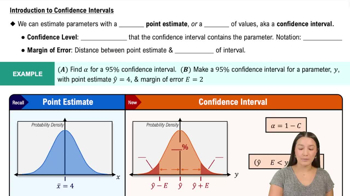
A confidence interval is a range of values, derived from sample statistics, that is likely to contain the true population parameter. For example, a 95% confidence interval suggests that if we were to take many samples and construct intervals in the same way, approximately 95% of those intervals would contain the true mean. This concept is crucial for estimating population parameters based on sample data.
Recommended video:
06:33
Introduction to Confidence Intervals

Mean Weight

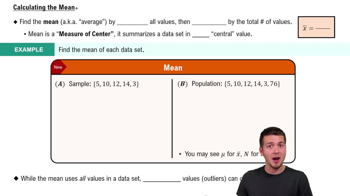
The mean weight is the average weight of a set of data points, calculated by summing all the weights and dividing by the number of observations. In this context, it refers to the average weight of quarters minted after 1964. Understanding the mean is essential for interpreting the confidence interval, as it provides a central value around which the interval is constructed.
Recommended video:
Guided course
04:52
Calculating the Mean

Specification Requirement

Specification requirements are predetermined standards that a product must meet, in this case, the weight of quarters set at 5.670 grams. Analyzing the confidence interval in relation to this specification helps determine whether the average weight of the sampled quarters meets the regulatory standard, indicating the quality control of the minting process.
Recommended video:
Guided course
08:09
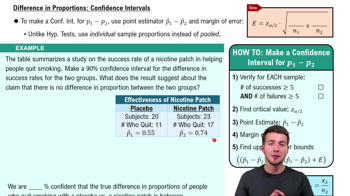
Difference in Proportions: Confidence Intervals
Related Practice
Textbook Question

In Exercises 5–8, (a) identify the critical value ta/2 used for finding the margin of error, (b) find the margin of error, (c) find the confidence interval estimate of u, and (d) write a brief statement that interprets the confidence interval.


Pepsi Weights Here are summary statistics for the weights of Pepsi in randomly selected cans: n=36, x=0.82410 lb, s=0.00570 lb (based on Data Set 37 “Cola Weights and Volumes” in Appendix B). Use a confidence level of 99%.

217
views
Textbook Question

Constructing and Interpreting Confidence Intervals. In Exercises 13–16, use the given sample data and confidence level. In each case, (a) find the best point estimate of the population proportion p; (b) identify the value of the margin of error E; (c) construct the confidence interval; (d) write a statement that correctly interprets the confidence interval.


Medical Malpractice In a study of 1228 randomly selected medical malpractice lawsuits, it was found that 856 of them were dropped or dismissed (based on data from the Physicians Insurers Association of America). Construct a 95% confidence interval for the proportion of medical malpractice lawsuits that are dropped or dismissed.

181
views
Textbook Question

FINDING SAMPLE SIZE Instead of using Table 7-2 for determining the sample size required to estimate a population standard deviation σ, the following formula can also be used


n=12(zα/2d)2n=\(\frac{1}{2}\]\left\)(\(\frac{z_{\alpha/2}\)}{d}\(\right\))^2


where zα/2z_{_{}\(\alpha\)/2} corresponds to the confidence level and d is the decimal form of the percentage error. For example, to be 95% confident that s is within 15% of the value of σ, use zα/2=1.96 and d=0.15 to get a sample size of n=86. Find the sample size required to estimate the standard deviation of IQ scores of data scientists, assuming that we want 98% confidence that s is within 5% of σ.

140
views
Textbook Question

Constructing and Interpreting Confidence Intervals. In Exercises 13–16, use the given sample data and confidence level. In each case, (a) find the best point estimate of the population proportion p; (b) identify the value of the margin of error E; (c) construct the confidence interval; (d) write a statement that correctly interprets the confidence interval.


Eliquis The drug Eliquis (apixaban) is used to help prevent blood clots in certain patients. In clinical trials, among 5924 patients treated with Eliquis, 153 developed the adverse reaction of nausea (based on data from Bristol-Myers Squibb Co.). Construct a 99% confidence interval for the proportion of adverse reactions.

198
views
Textbook Question

Job Interviews In a Harris poll of 514 human resource professionals, 463 said that the appearance of a job applicant is most important for a good first impression. Use 1000 bootstrap samples to construct a 99% confidence interval estimate of the proportion of all human resource professionals believing that the appearance of a job applicant is most important for a good first impression. How does the result compare to the confidence interval found in Exercise 24 part (b) in Section 7-1?

68
views
Textbook Question

Atkins Weight Loss Program In a test of weight loss programs, 40 adults used the Atkins weight loss program. After 12 months, their mean weight loss was found to be 2.1 lb, with a standard deviation of 4.8 lb. Construct a 90% confidence interval estimate of the mean weight loss for all such subjects. Does the Atkins program appear to be effective? Does it appear to be practical?

161
views