In a chi-square test for independence, how does the difference between the expected frequency and the observed frequency affect the value of the chi-square statistic?
Table of contents
- 1. Intro to Stats and Collecting Data1h 14m
- 2. Describing Data with Tables and Graphs1h 55m
- 3. Describing Data Numerically2h 5m
- 4. Probability2h 16m
- 5. Binomial Distribution & Discrete Random Variables3h 6m
- 6. Normal Distribution and Continuous Random Variables2h 11m
- 7. Sampling Distributions & Confidence Intervals: Mean3h 23m
- Sampling Distribution of the Sample Mean and Central Limit Theorem19m
- Distribution of Sample Mean - Excel23m
- Introduction to Confidence Intervals15m
- Confidence Intervals for Population Mean1h 18m
- Determining the Minimum Sample Size Required12m
- Finding Probabilities and T Critical Values - Excel28m
- Confidence Intervals for Population Means - Excel25m
- 8. Sampling Distributions & Confidence Intervals: Proportion2h 10m
- 9. Hypothesis Testing for One Sample5h 9m
- Steps in Hypothesis Testing1h 6m
- Performing Hypothesis Tests: Means1h 4m
- Hypothesis Testing: Means - Excel42m
- Performing Hypothesis Tests: Proportions37m
- Hypothesis Testing: Proportions - Excel27m
- Performing Hypothesis Tests: Variance12m
- Critical Values and Rejection Regions28m
- Link Between Confidence Intervals and Hypothesis Testing12m
- Type I & Type II Errors17m
- 10. Hypothesis Testing for Two Samples5h 37m
- Two Proportions1h 13m
- Two Proportions Hypothesis Test - Excel28m
- Two Means - Unknown, Unequal Variance1h 3m
- Two Means - Unknown Variances Hypothesis Test - Excel12m
- Two Means - Unknown, Equal Variance15m
- Two Means - Unknown, Equal Variances Hypothesis Test - Excel9m
- Two Means - Known Variance12m
- Two Means - Sigma Known Hypothesis Test - Excel21m
- Two Means - Matched Pairs (Dependent Samples)42m
- Matched Pairs Hypothesis Test - Excel12m
- Two Variances and F Distribution29m
- Two Variances - Graphing Calculator16m
- 11. Correlation1h 24m
- 12. Regression3h 33m
- Linear Regression & Least Squares Method26m
- Residuals12m
- Coefficient of Determination12m
- Regression Line Equation and Coefficient of Determination - Excel8m
- Finding Residuals and Creating Residual Plots - Excel11m
- Inferences for Slope31m
- Enabling Data Analysis Toolpak1m
- Regression Readout of the Data Analysis Toolpak - Excel21m
- Prediction Intervals13m
- Prediction Intervals - Excel19m
- Multiple Regression - Excel29m
- Quadratic Regression15m
- Quadratic Regression - Excel10m
- 13. Chi-Square Tests & Goodness of Fit2h 21m
- 14. ANOVA2h 28m
13. Chi-Square Tests & Goodness of Fit
Independence Tests
Problem 12.2.7b
Textbook Question
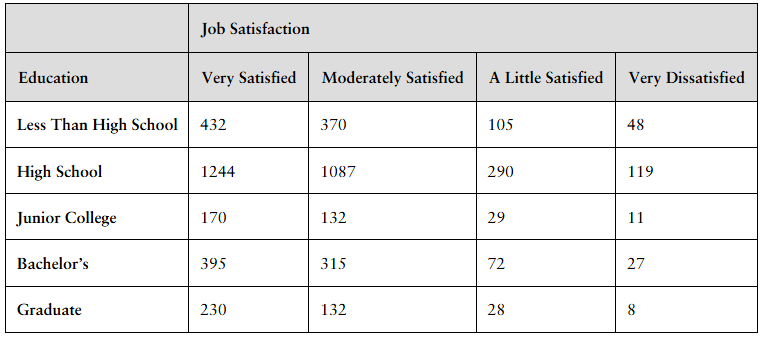
[NOW WORK] Job Satisfaction Is there an association between one’s level of education and satisfaction with work? A random sample of 5244 employed individuals were asked to disclose their highest level of education and satisfaction with their work/job. The results are shown in the table below. The data are from the General Social Survey.

b. Verify that the requirements for performing a chi-square test of independence are satisfied.
Verified step by step guidance1
Step 1: Identify the type of test and data structure. Since we want to check if there is an association between two categorical variables (Education level and Job Satisfaction), a chi-square test of independence is appropriate. The data is presented in a contingency table with counts for each combination of education level and job satisfaction category.
Step 2: Check the assumptions for the chi-square test of independence. The main requirements are: (a) The data should be from a random sample, (b) The observations should be independent, and (c) The expected frequency in each cell of the contingency table should be at least 5.
Step 3: Verify randomness and independence. The problem states that the sample is random, and since individuals are independently surveyed, the independence assumption is satisfied.
Step 4: Calculate the expected counts for each cell using the formula: \[\text{Expected Count} = \frac{(\text{Row Total}) \times (\text{Column Total})}{\text{Grand Total}}\]. This step is necessary to check if all expected counts are at least 5.
Step 5: Confirm that all expected counts are 5 or greater. If any expected count is less than 5, the chi-square test may not be valid, and an alternative method or combining categories might be needed. If all expected counts meet this criterion, the requirements for the chi-square test of independence are satisfied.
Verified video answer for a similar problem:This video solution was recommended by our tutors as helpful for the problem above
Video duration:
3mPlay a video:
Was this helpful?
Key Concepts
Here are the essential concepts you must grasp in order to answer the question correctly.
Chi-Square Test of Independence
This test determines whether there is a significant association between two categorical variables. It compares observed frequencies in each category to expected frequencies under the assumption of independence. A large difference suggests a relationship between variables.
Recommended video:
Guided course
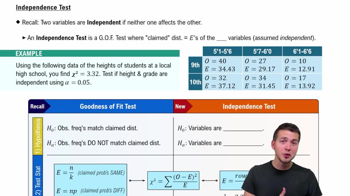
Independence Test
Requirements for Chi-Square Test
Key conditions include: data must be from a random sample, categories must be mutually exclusive, and expected cell counts should generally be at least 5 to ensure validity. These requirements ensure the test's assumptions are met for accurate results.
Recommended video:
Guided course
Intro to Least Squares Regression
Contingency Table Analysis
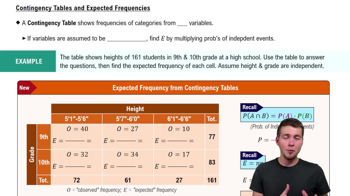
A contingency table displays the frequency distribution of variables and helps visualize the relationship between them. It is essential for calculating observed and expected counts, which are used in the chi-square test to assess independence.
Recommended video:
Guided course
Contingency Tables & Expected Frequencies
Related Videos
Related Practice
Multiple Choice
30
views