The specific relationship between a legume and its mutualistic Rhizobium strain probably depends on: a. Each legume having a chemical dialogue with a fungus b. Each Rhizobium strain having a form of nitrogenase that works only in the appropriate legume host c. Each legume being found where the soil has only the Rhizobium specific to that legume d. Specific recognition between chemical signals and signal receptors of the Rhizobium strain and legume species
Verified step by step guidance
1
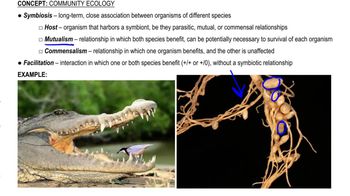
Understand the concept of mutualism: Mutualism is a type of symbiotic relationship where both parties benefit. In this case, legumes and Rhizobium bacteria have a mutualistic relationship where the bacteria fix nitrogen for the plant, and the plant provides carbohydrates and a niche for the bacteria.
Identify the role of Rhizobium: Rhizobium bacteria are known for their ability to fix atmospheric nitrogen into a form that plants can use. This process is crucial for plant growth, especially in nitrogen-poor soils.
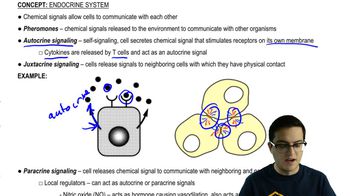
Recognize the importance of chemical signaling: In mutualistic relationships, communication between the two organisms is key. Legumes and Rhizobium communicate through chemical signals to establish a successful symbiotic relationship.
Consider the specificity of the interaction: The relationship between a legume and its Rhizobium strain is highly specific. This specificity is often due to the recognition of chemical signals produced by the legume and the corresponding receptors on the Rhizobium bacteria.
Conclude with the most likely answer: Based on the understanding of mutualistic relationships and the specificity of chemical signaling, the specific relationship between a legume and its mutualistic Rhizobium strain probably depends on specific recognition between chemical signals and signal receptors of the Rhizobium strain and legume species.
Verified video answer for a similar problem:
This video solution was recommended by our tutors as helpful for the problem above
Video duration:
1m
Play a video:
Was this helpful?
Key Concepts
Here are the essential concepts you must grasp in order to answer the question correctly.
Mutualism in Legume-Rhizobium Symbiosis
Mutualism is a type of symbiotic relationship where both parties benefit. In the legume-Rhizobium symbiosis, legumes provide carbohydrates to Rhizobium bacteria, while the bacteria fix atmospheric nitrogen into a form the plant can use. This relationship is crucial for plant growth in nitrogen-poor soils and is highly specific, often involving unique interactions between particular legume species and Rhizobium strains.
Chemical signaling is essential in plant-microbe interactions, where plants and microbes exchange chemical signals to establish symbiosis. In legumes, flavonoids released by the plant root attract Rhizobium, which responds by producing Nod factors. These Nod factors are recognized by specific receptors on the legume, initiating root nodule formation where nitrogen fixation occurs. This specificity ensures that only compatible partners engage in symbiosis.
Nitrogenase is an enzyme complex crucial for the biological nitrogen fixation process, converting atmospheric nitrogen (N2) into ammonia (NH3), a form usable by plants. This enzyme is sensitive to oxygen, requiring a low-oxygen environment provided by the root nodules. Each Rhizobium strain may have a slightly different nitrogenase, adapted to function optimally with its specific legume host, ensuring efficient nitrogen fixation and mutual benefit.