How do we know that crossing over results from a physical exchange between chromatids?
Table of contents
- 1. Introduction to Genetics51m
- 2. Mendel's Laws of Inheritance3h 37m
- 3. Extensions to Mendelian Inheritance2h 41m
- 4. Genetic Mapping and Linkage2h 28m
- 5. Genetics of Bacteria and Viruses1h 21m
- 6. Chromosomal Variation1h 48m
- 7. DNA and Chromosome Structure56m
- 8. DNA Replication1h 10m
- 9. Mitosis and Meiosis1h 34m
- 10. Transcription1h 0m
- 11. Translation58m
- 12. Gene Regulation in Prokaryotes1h 19m
- 13. Gene Regulation in Eukaryotes44m
- 14. Genetic Control of Development44m
- 15. Genomes and Genomics1h 50m
- 16. Transposable Elements47m
- 17. Mutation, Repair, and Recombination1h 6m
- 18. Molecular Genetic Tools19m
- 19. Cancer Genetics29m
- 20. Quantitative Genetics1h 26m
- 21. Population Genetics50m
- 22. Evolutionary Genetics29m
4. Genetic Mapping and Linkage
Mapping Overview
Problem 2
Textbook Question
Write a short essay that discusses how crossing over can be detected and how the resultant data provide the basis of chromosome mapping.
Verified step by step guidance1
Begin by explaining that crossing over is a process during meiosis where homologous chromosomes exchange segments, leading to new combinations of alleles in the gametes.
Describe how crossing over can be detected by analyzing the phenotypes or genotypes of offspring from a test cross, where one parent is heterozygous for two or more genes and the other is homozygous recessive.
Explain that the frequency of recombinant offspring (those with new allele combinations) compared to parental types indicates the occurrence of crossing over between genes.
Introduce the concept that the recombination frequency (RF) is calculated using the formula: \(\text{RF} = \frac{\text{Number of recombinant offspring}}{\text{Total number of offspring}} \times 100\%\).
Conclude by stating that these recombination frequencies are used to construct chromosome maps, where the distance between genes is proportional to the recombination frequency, providing a genetic map of gene order and relative distances on chromosomes.
Verified video answer for a similar problem:This video solution was recommended by our tutors as helpful for the problem above
Video duration:
2mPlay a video:
Was this helpful?
Key Concepts
Here are the essential concepts you must grasp in order to answer the question correctly.
Crossing Over
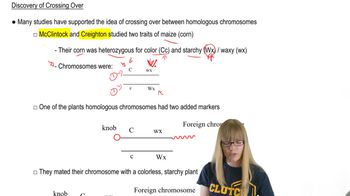
Crossing over is the process during meiosis where homologous chromosomes exchange genetic material. This recombination creates new allele combinations, increasing genetic diversity. It occurs at points called chiasmata and is essential for proper chromosome segregation.
Recommended video:
Guided course
Discovery of Crossing Over
Detection of Crossing Over
Crossing over is detected by analyzing offspring phenotypes from genetic crosses. Recombinant phenotypes, which differ from parental types, indicate crossover events. The frequency of recombinants reflects how often crossing over occurs between specific genes.
Recommended video:
Guided course
Discovery of Crossing Over
Chromosome Mapping
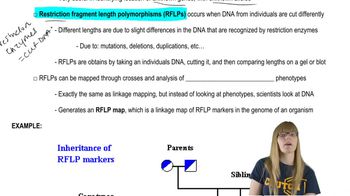
Chromosome mapping uses recombination frequencies to determine gene order and distances on chromosomes. Genes that crossover less frequently are closer together, while those with higher recombination rates are farther apart. This method creates linkage maps essential for genetic studies.
Recommended video:
Guided course
Mapping with Markers
Related Videos
Related Practice
Textbook Question
493
views