How do we know that X chromosomal inactivation of either the paternal or maternal homolog is a random event during early development in mammalian females?
Table of contents
- 1. Introduction to Genetics51m
- 2. Mendel's Laws of Inheritance3h 37m
- 3. Extensions to Mendelian Inheritance2h 41m
- 4. Genetic Mapping and Linkage2h 28m
- 5. Genetics of Bacteria and Viruses1h 21m
- 6. Chromosomal Variation1h 48m
- 7. DNA and Chromosome Structure56m
- 8. DNA Replication1h 10m
- 9. Mitosis and Meiosis1h 34m
- 10. Transcription1h 0m
- 11. Translation58m
- 12. Gene Regulation in Prokaryotes1h 19m
- 13. Gene Regulation in Eukaryotes44m
- 14. Genetic Control of Development44m
- 15. Genomes and Genomics1h 50m
- 16. Transposable Elements47m
- 17. Mutation, Repair, and Recombination1h 6m
- 18. Molecular Genetic Tools19m
- 19. Cancer Genetics29m
- 20. Quantitative Genetics1h 26m
- 21. Population Genetics50m
- 22. Evolutionary Genetics29m
3. Extensions to Mendelian Inheritance
Sex Chromosome
Problem 2
Textbook Question
Write a short essay that discusses sex chromosomes as they contrast with autosomes.
Verified step by step guidance1
Begin by defining autosomes and sex chromosomes, explaining that autosomes are chromosomes that are the same in both sexes and carry genes for most traits, while sex chromosomes determine the biological sex of an organism.
Explain the typical number and types of autosomes and sex chromosomes in humans, noting that humans have 22 pairs of autosomes and 1 pair of sex chromosomes (XX in females and XY in males).
Discuss the differences in inheritance patterns between autosomes and sex chromosomes, highlighting that autosomes are inherited equally from both parents, whereas sex chromosomes follow sex-linked inheritance patterns.
Describe how genes on sex chromosomes can lead to sex-linked traits and disorders, such as color blindness or hemophilia, which are more common in males due to the presence of only one X chromosome.
Conclude by summarizing the functional and genetic distinctions between autosomes and sex chromosomes, emphasizing their roles in development, inheritance, and genetic diversity.
Verified video answer for a similar problem:This video solution was recommended by our tutors as helpful for the problem above
Video duration:
2mPlay a video:
Was this helpful?
Key Concepts
Here are the essential concepts you must grasp in order to answer the question correctly.
Sex Chromosomes
Sex chromosomes are a pair of chromosomes that determine the biological sex of an organism. In humans, these are the X and Y chromosomes, where typically females have two X chromosomes and males have one X and one Y. They carry genes related to sex determination and some other traits.
Recommended video:
Guided course
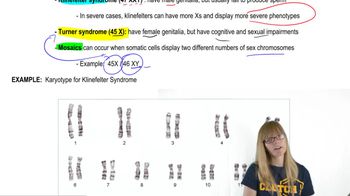
Human Sex Chromosomes
Autosomes
Autosomes are all chromosomes that are not involved in determining sex. Humans have 22 pairs of autosomes, which carry the majority of an individual's genetic information, including genes responsible for most physical and biochemical traits.
Recommended video:
Guided course
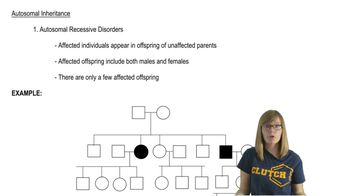
Autosomal Pedigrees
Differences Between Sex Chromosomes and Autosomes
Sex chromosomes differ from autosomes in number, gene content, and function. Sex chromosomes are involved in sex determination and often have unique inheritance patterns, such as hemizygosity in males for the X chromosome, while autosomes are inherited in pairs and carry genes for general traits.
Recommended video:
Guided course
Human Sex Chromosomes
Related Videos
Related Practice
Textbook Question
794
views