How do we know that Drosophila utilizes a different sex-determination mechanism than mammals, even though it has the same sex-chromosome compositions in males and females?
Table of contents
- 1. Introduction to Genetics51m
- 2. Mendel's Laws of Inheritance3h 37m
- 3. Extensions to Mendelian Inheritance2h 41m
- 4. Genetic Mapping and Linkage2h 28m
- 5. Genetics of Bacteria and Viruses1h 21m
- 6. Chromosomal Variation1h 48m
- 7. DNA and Chromosome Structure56m
- 8. DNA Replication1h 10m
- 9. Mitosis and Meiosis1h 34m
- 10. Transcription1h 0m
- 11. Translation58m
- 12. Gene Regulation in Prokaryotes1h 19m
- 13. Gene Regulation in Eukaryotes44m
- 14. Genetic Control of Development44m
- 15. Genomes and Genomics1h 50m
- 16. Transposable Elements47m
- 17. Mutation, Repair, and Recombination1h 6m
- 18. Molecular Genetic Tools19m
- 19. Cancer Genetics29m
- 20. Quantitative Genetics1h 26m
- 21. Population Genetics50m
- 22. Evolutionary Genetics29m
3. Extensions to Mendelian Inheritance
Sex Chromosome
Problem 3
Textbook Question
Distinguish between the concepts of sexual differentiation and sex determination.
Verified step by step guidance1
Define sex determination as the biological process that establishes the genetic and chromosomal basis of an organism's sex, typically occurring at fertilization when sex chromosomes are inherited (e.g., XX for female, XY for male in humans).
Explain sexual differentiation as the subsequent developmental process by which the undifferentiated gonads and reproductive structures develop into male or female phenotypes, influenced by genetic, hormonal, and environmental factors.
Highlight that sex determination is the initial step that sets the genetic sex, while sexual differentiation is the cascade of events that lead to the physical and physiological traits associated with that sex.
Provide examples: in humans, sex determination involves the presence or absence of the SRY gene on the Y chromosome, whereas sexual differentiation involves the development of testes or ovaries and secondary sexual characteristics.
Summarize by emphasizing that sex determination is about 'what sex an organism is genetically,' and sexual differentiation is about 'how that genetic sex is expressed in the organism's body.'
Verified video answer for a similar problem:This video solution was recommended by our tutors as helpful for the problem above
Video duration:
4mPlay a video:
Was this helpful?
Key Concepts
Here are the essential concepts you must grasp in order to answer the question correctly.
Sex Determination
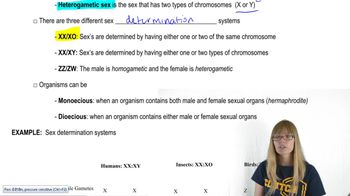
Sex determination is the biological process that establishes the genetic or chromosomal sex of an organism, typically at fertilization. It involves mechanisms like the presence of sex chromosomes (e.g., XY in males, XX in females) that dictate whether an individual develops as male or female.
Recommended video:
Guided course
Sex Determination
Sexual Differentiation
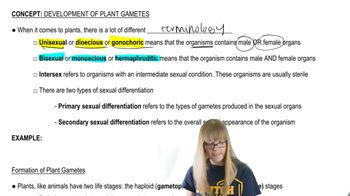
Sexual differentiation refers to the developmental process by which the undifferentiated gonads and reproductive structures develop into male or female phenotypes. This includes the formation of internal and external genitalia and secondary sexual characteristics influenced by hormones.
Recommended video:
Guided course
Plant Gamete Terminology
Relationship Between Sex Determination and Sexual Differentiation
Sex determination sets the genetic foundation for sex, while sexual differentiation is the downstream process that translates this genetic information into physical and physiological traits. Understanding their distinction clarifies how genetic sex leads to phenotypic sex.
Recommended video:
Guided course
Sex Determination
Related Videos
Related Practice
Textbook Question
904
views