
FIGURE P29.64 shows a mass spectrometer, an analytical instrument used to identify the various molecules in a sample by measuring their charge-to-mass ratio q/m. The sample is ionized, the positive ions are accelerated (starting from rest) through a potential difference ∆V, and they then enter a region of uniform magnetic field. The field bends the ions into circular trajectories, but after just half a circle they either strike the wall or pass through a small opening to a detector. As the accelerating voltage is slowly increased, different ions reach the detector and are measured. Consider a mass spectrometer with a 200.00 mT magnetic field and an 8.0000 cm spacing between the entrance and exit holes. To five significant figures, what accelerating potential differences ∆V are required to detect the ions (a) O₂⁺ (b) N₂⁺ and (c) CO⁺? See Exercise 29 for atomic masses; the mass of the missing electron is less than 0.001 u and is not relevant at this level of precision. Although N₂⁺ and CO⁺ both have a nominal molecular mass of 28, they are easily distinguished by virtue of their slightly different accelerating voltages. Use the following constants: 1 u = 1.6605 x 10⁻²⁷ kg, e = 1.6022 x 10⁻¹⁹ C.

- Ch 01: Concepts of Motion35
- Ch 02: Kinematics in One Dimension75
- Ch 03: Vectors and Coordinate Systems58
- Ch 04: Kinematics in Two Dimensions60
- Ch 05: Force and Motion23
- Ch 06: Dynamics I: Motion Along a Line53
- Ch 07: Newton's Third Law27
- Ch 08: Dynamics II: Motion in a Plane52
- Ch 09: Work and Kinetic Energy56
- Ch 10: Interactions and Potential Energy50
- Ch 11: Impulse and Momentum56
- Ch 12: Rotation of a Rigid Body71
- Ch 13: Newton's Theory of Gravity52
- Ch 14: Fluids and Elasticity44
- Ch 15: Oscillations55
- Ch 16: Traveling Waves37
- Ch 17: Superposition39
- Ch 18: A Macroscopic Description of Matter53
- Ch 19: Work, Heat, and the First Law of Thermodynamics60
- Ch 20: The Micro/Macro Connection53
- Ch 21: Heat Engines and Refrigerators34
- Ch 22: Electric Charges and Forces40
- Ch 23: The Electric Field39
- Ch 24: Gauss' Law32
- Ch 25: The Electric Potential63
- Ch 26: Potential and Field57
- Ch 27: Current and Resistance42
- Ch 28: Fundamentals of Circuits39
- Ch 29: The Magnetic Field47
- Ch 30: Electromagnetic Induction60
- Ch 31: Electromagnetic Fields and Waves32
- Ch 32: AC Circuits63
- Ch 33: Wave Optics32
- Ch 34: Ray Optics57
- Ch 35: Optical Instruments30
- Ch 36: Special Relativity38
- Ch 37: The Foundations of Modern Physics25
- Ch 38: Quantization49
- Ch 39: Wave Functions and Uncertainty31
- Ch 40: One-Dimensional Quantum Mechanics35
- Ch 41: Atomic Physics18
- Ch 42: Nuclear Physics27
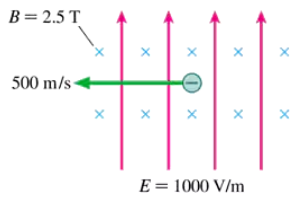
An antiproton (same properties as a proton except that q = -e) is moving in the combined electric and magnetic fields of FIGURE P29.61. What are the magnitude and direction of the antiproton's acceleration at this instant?
 Verified step by step guidance
Verified video answer for a similar problem:
Key Concepts
Lorentz Force
 13:39
13:39
Acceleration
 05:47
05:47Direction of Forces
 09:49
09:49A long, hollow wire has inner radius R₁ and outer radius R₂. The wire carries current I uniformly distributed across the area of the wire. Use Ampère's law to find an expression for the magnetic field strength in the three regions 0 < r < R₁, R₁ < r < R₂, and R₂ < r.
The uniform 30 mT magnetic field in FIGURE P29.65 points in the positive z-direction. An electron enters the region of magnetic field with a speed of 5.0 x 10⁶ m/s and at an angle of 30° above the xy-plane. Find the radius r and the pitch p of the electron's spiral trajectory.
A 65-cm-diameter cyclotron uses a 500 V oscillating potential difference between the dees. What is the maximum kinetic energy of a proton if the magnetic field strength is 0.75 T?
A proton moving in a uniform magnetic field with experiences force . A second proton with experiences in the same field. What is ? Give your answer as a magnitude and an angle measured counter-clockwise from the -axis.
An electron in a cathode-ray tube is accelerated through a potential difference of 10 kV, then passes through the 2.0-cm-wide region of uniform magnetic field in FIGURE P29.60. What field strength will deflect the electron by 10°?