Ch 29: The Magnetic Field
Knight Calc - Physics for Scientists and Engineers 5th Edition
Knight Calc5th EditionPhysics for Scientists and EngineersISBN: 9780137344796Not the one you use?Change textbook
Chapter 29, Problem 60

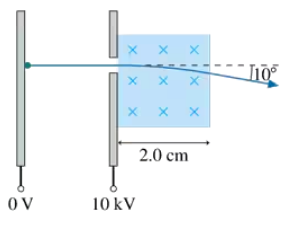
An electron in a cathode-ray tube is accelerated through a potential difference of 10 kV, then passes through the 2.0-cm-wide region of uniform magnetic field in FIGURE P29.60. What field strength will deflect the electron by 10°?

Verified step by step guidance
1
Step 1: Calculate the velocity of the electron after being accelerated through the potential difference. Use the energy conservation principle: the kinetic energy gained by the electron equals the electric potential energy lost. The formula is \( \frac{1}{2}mv^2 = eV \), where \( m \) is the mass of the electron, \( v \) is its velocity, \( e \) is the charge of the electron, and \( V \) is the potential difference.
Step 2: Determine the time the electron spends in the magnetic field region. Use the formula \( t = \frac{d}{v} \), where \( d \) is the width of the magnetic field region (2.0 cm) and \( v \) is the velocity calculated in Step 1.
Step 3: Relate the magnetic force to the centripetal motion of the electron. The magnetic force \( F_B \) is given by \( F_B = evB \), where \( B \) is the magnetic field strength. This force causes the electron to move in a circular arc, and the radius of curvature \( r \) can be related to the deflection angle \( \theta \).
Step 4: Use the geometry of the deflection to relate the radius of curvature \( r \) to the deflection angle \( \theta \). The relationship is \( \theta = \frac{d}{r} \), where \( d \) is the width of the magnetic field region. Rearrange this equation to solve for \( r \).
Step 5: Combine the equations from Steps 3 and 4 to solve for the magnetic field strength \( B \). Substitute \( r \) from Step 4 into the equation \( F_B = \frac{mv^2}{r} \), and solve for \( B \).

Verified video answer for a similar problem:

This video solution was recommended by our tutors as helpful for the problem above.
Was this helpful?

Key Concepts

Here are the essential concepts you must grasp in order to answer the question correctly.

Electric Potential and Kinetic Energy

When an electron is accelerated through a potential difference, it gains kinetic energy equal to the work done on it by the electric field. The kinetic energy (KE) can be calculated using the formula KE = eV, where e is the charge of the electron and V is the potential difference. In this case, a 10 kV potential difference means the electron gains significant kinetic energy, which will affect its motion in the magnetic field.
Recommended video:
Guided course
07:51
Electric Potential Energy

Magnetic Force on a Charged Particle

A charged particle moving through a magnetic field experiences a magnetic force given by the equation F = qvB sin(θ), where q is the charge, v is the velocity, B is the magnetic field strength, and θ is the angle between the velocity and the magnetic field direction. This force acts perpendicular to both the velocity of the particle and the magnetic field, causing the particle to follow a curved path.
Recommended video:
Guided course
09:08
Magnetic Force Between Two Moving Charges

Deflection Angle in a Magnetic Field

The deflection angle of a charged particle in a magnetic field is influenced by its velocity, the strength of the magnetic field, and the time it spends in the field. The relationship between these factors can be analyzed using trigonometric principles, particularly when determining the angle of deflection. In this scenario, the goal is to find the magnetic field strength that results in a 10° deflection of the electron as it travels through the 2.0 cm wide magnetic field region.
Recommended video:
Guided course
05:30
Magnetic Fields and Magnetic Dipoles
Related Practice
Textbook Question

An antiproton (same properties as a proton except that q = -e) is moving in the combined electric and magnetic fields of FIGURE P29.61. What are the magnitude and direction of the antiproton's acceleration at this instant?

300
views
Textbook Question

FIGURE P29.64 shows a mass spectrometer, an analytical instrument used to identify the various molecules in a sample by measuring their charge-to-mass ratio q/m. The sample is ionized, the positive ions are accelerated (starting from rest) through a potential difference ∆V, and they then enter a region of uniform magnetic field. The field bends the ions into circular trajectories, but after just half a circle they either strike the wall or pass through a small opening to a detector. As the accelerating voltage is slowly increased, different ions reach the detector and are measured. Consider a mass spectrometer with a 200.00 mT magnetic field and an 8.0000 cm spacing between the entrance and exit holes. To five significant figures, what accelerating potential differences ∆V are required to detect the ions (a) O₂⁺ (b) N₂⁺ and (c) CO⁺? See Exercise 29 for atomic masses; the mass of the missing electron is less than 0.001 u and is not relevant at this level of precision. Although N₂⁺ and CO⁺ both have a nominal molecular mass of 28, they are easily distinguished by virtue of their slightly different accelerating voltages. Use the following constants: 1 u = 1.6605 x 10⁻²⁷ kg, e = 1.6022 x 10⁻¹⁹ C.

1575
views
Textbook Question

A long, hollow wire has inner radius R₁ and outer radius R₂. The wire carries current I uniformly distributed across the area of the wire. Use Ampère's law to find an expression for the magnetic field strength in the three regions 0 < r < R₁, R₁ < r < R₂, and R₂ < r.

248
views
Textbook Question

A 65-cm-diameter cyclotron uses a 500 V oscillating potential difference between the dees. What is the maximum kinetic energy of a proton if the magnetic field strength is 0.75 T?

275
views
Textbook Question

A proton moving in a uniform magnetic field with v1=(1.00×10⁶i^)m/s\(\vec{v}\)_1 = (1.00 \(\times\) 10^6\,\(\hat{i}\))\,\(\text{m/s}\) experiences force F1=(1.20×10¹⁶k^)N\(\vec{F}\)_1 = (1.20 \(\times\) 10^{-16}\,\(\hat{k}\))\,\(\text{N}\). A second proton with v2=(2.0×10⁶j^)m/s\(\vec{v}\)_2 = (2.0 \(\times\) 10^6\,\(\hat{j}\))\,\(\text{m/s}\) experiences F2=(4.16×10¹⁶k^)N\(\vec{F}\)_2 = (-4.16 \(\times\) 10^{-16}\,\(\hat{k}\))\,\(\text{N}\) in the same field. What is B\(\vec{B}\)? Give your answer as a magnitude and an angle measured counter-clockwise from the +x+x-axis.

335
views
Textbook Question

A flat, circular disk of radius R is uniformly charged with total charge Q. The disk spins at angular velocity ω about an axis through its center. What is the magnetic field strength at the center of the disk?

224
views