


The power cable for an electric trolley (Fig. 27–60) carries a horizontal current of 330 A toward the east. The Earth’s magnetic field has a strength 5.0 x 10⁻⁵ T and makes an angle of dip of 22° at this location. Calculate the magnitude and direction of the magnetic force on a 15-m length of this cable.
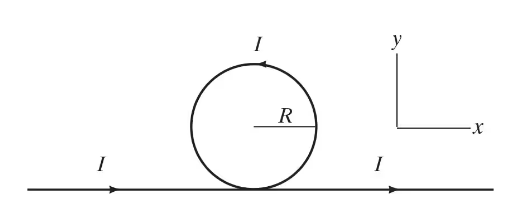
Part of a long, thin insulated straight wire is formed into a single circular loop of radius 𝑅 (Fig. 28–68) and carries a current I. (a) What is the magnitude and direction of the magnetic field at the center of the loop? (b) If the plane of the loop is twisted 90 degrees so that the plane is perpendicular to the straight part of the wire (i.e., in the yz plane) what is the magnitude and direction of the field now at the center of the loop?

Verified step by step guidance
Verified video answer for a similar problem:
Key Concepts
Magnetic Field Due to a Current Loop
Right-Hand Rule
Effect of Loop Orientation on Magnetic Field
You want to get an idea of the magnitude of magnetic fields produced by overhead power lines. You estimate that a transmission wire is about 12 m above the ground. The local power company tells you that the lines operate at 145 kV and provide a maximum of 45 MW to the local area. Estimate the maximum magnetic field you might experience walking under one such power line, and compare to the Earth’s field. [For an ac current, values are rms, and the magnetic field will be changing.]
A toroid is fabricated with a circular shape and loops with a square cross section as shown in Fig. 28–69. The cross-section of a loop is a square of side 6.0 cm. The inner radius of the whole circular toroid is 3.0 m. There are 320 loops of wire which carry a 45-A dc current using a nearby power supply at 20.0 V. The arrows show the current flow in and out of the toroid. The current flows up at the inner diameter and down at the outer diameter. (a) Calculate the strength of the magnetic field at the center of the square’s cross section at point P. (b) Is the magnetic field pointing clockwise or counterclockwise? (c) The square cross-sectional area of the wire is uniformly 0.10 cm2. What is the resistivity of the wire?
Two long straight aluminum wires, each of diameter 0.42 mm, carry the same current but in opposite directions. They are suspended by 0.50-m-long strings as shown in Fig. 28–66. If the suspension strings make an angle of 3.0° with the vertical and are hanging freely, what is the current in the wires?
