Ch 04: Kinematics in Two Dimensions
Knight Calc - Physics for Scientists and Engineers 5th Edition
Knight Calc5th EditionPhysics for Scientists and EngineersISBN: 9780137344796Not the one you use?Change textbook
Chapter 4, Problem 48a

A projectile is launched from ground level at angle θ and speed v0 into a headwind that causes a constant horizontal acceleration of magnitude a opposite the direction of motion. Find an expression in terms of a and g for the launch angle that gives maximum range.

Verified step by step guidance
1
Start by recalling the general equation for the range of a projectile in the absence of air resistance: \( R = \frac{v_0^2 \sin(2\theta)}{g} \). However, in this case, there is a horizontal acceleration \( a \) due to the headwind, which modifies the motion.
Break the motion into horizontal and vertical components. The horizontal motion is affected by the headwind, so the horizontal acceleration is \( -a \). The horizontal velocity at any time \( t \) is given by \( v_x = v_0 \cos(\theta) - at \).
For the vertical motion, the acceleration is due to gravity \( g \), and the vertical velocity at any time \( t \) is \( v_y = v_0 \sin(\theta) - gt \). The projectile reaches the ground when \( y = 0 \), which gives the total time of flight \( T \). Solve for \( T \) using the vertical motion equation: \( y = v_0 \sin(\theta) t - \frac{1}{2} g t^2 = 0 \). This simplifies to \( T = \frac{2 v_0 \sin(\theta)}{g} \).
Now, use the horizontal motion to find the range \( R \). The range is the horizontal displacement when the projectile lands, given by \( R = \int_0^T v_x \, dt \). Substitute \( v_x = v_0 \cos(\theta) - at \) and integrate over the time interval \( [0, T] \). This gives \( R = v_0 \cos(\theta) T - \frac{1}{2} a T^2 \). Substitute \( T = \frac{2 v_0 \sin(\theta)}{g} \) into this expression.
To maximize the range \( R \), take the derivative of \( R \) with respect to \( \theta \), set it equal to zero, and solve for \( \theta \). This will yield the launch angle \( \theta \) in terms of \( a \) and \( g \).

Verified video answer for a similar problem:

This video solution was recommended by our tutors as helpful for the problem above.
Video duration:
17m
Was this helpful?

Key Concepts

Here are the essential concepts you must grasp in order to answer the question correctly.

Projectile Motion

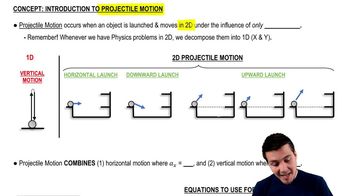
Projectile motion refers to the motion of an object that is launched into the air and is subject to gravitational force and any other forces acting on it, such as air resistance. The trajectory of a projectile is typically parabolic, and its motion can be analyzed in two dimensions: horizontal and vertical. Understanding the components of velocity and the effects of gravity is crucial for determining the range and height of the projectile.
Recommended video:
Guided course
04:44
Introduction to Projectile Motion

Range of a Projectile

The range of a projectile is the horizontal distance it travels before landing. It depends on the initial speed, launch angle, and the effects of any forces acting on the projectile, such as gravity and air resistance. The optimal launch angle for maximum range in a vacuum is 45 degrees, but this angle changes when other forces, like a headwind, are considered, necessitating adjustments in calculations.
Recommended video:
Guided course
04:44
Introduction to Projectile Motion

Effect of Headwind

A headwind is a wind that blows directly opposite to the direction of motion of the projectile, creating a constant horizontal acceleration that affects its range. This force reduces the effective horizontal velocity of the projectile, requiring a recalibration of the launch angle to achieve maximum range. Understanding how to incorporate this opposing force into the equations of motion is essential for solving problems involving projectiles in windy conditions.
Recommended video:
Guided course
07:40
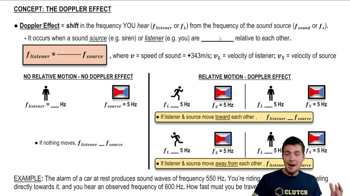
The Doppler Effect
Related Practice
Textbook Question

Starting from rest, a DVD steadily accelerates to 500 rpm in 1.0 s, rotates at this angular speed for 3.0 s, then steadily decelerates to a halt in 2.0 s. How many revolutions does it make?

2078
views

Textbook Question

A ball is thrown toward a cliff of height h with a speed of 30 m/s and an angle of 60° above horizontal. It lands on the edge of the cliff 4.0 s later. What was the maximum height of the ball?

2639
views
Textbook Question

A projectile's horizontal range over level ground is v02sin2θg\(\frac{v_0^2 \sin 2\theta}{g}\). At what launch angle or angles will the projectile land at half of its maximum possible range?

2391
views
Textbook Question

A gray kangaroo can bound across level ground with each jump carrying it 10 m from the takeoff point. Typically the kangaroo leaves the ground at a 20° angle. If this is so: What is its maximum height above the ground?

451
views
Textbook Question

A spaceship maneuvering near Planet Zeta is located at r=(600i400j+200k)×103km,\(\mathbf{r}\) = (600\(\mathbf{i}\) - 400\(\mathbf{j}\) + 200\(\mathbf{k}\)) \(\times\) 10^3 \, \(\text{km}\), relative to the planet, and traveling at v=9500im/s\(\mathbf{v}\) = 9500\(\mathbf{i}\) \, \(\text{m/s}\). It turns on its thruster engine and accelerates with a=(40i20k)m/s2\(\mathbf{a}\) = (40\(\mathbf{i}\) - 20\(\mathbf{k}\)) \, \(\text{m/s}\)^2 for 35 min35\(\text{ min}\). What is the spaceship's position when the engine shuts off? Give your answer as a position vector measured in km\(\operatorname{km}\).

2136
views
Textbook Question

A projectile is launched from ground level at angle θ and speed v₀ into a headwind that causes a constant horizontal acceleration of magnitude a opposite the direction of motion. What is the angle for maximum range if a is 10% of g?

2490
views
1
rank