
Ch. 08 - Conservation of Energy
Giancoli Douglas - Physics for Scientists and Engineers 5th edition
Giancoli Douglas5th editionPhysics for Scientists and EngineersISBN: 9780137488179Not the one you use?Change textbook
Chapter 8, Problem 96c

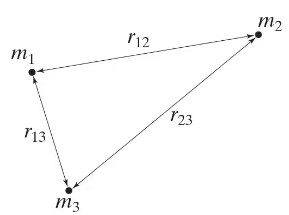
Suppose we have three masses, m₁ , m₂ and m₃, that initially are extremely (≈ infinitely) far apart from each other. The work needed to bring them to the positions shown in Fig. 8–50 is W = - G ((m₁m₂/ r₁₂) + (m₁m₃/r₁₃) + (m₂m₃/r₂₃)). Is W equal to the binding energy of the system—that is, is W equal to the energy required to separate the components by an infinite distance? Explain.

Verified step by step guidance
1
Step 1: Understand the given formula for work (W). The formula provided is W = - G ((m₁m₂ / r₁₂) + (m₁m₃ / r₁₃) + (m₂m₃ / r₂₃)), where G is the gravitational constant, m₁, m₂, and m₃ are the masses, and r₁₂, r₁₃, and r₂₃ are the distances between the respective pairs of masses. This represents the gravitational potential energy of the system when the masses are brought from infinity to their current positions.
Step 2: Recall the concept of binding energy. Binding energy is the energy required to separate a system into its individual components, moving them infinitely far apart. For a gravitational system, this energy is equal in magnitude but opposite in sign to the work done to assemble the system from infinity.
Step 3: Analyze the relationship between W and the binding energy. Since W is negative (indicating that energy is released when the masses are brought together), the binding energy of the system is equal to the magnitude of W. This is because the same amount of energy (but positive) would be required to overcome the gravitational attraction and separate the masses to infinity.
Step 4: Conclude whether W equals the binding energy. Yes, W is equal to the binding energy of the system in magnitude but opposite in sign. The negative sign of W indicates that the system is bound, and the positive binding energy represents the energy needed to unbind the system.
Step 5: Summarize the explanation. The work W represents the gravitational potential energy of the system, and its magnitude corresponds to the binding energy. The negative sign of W reflects the fact that energy is released when the system is assembled, while the binding energy is the positive energy required to separate the masses to infinity.

Verified video answer for a similar problem:

This video solution was recommended by our tutors as helpful for the problem above.
Video duration:
2m
Was this helpful?

Key Concepts

Here are the essential concepts you must grasp in order to answer the question correctly.

Gravitational Potential Energy

Gravitational potential energy is the energy an object possesses due to its position in a gravitational field. In the context of multiple masses, it is calculated based on the distances between them and their respective masses. The formula for gravitational potential energy between two masses is given by U = -G(m₁m₂/r), where G is the gravitational constant, m₁ and m₂ are the masses, and r is the distance between them.
Recommended video:
Guided course
06:35
Gravitational Potential Energy

Work-Energy Principle

The work-energy principle states that the work done on an object is equal to the change in its kinetic energy. In gravitational systems, the work done to bring masses from infinity to a certain configuration is related to the potential energy of that configuration. Thus, the work W calculated in the question represents the energy required to assemble the system of masses from an infinite separation.
Recommended video:
Guided course
04:10
The Work-Energy Theorem

Binding Energy

Binding energy is the energy required to separate a system of particles to an infinite distance, effectively breaking the system apart. In gravitational systems, the binding energy is equivalent to the negative of the total gravitational potential energy of the system. Therefore, if W represents the work done to assemble the masses, it is indeed equal to the binding energy, as it quantifies the energy needed to separate the masses completely.
Recommended video:
Guided course
04:10
Intro to Energy & Types of Energy
Related Practice
Textbook Question

Water flows slowly over a dam at the rate of 320 kg/s and falls vertically 88 m before striking the turbine blades. Calculate the rate at which mechanical energy is transferred to the turbine blades, assuming 55% efficiency.

1632
views
Textbook Question

How much work can a 3.0-hp motor do in 1.0h?

2039
views
Textbook Question

Proper design of automobile braking systems must account for heat buildup under heavy braking. Calculate the thermal energy dissipated from brakes in a 1500-kg car that descends a 17° hill. The car begins braking when its speed is 95 km/h and slows to a speed of 35 km/h in a distance of 0.30 km measured along the road.

1617
views
Textbook Question

The two atoms in a diatomic molecule exert an attractive force on each other at large distances and a repulsive force at short distances. The magnitude of the force between two atoms in a diatomic molecule can be approximated by the Lennard-Jones force, or F(r) = F₀ [2(σ/r)¹³ - (σ/r)⁷], where r is the separation between the two atoms, and σ and F₀ are constants. For an oxygen molecule (which is diatomic) F₀ = 9.60 x 10⁻¹¹ N and σ = 3.50 x 100⁻¹¹ m. Integrate the equation for F(r) to determine the potential energy U(r) of the oxygen molecule.

1588
views
Textbook Question

If you stand on a bathroom scale, the spring inside the scale compresses 0.60 mm, and it tells you your weight is 760 N. Now if you jump on the scale from a height of 1.0 m, what does the scale read at its peak? Assume Hooke’s law holds.

1306
views