
Textbook Question
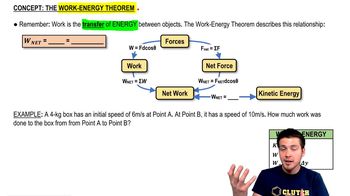
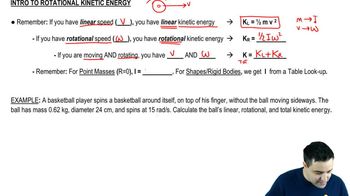
At room temperature, an oxygen molecule, with mass of 5.31 x 10⁻²⁶ kg, typically has a kinetic energy of about 6.21 x 10⁻²¹ J . How fast is it moving?
2119
views

 Verified step by step guidance
 04:10
04:10
 06:07
06:07 06:54
06:54At room temperature, an oxygen molecule, with mass of 5.31 x 10⁻²⁶ kg, typically has a kinetic energy of about 6.21 x 10⁻²¹ J . How fast is it moving?
A 2800-kg space vehicle, initially at rest, falls vertically from a height of 2900 km above the Earth’s surface. Determine how much work is done by the force of gravity in bringing the vehicle to the Earth’s surface.
A 3.0-m-long steel chain is stretched out along the top level of a horizontal scaffold at a construction site, in such a way that 2.0 m of the chain remains on the top level and 1.0 m hangs vertically, Fig. 7–27. At this point, the force on the hanging segment is sufficient to pull the entire chain over the edge. Once the chain is moving, the kinetic friction is so small that it can be neglected. How much work is performed on the chain by the force of gravity as the chain falls from the point where 2.0 m remains on the scaffold to the point where the entire chain has left the scaffold? (Assume that the chain has a linear weight density of 24 N/m.)
A car traveling at a velocity v can stop in a minimum distance d. What would be the car’s minimum stopping distance if it were traveling at a velocity of 2v?
In the game of paintball, players use guns powered by pressurized gas to propel 33-g gel capsules filled with paint at the opposing team. Game rules dictate that a paintball cannot leave the barrel of a gun with a speed greater than 85 m/s. Model the shot by assuming the pressurized gas applies a constant force F to a 33-g capsule over the length of the 32-cm barrel. Determine F by using the work-energy principle.
The force required to compress an “imperfect” horizontal spring (doesn’t follow Hooke’s law) an amount x is given by F = 150x + 12x³, where x is in meters and F in newtons. If the spring is compressed 2.0 m, what speed will it give to a 3.0-kg ball held against it and then released?