Ch 28: Fundamentals of Circuits
Knight Calc - Physics for Scientists and Engineers 5th Edition
Knight Calc5th EditionPhysics for Scientists and EngineersISBN: 9780137344796Not the one you use?Change textbook
Chapter 28, Problem 37

A capacitor is discharged through a 100 Ω resistor. The discharge current decreases to 25% of its initial value in 2.5 ms. What is the value of the capacitor?

Verified step by step guidance
1
Start by recalling the formula for the discharge of a capacitor through a resistor: \( I(t) = I_0 e^{-t / \tau} \), where \( I(t) \) is the current at time \( t \), \( I_0 \) is the initial current, and \( \tau \) is the time constant of the circuit.
The time constant \( \tau \) is defined as \( \tau = RC \), where \( R \) is the resistance and \( C \) is the capacitance. In this problem, \( R = 100 \ \Omega \).
From the problem, the current decreases to 25% of its initial value in \( t = 2.5 \ \text{ms} \). Substitute \( I(t) = 0.25 I_0 \) and \( t = 2.5 \times 10^{-3} \ \text{s} \) into the discharge formula: \( 0.25 I_0 = I_0 e^{-t / \tau} \).
Simplify the equation by dividing through by \( I_0 \): \( 0.25 = e^{-t / \tau} \). Take the natural logarithm of both sides: \( \ln(0.25) = -t / \tau \).
Solve for \( \tau \): \( \tau = -t / \ln(0.25) \). Substitute \( t = 2.5 \times 10^{-3} \ \text{s} \) and calculate \( \ln(0.25) \). Finally, use \( \tau = RC \) to solve for \( C \): \( C = \tau / R \).

Verified video answer for a similar problem:

This video solution was recommended by our tutors as helpful for the problem above.
Was this helpful?

Key Concepts

Here are the essential concepts you must grasp in order to answer the question correctly.

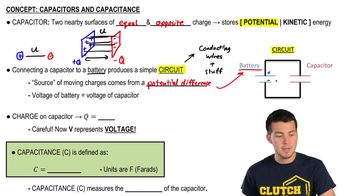
Capacitance

Capacitance is the ability of a capacitor to store electrical charge per unit voltage. It is measured in farads (F) and is defined by the formula C = Q/V, where C is capacitance, Q is the charge stored, and V is the voltage across the capacitor. Understanding capacitance is crucial for analyzing how capacitors behave in circuits, especially during charging and discharging processes.
Recommended video:
Guided course
08:02
Capacitors & Capacitance (Intro)

RC Time Constant

The RC time constant, denoted as τ (tau), is a measure of the time it takes for the voltage across a capacitor to either charge or discharge to approximately 63.2% of its maximum value. It is calculated as τ = R × C, where R is the resistance in ohms and C is the capacitance in farads. This concept is essential for understanding the exponential nature of capacitor discharge in resistive circuits.
Recommended video:
Guided course
08:59
Phase Constant of a Wave Function

Exponential Decay

Exponential decay describes the process by which a quantity decreases at a rate proportional to its current value. In the context of a discharging capacitor, the current and voltage drop exponentially over time, following the equation I(t) = I0 * e^(-t/τ), where I0 is the initial current, t is time, and τ is the time constant. This concept is key to solving problems involving the discharge of capacitors in circuits.
Recommended video:
Guided course
04:24
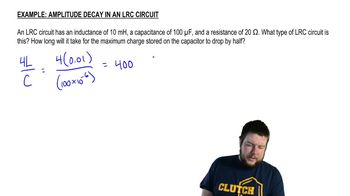
Amplitude Decay in an LRC Circuit