Ch 26: Potential and Field
Knight Calc - Physics for Scientists and Engineers 5th Edition
Knight Calc5th EditionPhysics for Scientists and EngineersISBN: 9780137344796Not the one you use?Change textbook
Chapter 26, Problem 44

Engineers discover that the electric potential between two electrodes can be modeled as V(x)=V0ln(1+x/d) , where V0 is a constant, x is the distance from the first electrode in the direction of the second, and d is the distance between the electrodes. What is the electric field strength midway between the electrodes?

Verified step by step guidance
1
Step 1: Recall the relationship between electric potential and electric field. The electric field strength, E(x), is the negative gradient of the electric potential, V(x). Mathematically, this is expressed as: E(x) = -dV(x)/dx.
Step 2: Write down the given electric potential function: V(x) = V₀ ln(1 + x/d), where V₀ is a constant, x is the distance from the first electrode, and d is the distance between the electrodes.
Step 3: Differentiate the potential function with respect to x to find the electric field. Using the chain rule, the derivative of ln(1 + x/d) is 1/(1 + x/d) * (1/d). Thus, E(x) = -V₀/(d(1 + x/d)).
Step 4: Determine the position midway between the electrodes. Since the distance between the electrodes is d, the midpoint corresponds to x = d/2.
Step 5: Substitute x = d/2 into the expression for the electric field: E(d/2) = -V₀/(d(1 + (d/2)/d)). Simplify the denominator to find the electric field strength at the midpoint.

Verified video answer for a similar problem:

This video solution was recommended by our tutors as helpful for the problem above.
Video duration:
4m
Was this helpful?

Key Concepts

Here are the essential concepts you must grasp in order to answer the question correctly.

Electric Potential

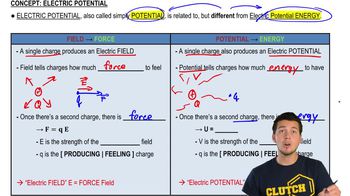
Electric potential, denoted as V, is the amount of electric potential energy per unit charge at a point in an electric field. It is a scalar quantity that indicates the work done to move a charge from a reference point to a specific point in the field without any acceleration. In this context, the potential is modeled as a logarithmic function of distance, which reflects how the potential changes as one moves between the electrodes.
Recommended video:
Guided course
07:33
Electric Potential

Electric Field Strength

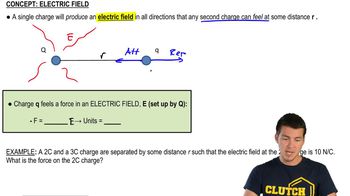
Electric field strength, represented as E, is defined as the force per unit charge experienced by a positive test charge placed in the field. It is a vector quantity that points in the direction of the force that a positive charge would experience. The electric field can be derived from the electric potential by taking the negative gradient of the potential function, which indicates how rapidly the potential changes with respect to position.
Recommended video:
Guided course
03:16
Intro to Electric Fields

Gradient and Derivatives

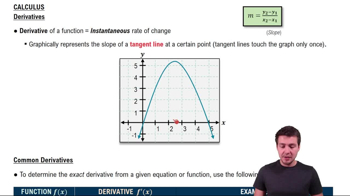
In physics, the gradient of a scalar field, such as electric potential, is a vector that points in the direction of the greatest rate of increase of the field and whose magnitude is the rate of increase in that direction. The derivative of the potential function with respect to distance gives the electric field strength. Understanding how to compute derivatives is essential for analyzing how physical quantities change in space, particularly in the context of electric fields.
Recommended video: