
Ch 35: Interference
Young & Freedman Calc - University Physics 14th Edition
Young & Freedman Calc14th EditionUniversity PhysicsISBN: 9780321973610Not the one you use?Change textbook
Chapter 35, Problem 17a

In a two-slit interference pattern, the intensity at the peak of the central maximum is I0. At a point in the pattern where the phase difference between the waves from the two slits is 60.0°, what is the intensity?

Verified step by step guidance
1
Step 1: Understand the relationship between intensity and phase difference in a two-slit interference pattern. The intensity at a given point is determined by the superposition of the electric fields from the two slits. The formula for intensity is: \( I = I_0 \cos^2(\Delta \phi / 2) \), where \( \Delta \phi \) is the phase difference and \( I_0 \) is the maximum intensity.
Step 2: Identify the given values in the problem. The maximum intensity \( I_0 \) is provided, and the phase difference \( \Delta \phi \) is given as 60.0°.
Step 3: Convert the phase difference from degrees to radians if necessary, since trigonometric functions in physics often use radians. Use the conversion formula: \( \Delta \phi_{\text{radians}} = \Delta \phi_{\text{degrees}} \times \frac{\pi}{180} \).
Step 4: Substitute the phase difference \( \Delta \phi \) into the formula \( I = I_0 \cos^2(\Delta \phi / 2) \). Divide the phase difference by 2 to calculate \( \Delta \phi / 2 \), and then compute \( \cos(\Delta \phi / 2) \).
Step 5: Square the result of \( \cos(\Delta \phi / 2) \) to find \( \cos^2(\Delta \phi / 2) \), and multiply this value by \( I_0 \) to determine the intensity \( I \) at the given phase difference.

Verified video answer for a similar problem:

This video solution was recommended by our tutors as helpful for the problem above.
Video duration:
2m
Was this helpful?

Key Concepts

Here are the essential concepts you must grasp in order to answer the question correctly.

Interference of Waves

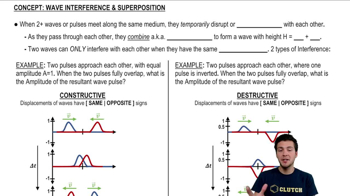
Interference occurs when two or more waves overlap and combine to form a new wave pattern. In the context of light waves, constructive interference happens when waves are in phase, leading to increased intensity, while destructive interference occurs when waves are out of phase, resulting in reduced intensity. The two-slit experiment exemplifies this phenomenon, demonstrating how light can create patterns of bright and dark fringes.
Recommended video:
Guided course
03:47
Wave Interference & Superposition

Phase Difference

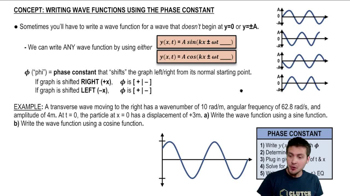
Phase difference refers to the difference in the phase of two waves at a given point in time. It is measured in degrees or radians and is crucial in determining the type of interference that occurs. For example, a phase difference of 0° or 360° results in constructive interference, while a phase difference of 180° leads to destructive interference. In this question, a phase difference of 60° will affect the resulting intensity at that point in the interference pattern.
Recommended video:
Guided course
08:59
Phase Constant of a Wave Function

Intensity of Light

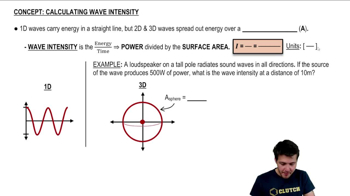
The intensity of light is a measure of the power per unit area carried by a wave and is proportional to the square of the amplitude of the wave. In interference patterns, the intensity at any point can be calculated using the formula I = I0 * (1 + cos(Δφ)), where I0 is the maximum intensity and Δφ is the phase difference. This relationship allows us to determine the intensity at points in the pattern based on the phase differences between the interfering waves.
Recommended video:
Guided course
02:32
Wave Intensity
Related Practice
Textbook Question

Two slits spaced 0.450 mm apart are placed 75.0 cm from a screen. What is the distance between the second and third dark lines of the interference pattern on the screen when the slits are illuminated with coherent light with a wavelength of 500 nm?

1669
views
Textbook Question

Coherent light with wavelength 450 nm falls on a pair of slits. On a screen 1.80 m away, the distance between dark fringes is 3.90 mm. What is the slit separation?

2223
views
Textbook Question

Two slits spaced 0.260 mm apart are 0.900 m from a screen and illuminated by coherent light of wavelength 660 nm. The intensity at the center of the central maximum (u = 0°) is I0. What is the distance on the screen from the center of the central maximum to the point where the intensity has fallen to I0/2?

1691
views
Textbook Question

Two slits spaced 0.260 mm apart are 0.900 m from a screen and illuminated by coherent light of wavelength 660 nm. The intensity at the center of the central maximum (u = 0°) is I0. What is the distance on the screen from the center of the central maximum to the first minimum

1516
views
Textbook Question

Coherent light of frequency 6.32 × 10¹⁴ Hz passes through two thin slits and falls on a screen 85.0 cm away. You observe that the third bright fringe occurs at ±3.11 cm on either side of the central bright fringe. (a) How far apart are the two slits? (b) At what distance from the central bright fringe will the third dark fringe occur?

1942
views
Textbook Question

What is the thinnest film of a coating with n = 1.42 on glass (n = 1.52) for which destructive interference of the red component (650 nm) of an incident white light beam in air can take place by reflection?

393
views