
Ch 04: Kinematics in Two Dimensions
Knight Calc - Physics for Scientists and Engineers 5th Edition
Knight Calc5th EditionPhysics for Scientists and EngineersISBN: 9780137344796Not the one you use?Change textbook
Chapter 4, Problem 49b

A gray kangaroo can bound across level ground with each jump carrying it 10 m from the takeoff point. Typically the kangaroo leaves the ground at a 20° angle. If this is so: What is its maximum height above the ground?

Verified step by step guidance
1
Step 1: Identify the given values in the problem. The kangaroo's jump covers a horizontal distance of 10 m, and the angle of takeoff is 20°. The goal is to find the maximum height above the ground. To do this, we need to analyze the vertical motion of the kangaroo using kinematic equations.
Step 2: Break the initial velocity into horizontal and vertical components. Let the initial velocity be \( v_0 \). The vertical component of the velocity is \( v_{0y} = v_0 \sin(\theta) \), and the horizontal component is \( v_{0x} = v_0 \cos(\theta) \), where \( \theta = 20° \).
Step 3: Use the horizontal motion to find the initial velocity \( v_0 \). The horizontal range \( R \) is given by \( R = \frac{v_0^2 \sin(2\theta)}{g} \), where \( g \) is the acceleration due to gravity (\( 9.8 \, \text{m/s}^2 \)). Rearrange this equation to solve for \( v_0 \).
Step 4: Once \( v_0 \) is determined, calculate the vertical component of the velocity \( v_{0y} \). The maximum height \( h_{\text{max}} \) is reached when the vertical velocity becomes zero. Use the kinematic equation \( v_y^2 = v_{0y}^2 - 2gh_{\text{max}} \), where \( v_y = 0 \) at the maximum height. Rearrange this equation to solve for \( h_{\text{max}} \): \( h_{\text{max}} = \frac{v_{0y}^2}{2g} \).
Step 5: Substitute \( v_{0y} = v_0 \sin(\theta) \) into the equation for \( h_{\text{max}} \). This gives \( h_{\text{max}} = \frac{(v_0 \sin(\theta))^2}{2g} \). Use the value of \( v_0 \) obtained earlier and the given angle \( \theta = 20° \) to complete the calculation.

Verified video answer for a similar problem:

This video solution was recommended by our tutors as helpful for the problem above.
Was this helpful?

Key Concepts

Here are the essential concepts you must grasp in order to answer the question correctly.

Projectile Motion

Projectile motion refers to the motion of an object that is launched into the air and is influenced only by the force of gravity and its initial velocity. In this case, the kangaroo's jump can be analyzed as a projectile, where its trajectory is determined by the angle of launch and the initial speed. Understanding the components of projectile motion, including horizontal and vertical motions, is essential for calculating maximum height.
Recommended video:
Guided course
04:44
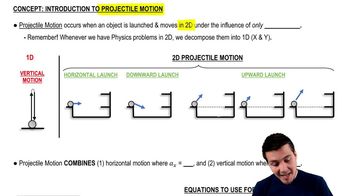
Introduction to Projectile Motion

Trigonometric Functions

Trigonometric functions, such as sine and cosine, are crucial for resolving the initial velocity of the kangaroo's jump into its vertical and horizontal components. The angle of launch (20°) allows us to use these functions to determine how much of the initial velocity contributes to the upward motion, which directly affects the maximum height reached during the jump.
Recommended video:
Guided course
08:30
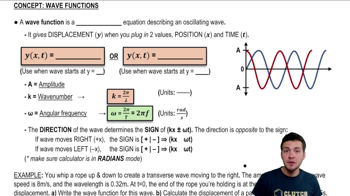
Intro to Wave Functions

Kinematic Equations

Kinematic equations describe the motion of objects under constant acceleration, such as gravity. For the kangaroo's jump, we can use these equations to relate the initial vertical velocity, the maximum height, and the acceleration due to gravity. Specifically, the equation that relates maximum height to initial velocity and acceleration will help us find the height above the ground.
Recommended video:
Guided course
08:25
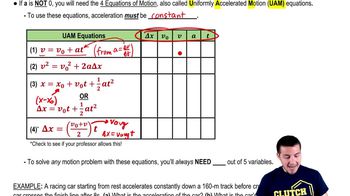
Kinematics Equations
Related Practice
Textbook Question

You are watching an archery tournament when you start wondering how fast an arrow is shot from the bow. Remembering your physics, you ask one of the archers to shoot an arrow parallel to the ground. You find the arrow stuck in the ground 60 m away, making a 30° angle with the ground. How fast was the arrow shot?

2499
views
Textbook Question

A projectile is launched from ground level at angle θ and speed v0 into a headwind that causes a constant horizontal acceleration of magnitude a opposite the direction of motion. Find an expression in terms of a and g for the launch angle that gives maximum range.

2230
views
Textbook Question

A ball is thrown toward a cliff of height h with a speed of 30 m/s and an angle of 60° above horizontal. It lands on the edge of the cliff 4.0 s later. What was the maximum height of the ball?

2639
views
Textbook Question

A projectile's horizontal range over level ground is v02sin2θg\(\frac{v_0^2 \sin 2\theta}{g}\). At what launch angle or angles will the projectile land at half of its maximum possible range?

2391
views
Textbook Question

A ball is thrown toward a cliff of height h with a speed of 30 m/s and an angle of 60° above horizontal. It lands on the edge of the cliff 4.0 s later. What is the ball's impact speed?

2052
views
Textbook Question

A projectile is launched from ground level at angle θ and speed v₀ into a headwind that causes a constant horizontal acceleration of magnitude a opposite the direction of motion. What is the angle for maximum range if a is 10% of g?

2490
views
1
rank