
Ch 02: Motion Along a Straight Line
Young & Freedman Calc - University Physics 14th Edition
Young & Freedman Calc14th EditionUniversity PhysicsISBN: 9780321973610Not the one you use?Change textbook
Chapter 2, Problem 9a

A ball moves in a straight line (the xx-axis). The graph in Fig. E2.92.9 shows this ball's velocity as a function of time. What are the ball's average speed and average velocity during the first 3.03.0 s?
Velocity-time graph depicting a ball's velocity with a step change from 2 m/s to 3 m/s over 3 seconds.

Verified step by step guidance
1
Examine the velocity-time graph to determine the velocity of the ball at different time intervals. From 0 to 2 seconds, the velocity is 2 m/s, and from 2 to 3 seconds, the velocity is 3 m/s.
Calculate the displacement for each time interval. For the first interval (0 to 2 seconds), use the formula: displacement = velocity × time. For the second interval (2 to 3 seconds), use the same formula.
Add the displacements from each interval to find the total displacement over the first 3 seconds.
Calculate the average velocity using the formula: average velocity = total displacement / total time. Here, the total time is 3 seconds.
To find the average speed, calculate the total distance traveled (which is the same as the total displacement in this case since the motion is in a straight line) and divide it by the total time (3 seconds).

Verified video answer for a similar problem:

This video solution was recommended by our tutors as helpful for the problem above.
Video duration:
7m
Was this helpful?

Key Concepts

Here are the essential concepts you must grasp in order to answer the question correctly.

Average Speed

Average speed is defined as the total distance traveled divided by the total time taken. It is a scalar quantity, meaning it only has magnitude and no direction. In the context of the given problem, to find the average speed, one would need to calculate the distance covered by the ball during the specified time interval and divide it by that time.
Recommended video:
Guided course
05:44
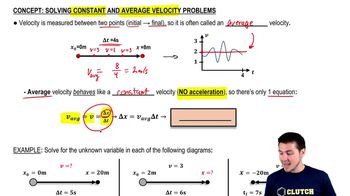
Solving Constant and Average Velocity Problems

Average Velocity

Average velocity is the total displacement divided by the total time taken. Unlike average speed, average velocity is a vector quantity, which means it has both magnitude and direction. In this scenario, the average velocity can be determined by assessing the change in position of the ball over the time interval, taking into account the direction of motion.
Recommended video:
Guided course
05:44
Solving Constant and Average Velocity Problems

Velocity-Time Graph

A velocity-time graph visually represents an object's velocity as a function of time. The slope of the graph indicates acceleration, while the area under the curve represents displacement. In the provided graph, the step changes in velocity indicate constant speeds over specific time intervals, which are crucial for calculating both average speed and average velocity during the first 3 seconds.
Recommended video:
Guided course
05:59
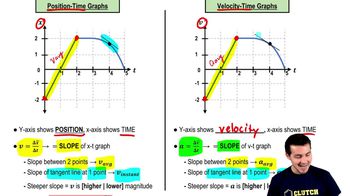
Velocity-Time Graphs & Acceleration
Related Practice
Textbook Question

Starting from the front door of a ranch house, you walk 60.060.0 m due east to a windmill, turn around, and then slowly walk 40.040.0 m west to a bench, where you sit and watch the sunrise. It takes you 28.028.0 s to walk from the house to the windmill and then 36.036.0 s to walk from the windmill to the bench. For the entire trip from the front door to the bench, what are your (a) average velocity? (b) average speed?

363
views
Textbook Question

A physics professor leaves her house and walks along the sidewalk toward campus. After 55 min, it starts to rain, and she returns home. Her distance from her house as a function of time is shown in Fig. E2.102.10. At which of the labeled points is her velocity constant and positive?

1780
views
Textbook Question

A physics professor leaves her house and walks along the sidewalk toward campus. After 55 min, it starts to rain, and she returns home. Her distance from her house as a function of time is shown in Fig. E2.102.10. At which of the labeled points is her velocity zero?

1321
views
Textbook Question

A physics professor leaves her house and walks along the sidewalk toward campus. After 55 min, it starts to rain, and she returns home. Her distance from her house as a function of time is shown in Fig. E2.102.10. At which of the labeled points is her velocity constant and negative?

1221
views
Textbook Question

A car is stopped at a traffic light. It then travels along a straight road such that its distance from the light is given by x(t)=bt2ct3x(t)=bt^2-ct^3, where b=2.40b = 2.40 m/s2 and c=0.120c = 0.120 m/s3. Calculate the instantaneous velocity of the car at t=0t = 0, t=5.0t = 5.0 s, and t=10.0t = 10.0 s.

118
views
1
rank
Textbook Question

A car is stopped at a traffic light. It then travels along a straight road such that its distance from the light is given by x(t)=bt2ct3x(t)=bt^2-ct^3, where b=2.40b = 2.40 m/s2 and c=0.120c = 0.120 m/s3. Calculate the average velocity of the car for the time interval t=0t = 0 to t=10.0t = 10.0 s.

3486
views
1
rank