
(III) A 4.0-kg block is stacked on top of a 12.0-kg block, which is accelerating along a horizontal table at a = 5.2m/s2 (Fig. 5–43). Let μk = μs = μ. What is the force that must be applied to the 12.0-kg block in (a) and in (b), assuming that the table is frictionless?
Giancoli Douglas 5th edition
Ch. 05 - Using Newton's Laws: Friction, Circular Motion, Drag Forces
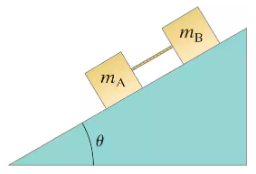
Problem 29bTwo blocks made of different materials connected together by a thin cord slide down a ramp inclined at an angle θ to the horizontal, Fig. 5–40 (block B is above block A). The masses of the blocks are mA and mB, and the coefficients of friction are μA and μB. If mA = mB = 4.0kg, and μA = 0.20 and μB = 0.30, determine the tension in the cord, for an angle θ = 32°.

Verified step by step guidance
Verified video answer for a similar problem:
Key Concepts
Newton's Second Law
Frictional Force
Inclined Plane Dynamics
On an ice rink two skaters of equal mass grab hands and spin in a mutual circle once every 2.5 s. If we assume their arms are each 0.80 m long and their individual masses are 55.0 kg, how hard are they pulling on one another?
Two blocks made of different materials connected together by a thin cord slide down a ramp inclined at an angle θ to the horizontal, Fig. 5–40 (block B is above block A). The masses of the blocks are mA and mB, and the coefficients of friction are μA and μB. If mA = mB=4.0kg, and μA = 0.20 and μB = 0.30, determine the acceleration of the blocks.
A jet plane traveling 1890 km/h (525 m/s) pulls out of a dive by moving in an arc of radius 4.80 km. What is the plane's acceleration in g's?
Piles of snow on slippery roofs can become dangerous projectiles as they melt. Consider a chunk of snow at the ridge of a roof with a slope of 24°. As the snow begins to melt, the coefficient of static friction decreases and the snow finally slips. Assuming that the distance from a chunk of snow to the edge of the roof is 6.0 m and the coefficient of kinetic friction is 0.20, calculate the speed of the snow chunk when it slides off the roof.
A flatbed truck is carrying a heavy crate. The coefficient of static friction between the crate and the bed of the truck is 0.75. What is the maximum rate at which the driver can decelerate and still avoid having the crate slide against the cab of the truck?