
Ch 09: Rotation of Rigid Bodies
Young & Freedman Calc - University Physics 14th Edition
Young & Freedman Calc14th EditionUniversity PhysicsISBN: 9780321973610Not the one you use?Change textbook
Chapter 9, Problem 4b

A fan blade rotates with angular velocity given by ωz(t) = g - bt2, where g = 5.00 rad/s and b = 0.800 rad/s3. Calculate the instantaneous angular acceleration αz at t = 3.00 s and the average angular acceleration αav-z for the time interval t = 0 to t = 3.00 s. How do these two quantities compare? If they are different, why?

Verified step by step guidance
1
Step 1: Understand the problem. The angular velocity ω_z(t) is given as a function of time: ω_z(t) = g - bt^2, where g = 5.00 rad/s and b = 0.800 rad/s^3. We need to calculate two quantities: (1) the instantaneous angular acceleration α_z at t = 3.00 s, and (2) the average angular acceleration α_av-z over the interval t = 0 to t = 3.00 s. Finally, we compare these two values and explain any differences.
Step 2: Recall the definition of instantaneous angular acceleration α_z. It is the time derivative of angular velocity ω_z(t). Mathematically, α_z = dω_z/dt. Differentiate ω_z(t) = g - bt^2 with respect to t to find α_z(t). The derivative is: α_z(t) = -2bt.
Step 3: Substitute t = 3.00 s into the expression for α_z(t) to find the instantaneous angular acceleration at that specific time. Use the given value of b = 0.800 rad/s^3 in the formula α_z(t) = -2bt.
Step 4: Recall the definition of average angular acceleration α_av-z. It is the change in angular velocity Δω_z divided by the time interval Δt. Mathematically, α_av-z = (ω_z(final) - ω_z(initial)) / (t(final) - t(initial)). Calculate ω_z(initial) at t = 0 and ω_z(final) at t = 3.00 s using the given formula ω_z(t) = g - bt^2. Then compute α_av-z using the formula.
Step 5: Compare the instantaneous angular acceleration α_z at t = 3.00 s with the average angular acceleration α_av-z over the interval t = 0 to t = 3.00 s. Discuss why they might differ. Instantaneous angular acceleration reflects the rate of change of angular velocity at a specific moment, while average angular acceleration represents the overall change in angular velocity over a time interval. If the angular velocity changes non-linearly (e.g., due to the quadratic term in ω_z(t)), the two values will generally differ.

Verified video answer for a similar problem:

This video solution was recommended by our tutors as helpful for the problem above.
Video duration:
4m
Was this helpful?

Key Concepts

Here are the essential concepts you must grasp in order to answer the question correctly.

Angular Velocity

Angular velocity is a measure of how quickly an object rotates around an axis, typically expressed in radians per second (rad/s). In this context, the angular velocity function ω_z(t) describes how the rotation speed of the fan blade changes over time, influenced by constants g and b. Understanding this concept is crucial for calculating both instantaneous and average angular acceleration.
Recommended video:
Guided course
06:18
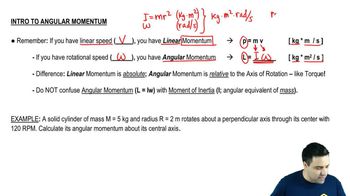
Intro to Angular Momentum

Angular Acceleration

Angular acceleration is the rate of change of angular velocity over time, represented by α_z. It can be calculated as the derivative of the angular velocity function with respect to time. In this problem, finding the instantaneous angular acceleration at a specific time (t = 3.00 s) and the average angular acceleration over a time interval requires a solid grasp of this concept.
Recommended video:
Guided course
12:12
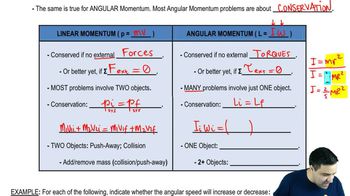
Conservation of Angular Momentum

Instantaneous vs. Average Acceleration

Instantaneous angular acceleration refers to the angular acceleration at a specific moment in time, while average angular acceleration is calculated over a defined time interval. These two quantities can differ due to the nature of the angular velocity function, which may not be constant. Understanding the distinction between these two types of acceleration is essential for analyzing the results and their implications in the context of the fan blade's motion.
Recommended video:
Guided course
05:44
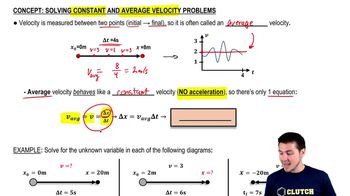
Solving Constant and Average Velocity Problems
Related Practice
Textbook Question

The angle θ through which a disk drive turns is given by θ(t) = a + bt - ct3, where a, b, and c are constants, t is in seconds, and θ is in radians. When t = 0, θ = π/4 rad and the angular velocity is 2.00 rad/s. When t = 1.50 s, the angular acceleration is 1.25 rad/s2. What are θ and the angular velocity when the angular acceleration is 3.50 rad/s2?

2103
views
Textbook Question

A fan blade rotates with angular velocity given by ωz(t) = g - bt2, where g = 5.00 rad/s and b = 0.800 rad/s3. Calculate the angular acceleration as a function of time.

1765
views
Textbook Question

The angle θ through which a disk drive turns is given by θ(t) = a + bt - ct3, where a, b, and c are constants, t is in seconds, and θ is in radians. When t = 0, θ = π/4 rad and the angular velocity is 2.00 rad/s. When t = 1.50 s, the angular acceleration is 1.25 rad/s2. (b) What is the angular acceleration when θ = π/4 rad?

2865
views
Textbook Question

The angular velocity of a flywheel obeys the equation ωz(t) = A + Bt2, where t is in seconds and A and B are constants having numerical values 2.75 (for A) and 1.50 (for B). What is the angular acceleration of the wheel at (i) t = 0 and (ii) t = 5.00 s?

3605
views
1
rank
Textbook Question

The angle θ through which a disk drive turns is given by θ(t) = a + bt - ct3, where a, b, and c are constants, t is in seconds, and θ is in radians. When t = 0, θ = π/4 rad and the angular velocity is 2.00 rad/s. When t = 1.50 s, the angular acceleration is 1.25 rad/s2. Find a, b, and c, including their units.

1733
views