Ch 21: Heat Engines and Refrigerators
Knight Calc - Physics for Scientists and Engineers 5th Edition
Knight Calc5th EditionPhysics for Scientists and EngineersISBN: 9780137344796Not the one you use?Change textbook
Chapter 21, Problem 70b

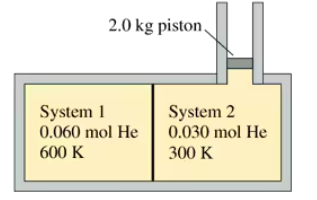
FIGURE CP21.70 shows two insulated compartments separated by a thin wall. The left side contains 0.060 mol of helium at an initial temperature of 600 K and the right side contains 0.030 mol of helium at an initial temperature of 300 K. The compartment on the right is attached to a vertical cylinder, above which the air pressure is 1.0 atm. A 10-cm-diameter, 2.0 kg piston can slide without friction up and down the cylinder. Neither the cylinder diameter nor the volumes of the compartments are known. How much heat is transferred from the left side to the right side?

Verified step by step guidance
1
Step 1: Identify the key principles involved in the problem. This problem involves the transfer of heat between two systems containing helium gas. The gases are ideal, and the heat transfer will occur until thermal equilibrium is reached. The piston on the right side is affected by external pressure and its own weight, which will influence the final state of the system.
Step 2: Write the equation for thermal equilibrium. When the two systems reach equilibrium, their final temperatures will be the same. Use the principle of conservation of energy: the heat lost by the left compartment (System 1) will equal the heat gained by the right compartment (System 2). The equation is: \( Q_1 = -Q_2 \).
Step 3: Use the formula for heat transfer for an ideal gas. The heat transferred in each system can be calculated using \( Q = n C_v \Delta T \), where \( n \) is the number of moles, \( C_v \) is the molar specific heat at constant volume for helium (\( C_v = \frac{3}{2}R \)), and \( \Delta T \) is the change in temperature. Write expressions for \( Q_1 \) and \( Q_2 \) in terms of \( T_f \), the final temperature.
Step 4: Account for the piston dynamics. The piston on the right side is affected by the external pressure (1 atm) and its own weight. The pressure inside the right compartment must balance these forces. Use the ideal gas law \( PV = nRT \) to relate the pressure, volume, and temperature of the gas in the right compartment. The piston’s equilibrium position will determine the final volume of the right compartment.
Step 5: Solve for the final temperature \( T_f \) and calculate the heat transferred. Combine the equations for heat transfer and the ideal gas law to solve for \( T_f \). Once \( T_f \) is determined, substitute it back into the heat transfer equations to find the amount of heat transferred from System 1 to System 2.

Verified video answer for a similar problem:

This video solution was recommended by our tutors as helpful for the problem above.
Was this helpful?

Key Concepts

Here are the essential concepts you must grasp in order to answer the question correctly.

Thermodynamics

Thermodynamics is the branch of physics that deals with heat, work, temperature, and the laws governing energy transfer. It is essential for understanding how energy moves between systems, particularly in processes involving heat transfer, such as the one described in the question. The first and second laws of thermodynamics provide the framework for analyzing energy conservation and entropy changes in the system.
Recommended video:
Guided course
08:04
The First Law of Thermodynamics

Ideal Gas Law

The Ideal Gas Law relates the pressure, volume, temperature, and number of moles of an ideal gas through the equation PV = nRT. In this scenario, it helps to determine the behavior of helium gas in both compartments as they exchange heat and work is done by the piston. Understanding this relationship is crucial for calculating changes in temperature and pressure during the heat transfer process.
Recommended video:
Guided course
07:21
Ideal Gases and the Ideal Gas Law

Heat Transfer

Heat transfer refers to the movement of thermal energy from one object or system to another due to a temperature difference. In this case, heat will flow from the hotter compartment (600 K) to the cooler one (300 K) until thermal equilibrium is reached. The amount of heat transferred can be calculated using specific heat capacities and the change in temperature, which is vital for solving the problem presented.
Recommended video:
Guided course
05:14
Overview of Heat Transfer
Related Practice
Textbook Question

The heat engine shown in FIGURE P21.63 uses 0.020 mol of a diatomic gas as the working substance. Make a table that shows ∆Eth, Ws, and Q for each of the three processes.

195
views

Textbook Question

A heat engine with 0.20 mol of a monatomic ideal gas initially fills a 2000 cm³ cylinder at 600 K. The gas goes through the following closed cycle: Isothermal expansion to 4000 cm³. Isochoric cooling to 300 K. Isothermal compression to 2000 cm³. Isochoric heating to 600 K. How much work does this engine do per cycle and what is its thermal efficiency?

1407
views
Textbook Question

100 mL of water at 15℃ is placed in the freezer compartment of a refrigerator with a coefficient of performance of 4.0. How much heat energy is exhausted into the room as the water is changed to ice at -15℃?

1865
views
Textbook Question

The gasoline engine in your car can be modeled as the Otto cycle shown in FIGURE CP21.73. A fuel-air mixture is sprayed into the cylinder at point 1, where the piston is at its farthest distance from the spark plug. This mixture is compressed as the piston moves toward the spark plug during the adiabatic compression stroke. The spark plug fires at point 2, releasing heat energy that had been stored in the gasoline. The fuel burns so quickly that the piston doesn't have time to move, so the heating is an isochoric process. The hot, high-pressure gas then pushes the piston outward during the power stroke. Finally, an exhaust value opens to allow the gas temperature and pressure to drop back to their initial values before starting the cycle over again. Analyze the Otto cycle and show that the work done per cycle is Wout=nR1γ(T2T1+T4T3)W_{\(\text{out}\)} = \(\frac{nR}{1-\gamma}\)(T_2 - T_1 + T_4 - T_3)

1653
views