Ch 29: The Magnetic Field
Knight Calc - Physics for Scientists and Engineers 5th Edition
Knight Calc5th EditionPhysics for Scientists and EngineersISBN: 9780137344796Not the one you use?Change textbook
Chapter 29, Problem 44

When seen from the end, three long, parallel wires form an equilateral triangle 6.0 cm on a side. The wires each carry a 5.0 A current, with one current direction opposite the other two. What is the magnetic field strength at the center of the triangle?

Verified step by step guidance
1
Convert the side length of the equilateral triangle from centimeters to meters. Since 1 cm = 0.01 m, the side length is 6.0 cm = 0.06 m.
Determine the distance from the center of the equilateral triangle to each wire. For an equilateral triangle, this distance (r) is given by \( r = \frac{a}{\sqrt{3}} \), where \( a \) is the side length. Substitute \( a = 0.06 \) m into the formula.
Use the Biot-Savart law to calculate the magnetic field contribution from each wire at the center. The magnetic field due to a long straight wire at a distance \( r \) is given by \( B = \frac{\mu_0 I}{2 \pi r} \), where \( \mu_0 = 4\pi \times 10^{-7} \, \text{T·m/A} \) is the permeability of free space, \( I \) is the current, and \( r \) is the distance calculated in the previous step.
Account for the direction of the magnetic fields. Use the right-hand rule to determine the direction of the magnetic field produced by each wire. Since two wires have currents in the same direction and one wire has a current in the opposite direction, their magnetic fields will combine vectorially. The symmetry of the equilateral triangle simplifies the vector addition.
Add the magnetic field contributions vectorially. The two wires with currents in the same direction will have their magnetic fields partially cancel the field from the wire with the opposite current. Use trigonometry to resolve the components and find the net magnetic field at the center of the triangle.

Verified video answer for a similar problem:

This video solution was recommended by our tutors as helpful for the problem above.
Was this helpful?

Key Concepts

Here are the essential concepts you must grasp in order to answer the question correctly.

Magnetic Field Due to a Current-Carrying Wire

A current-carrying wire generates a magnetic field around it, described by the right-hand rule. The strength of the magnetic field (B) at a distance (r) from a long straight wire is given by the formula B = (μ₀I)/(2πr), where μ₀ is the permeability of free space and I is the current. This principle is essential for calculating the magnetic field contributions from each wire in the problem.
Recommended video:
Guided course
09:57
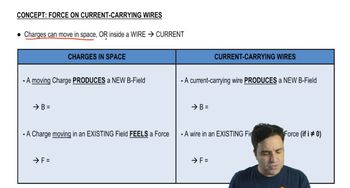
Magnetic Force on Current-Carrying Wire

Superposition of Magnetic Fields

The principle of superposition states that the total magnetic field at a point is the vector sum of the magnetic fields produced by each current-carrying wire. In this scenario, the magnetic fields from the three wires must be calculated individually and then combined, taking into account their directions, to find the net magnetic field at the center of the triangle.
Recommended video:
Guided course
05:30
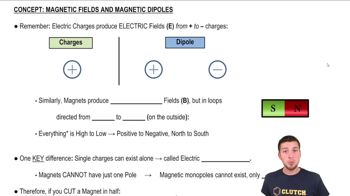
Magnetic Fields and Magnetic Dipoles

Equilateral Triangle Geometry

Understanding the geometry of an equilateral triangle is crucial for determining the distances from the center to each wire. In an equilateral triangle, the center (centroid) is equidistant from all three vertices. For a triangle with a side length of 6.0 cm, the distance from the center to each vertex can be calculated using geometric relationships, which is necessary for applying the magnetic field formula.
Recommended video:
Guided course
01:53
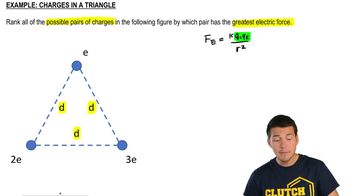
Charges In A Triangle (Rank Force Pairs)
Related Practice
Textbook Question

A small bar magnet experiences a 0.020 N m torque when the axis of the magnet is at 45° to a 0.10 T magnetic field. What is the magnitude of its magnetic dipole moment?

441
views

Textbook Question

Find an expression for the magnetic field strength at the center (point P) of the circular arc in FIGURE P29.45.

1067
views
Textbook Question

What is the loop's equilibrium orientation?

1606
views
Textbook Question

The earth's magnetic field, with a magnetic dipole moment of 8.0 x 10²² A m2, is generated by currents within the molten iron of the earth's outer core. Suppose we model the core current as a 3000-km-diameter current loop made from a 1000-km-diameter 'wire.' The loop diameter is measured from the centers of this very fat wire. What is the current density J in the current loop?

114
views
Textbook Question

A long wire carrying a 5.0 A current perpendicular to the xy-plane intersects the x-axis at x = -2.0 cm. A second, parallel wire carrying a 3.0 A current intersects the x-axis at x = +2.0 cm. At what point or points on the x-axis is the magnetic field zero if (a) the two currents are in the same direction and (b) the two currents are in opposite directions?

172
views
Textbook Question

Each turn of a solenoid is a current loop with a magnetic dipole moment. Consider a 200-turn cylindrical solenoid that has an interior volume of 40 cm3 and for which each turn is a magnetic dipole moment with magnitude 8.0 x 10⁻⁴ A m2. What is the magnetic field strength inside the solenoid?

1301
views