Ch 29: The Magnetic Field
Knight Calc - Physics for Scientists and Engineers 5th Edition
Knight Calc5th EditionPhysics for Scientists and EngineersISBN: 9780137344796Not the one you use?Change textbook
Chapter 29, Problem 41

A long wire carrying a 5.0 A current perpendicular to the xy-plane intersects the x-axis at x = -2.0 cm. A second, parallel wire carrying a 3.0 A current intersects the x-axis at x = +2.0 cm. At what point or points on the x-axis is the magnetic field zero if (a) the two currents are in the same direction and (b) the two currents are in opposite directions?

Verified step by step guidance
1
Step 1: Understand the problem. The magnetic field due to a long straight wire is given by the formula: B=μ0I2πr, where μ0 is the permeability of free space, I is the current, and r is the distance from the wire. The goal is to find the point(s) on the x-axis where the net magnetic field is zero.
Step 2: Analyze the direction of the magnetic field produced by each wire. Use the right-hand rule: curl your fingers around the wire in the direction of the current, and your thumb points in the direction of the magnetic field. For both cases (a) and (b), determine the direction of the magnetic field at any point on the x-axis due to each wire.
Step 3: Set up the condition for the magnetic field to be zero. The magnetic field due to the first wire at a distance r from it is B1=μ0I12πr, and the magnetic field due to the second wire at a distance r from it is B2=μ0I22πr. For the net magnetic field to be zero, the magnitudes of these fields must be equal, i.e., B1=B2. Solve for the position x where this condition is satisfied.
Step 4: Case (a): When the currents are in the same direction, the magnetic fields due to the two wires will oppose each other between the wires. Set up the equation I1r1=I2r2, where r1 and r2 are distances from the respective wires. Solve for x.
Step 5: Case (b): When the currents are in opposite directions, the magnetic fields due to the two wires will add between the wires and oppose each other outside the wires. Set up the same equation as in case (a), but consider the direction of the fields outside the wires. Solve for x where the net field is zero.

Verified video answer for a similar problem:

This video solution was recommended by our tutors as helpful for the problem above.
Was this helpful?

Key Concepts

Here are the essential concepts you must grasp in order to answer the question correctly.

Magnetic Field Due to a Current-Carrying Wire

A long, straight wire carrying an electric current generates a magnetic field around it. The direction of the magnetic field can be determined using the right-hand rule, where the thumb points in the direction of the current and the curled fingers indicate the direction of the magnetic field lines. The strength of the magnetic field decreases with distance from the wire and is given by the formula B = (μ₀I)/(2πr), where B is the magnetic field, μ₀ is the permeability of free space, I is the current, and r is the distance from the wire.
Recommended video:
Guided course
09:57
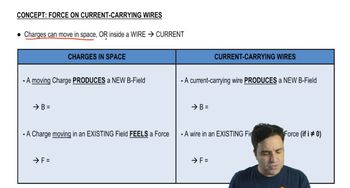
Magnetic Force on Current-Carrying Wire

Superposition of Magnetic Fields

When multiple sources generate magnetic fields, the total magnetic field at any point is the vector sum of the individual fields. This principle of superposition allows us to analyze the contributions of each wire's magnetic field at a given point on the x-axis. If the currents are in the same direction, the magnetic fields will add together, while if they are in opposite directions, they will partially or completely cancel each other out, leading to a point where the net magnetic field is zero.
Recommended video:
Guided course
05:30
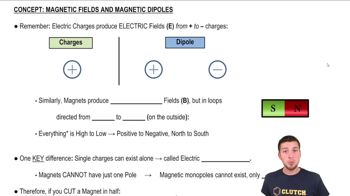
Magnetic Fields and Magnetic Dipoles

Equilibrium Condition for Magnetic Fields

To find the point where the magnetic field is zero, we set the magnetic fields produced by each wire equal to each other. This involves solving the equation B₁ = B₂, where B₁ is the magnetic field from the first wire and B₂ is from the second wire. The distances from each wire to the point of interest must be considered, as the magnetic field strength depends on the distance from the wire. This condition will yield one or more points along the x-axis where the magnetic fields cancel out.
Recommended video:
Guided course
05:30
Magnetic Fields and Magnetic Dipoles