
Textbook Question
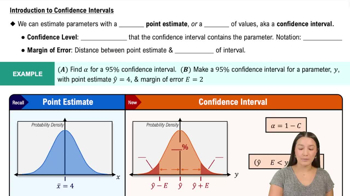
In Exercises 7–10, use the confidence interval to find the margin of error and the sample proportion.
(0.512, 0.596)
117
views

 Verified step by step guidance
 06:33
06:33
 04:08 06:33
In Exercises 7–10, use the confidence interval to find the margin of error and the sample proportion.
(0.512, 0.596)
Translating Statements In Exercises 29–34, translate the statement into a confidence interval. Approximate the level of confidence.
In a survey of 1502 U.S. adults, 31% said that they use Pinterest. The survey’s margin of error is ±2.9%. (Source: Pew Research Center)
In Exercises 9–12, construct the indicated confidence intervals for (a) the population variance and (b) the population standard deviation . Assume the sample is from a normally distributed population.
c = 0.95, s^2 = 11.56, n = 30
Determining a Minimum Sample Size Determine the minimum sample size required when you want to be 99% confident that the sample mean is within two units of the population mean and σ = 1.4. Assume the population is normally distributed.
Finding p^ and q^ In Exercises 3–6, let p be the population proportion for the situation. Find point estimates of p and q.
Social Security In a survey of 661 non-retired Americans, 218 said that they expect to rely on Social Security as major source of income when they retire. (Adapted from Gallup)
For the same sample statistics, which level of confidence would produce the widest confidence interval? Explain your reasoning.
a. 90%
b. 95%
c. 98%
d. 99%