Why do polling companies often survey 1060 individuals when they wish to estimate a population proportion with a margin of error of 3% with 95% confidence?
Table of contents
- 1. Intro to Stats and Collecting Data1h 14m
- 2. Describing Data with Tables and Graphs1h 55m
- 3. Describing Data Numerically2h 5m
- 4. Probability2h 16m
- 5. Binomial Distribution & Discrete Random Variables3h 6m
- 6. Normal Distribution and Continuous Random Variables2h 11m
- 7. Sampling Distributions & Confidence Intervals: Mean3h 23m
- Sampling Distribution of the Sample Mean and Central Limit Theorem19m
- Distribution of Sample Mean - Excel23m
- Introduction to Confidence Intervals15m
- Confidence Intervals for Population Mean1h 18m
- Determining the Minimum Sample Size Required12m
- Finding Probabilities and T Critical Values - Excel28m
- Confidence Intervals for Population Means - Excel25m
- 8. Sampling Distributions & Confidence Intervals: Proportion1h 25m
- 9. Hypothesis Testing for One Sample3h 29m
- 10. Hypothesis Testing for Two Samples4h 50m
- Two Proportions1h 13m
- Two Proportions Hypothesis Test - Excel28m
- Two Means - Unknown, Unequal Variance1h 3m
- Two Means - Unknown Variances Hypothesis Test - Excel12m
- Two Means - Unknown, Equal Variance15m
- Two Means - Unknown, Equal Variances Hypothesis Test - Excel9m
- Two Means - Known Variance12m
- Two Means - Sigma Known Hypothesis Test - Excel21m
- Two Means - Matched Pairs (Dependent Samples)42m
- Matched Pairs Hypothesis Test - Excel12m
- 11. Correlation1h 24m
- 12. Regression1h 50m
- 13. Chi-Square Tests & Goodness of Fit2h 21m
- 14. ANOVA1h 57m
8. Sampling Distributions & Confidence Intervals: Proportion
Confidence Intervals for Population Proportion
Problem 9.1.21b
Textbook Question
[NW] You Explain It! New Deal Policies In response to the Great Depression, Franklin D. Roosevelt enacted many New Deal policies. One such policy was the enactment of the National Recovery Administration (NRA), which required businesses to agree to wages and prices within their particular industry. The thought was that this would encourage higher wages among the working class, thereby spurring consumption. In a Gallup survey conducted in 1933 of 2025 adult Americans, 55% thought that wages paid to workers in industry were too low. The margin of error was 3 percentage points with 95% confidence. Which of the following represents a reasonable interpretation of the survey results? For those that are not reasonable, explain the flaw.
b. We are 92% to 98% confident 55% of adult Americans during the Great Depression felt wages paid to workers in industry were too low.
Verified step by step guidance1
Step 1: Understand the meaning of the confidence interval and confidence level. The survey reports a 55% proportion with a margin of error of 3 percentage points at 95% confidence. This means the 95% confidence interval is from 52% to 58%.
Step 2: Recognize that the confidence level (95%) indicates how confident we are that the interval contains the true population proportion, not the probability that the proportion itself lies within a certain range after the data is collected.
Step 3: Analyze the statement: 'We are 92% to 98% confident 55% of adult Americans felt wages were too low.' This statement incorrectly reverses the roles of the sample proportion and the population proportion. The 55% is the sample estimate, not the unknown population parameter.
Step 4: Identify the flaw: Confidence intervals provide a range for the population parameter based on the sample data, not a confidence range for the sample statistic itself. Also, the confidence level is fixed (95%), not a range (92% to 98%).
Step 5: Conclude that a reasonable interpretation would state that we are 95% confident that the true proportion of adult Americans who thought wages were too low lies between 52% and 58%, rather than expressing confidence about the sample proportion.
Verified video answer for a similar problem:This video solution was recommended by our tutors as helpful for the problem above
Video duration:
1mPlay a video:
Was this helpful?
Key Concepts
Here are the essential concepts you must grasp in order to answer the question correctly.
Confidence Interval and Confidence Level
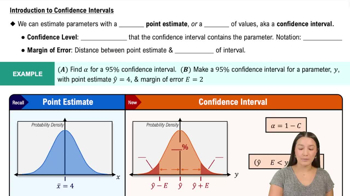
A confidence interval provides a range of values within which the true population parameter is expected to lie, based on sample data. The confidence level (e.g., 95%) indicates the proportion of such intervals that would contain the true parameter if the survey were repeated many times. It does not mean the probability that the parameter lies within the interval for a single sample.
Recommended video:
Introduction to Confidence Intervals
Margin of Error
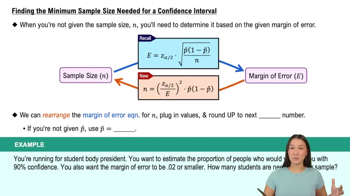
The margin of error quantifies the maximum expected difference between the sample statistic and the true population parameter, reflecting sampling variability. For example, a 3 percentage point margin of error means the true proportion is likely within 3 points above or below the sample estimate, assuming the confidence level is met.
Recommended video:
Finding the Minimum Sample Size Needed for a Confidence Interval
Interpretation of Survey Results and Confidence Statements
Interpreting survey results requires understanding that the confidence level applies to the method, not the specific sample. Saying 'we are 92% to 98% confident' is incorrect if the stated confidence level is 95%. Confidence intervals do not provide a probability range for the parameter but rather a range constructed from the sample that likely contains the parameter.
Recommended video:
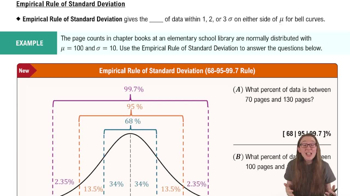
Empirical Rule of Standard Deviation and Range Rule of Thumb
Watch next
Master Constructing Confidence Intervals for Proportions with a bite sized video explanation from Patrick
Start learningRelated Videos
Related Practice
Textbook Question
3
views