Sampling Methods A student obtains a sample of responses to the question “Do you plan to take or have you taken a statistics course?” A second student obtains a sample of responses to the same question. The first student surveys only males at the same college, and the second student surveys only females at the same college. What is wrong with the samples? Can randomization be used to overcome the flaws of those samples?
Table of contents
- 1. Intro to Stats and Collecting Data1h 14m
- 2. Describing Data with Tables and Graphs1h 56m
- 3. Describing Data Numerically2h 5m
- 4. Probability2h 16m
- 5. Binomial Distribution & Discrete Random Variables3h 6m
- 6. Normal Distribution and Continuous Random Variables2h 11m
- 7. Sampling Distributions & Confidence Intervals: Mean3h 23m
- Sampling Distribution of the Sample Mean and Central Limit Theorem19m
- Distribution of Sample Mean - ExcelBonus23m
- Introduction to Confidence Intervals15m
- Confidence Intervals for Population Mean1h 18m
- Determining the Minimum Sample Size Required12m
- Finding Probabilities and T Critical Values - ExcelBonus28m
- Confidence Intervals for Population Means - ExcelBonus25m
- 8. Sampling Distributions & Confidence Intervals: Proportion2h 10m
- 9. Hypothesis Testing for One Sample5h 8m
- Steps in Hypothesis Testing1h 6m
- Performing Hypothesis Tests: Means1h 4m
- Hypothesis Testing: Means - ExcelBonus42m
- Performing Hypothesis Tests: Proportions37m
- Hypothesis Testing: Proportions - ExcelBonus27m
- Performing Hypothesis Tests: Variance12m
- Critical Values and Rejection Regions28m
- Link Between Confidence Intervals and Hypothesis Testing12m
- Type I & Type II Errors16m
- 10. Hypothesis Testing for Two Samples5h 37m
- Two Proportions1h 13m
- Two Proportions Hypothesis Test - ExcelBonus28m
- Two Means - Unknown, Unequal Variance1h 3m
- Two Means - Unknown Variances Hypothesis Test - ExcelBonus12m
- Two Means - Unknown, Equal Variance15m
- Two Means - Unknown, Equal Variances Hypothesis Test - ExcelBonus9m
- Two Means - Known Variance12m
- Two Means - Sigma Known Hypothesis Test - ExcelBonus21m
- Two Means - Matched Pairs (Dependent Samples)42m
- Matched Pairs Hypothesis Test - ExcelBonus12m
- Two Variances and F Distribution29m
- Two Variances - Graphing CalculatorBonus16m
- 11. Correlation1h 24m
- 12. Regression3h 33m
- Linear Regression & Least Squares Method26m
- Residuals12m
- Coefficient of Determination12m
- Regression Line Equation and Coefficient of Determination - ExcelBonus8m
- Finding Residuals and Creating Residual Plots - ExcelBonus11m
- Inferences for Slope31m
- Enabling Data Analysis ToolpakBonus1m
- Regression Readout of the Data Analysis Toolpak - ExcelBonus21m
- Prediction Intervals13m
- Prediction Intervals - ExcelBonus19m
- Multiple Regression - ExcelBonus29m
- Quadratic Regression15m
- Quadratic Regression - ExcelBonus10m
- 13. Chi-Square Tests & Goodness of Fit2h 21m
- 14. ANOVA2h 28m
9. Hypothesis Testing for One Sample
Steps in Hypothesis Testing
Problem 8.5.1c
Textbook Question
RESAMPLING
c. When testing a claim about a proportion or mean or standard deviation, what is an important advantage of using a resampling method instead of the parametric method described in the preceding sections of this chapter?
Verified step by step guidance1
Resampling methods, such as bootstrapping or permutation tests, do not rely on strict assumptions about the underlying population distribution. This is an important advantage because parametric methods often require the population to follow a specific distribution, such as normality.
Resampling methods are flexible and can be applied to small sample sizes or data sets with unknown or non-standard distributions, making them more robust in situations where parametric methods might fail.
Resampling methods use the data itself to generate sampling distributions by repeatedly sampling with replacement or rearranging the data, which allows for direct estimation of variability and confidence intervals without relying on theoretical formulas.
Resampling methods are computationally intensive but provide intuitive results that are easy to interpret, as they are based on the actual observed data rather than abstract theoretical models.
Resampling methods can be particularly useful when testing claims about proportions, means, or standard deviations in cases where the assumptions of parametric methods (e.g., independence, normality) are difficult to verify or are violated.
Verified video answer for a similar problem:This video solution was recommended by our tutors as helpful for the problem above
Video duration:
1mPlay a video:
0 Comments
Key Concepts
Here are the essential concepts you must grasp in order to answer the question correctly.
Resampling Methods
Resampling methods, such as bootstrapping and permutation tests, involve repeatedly drawing samples from the observed data to estimate the sampling distribution of a statistic. This approach allows for more flexible analysis, especially when the underlying distribution of the data is unknown or does not meet the assumptions of parametric tests.
Recommended video:
Guided course
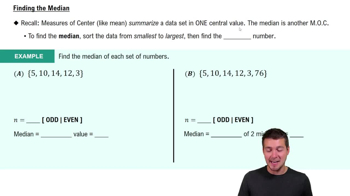
Calculating the Median
Parametric vs. Non-parametric Tests
Parametric tests assume that the data follows a specific distribution (e.g., normal distribution) and require certain conditions to be met, such as homogeneity of variance. In contrast, non-parametric tests, including resampling methods, do not rely on these assumptions, making them more robust in situations where data may be skewed or have outliers.
Recommended video:
Guided course
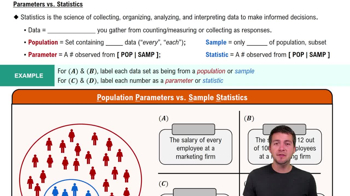
Parameters vs. Statistics
Statistical Power
Statistical power refers to the probability of correctly rejecting a false null hypothesis. Resampling methods can enhance statistical power by allowing for more accurate estimation of confidence intervals and p-values, particularly in small sample sizes or when the data does not conform to parametric assumptions, thus providing more reliable results.
Recommended video:
Guided course
Parameters vs. Statistics
Related Videos
Related Practice
Textbook Question
89
views
