
Ch. 8 - Hypothesis Testing
Triola - Elementary Statistics 14th Edition
Triola14th EditionElementary StatisticsISBN: 9780137366446Not the one you use?Change textbook
Chapter 8, Problem 8.1.2

Estimates vs. Hypothesis Tests Labels on cans of Dr. Pepper soda indicate that they contain 12 oz of the drink. We could collect samples of those cans and accurately measure the actual contents, then we could use methods of Section 7-2 for making an estimate of the mean amount of Dr. Pepper in cans, or we could use those measured amounts to test the claim that the cans contain a mean of 12 oz. What is the difference between estimating the mean and testing a hypothesis about the mean?

Verified step by step guidance
1
Step 1: Understand the concept of estimation. Estimation involves using sample data to calculate a statistic (such as the sample mean) that serves as an approximation of the population parameter (such as the population mean). For example, if we measure the contents of several cans of Dr. Pepper, we can calculate the sample mean to estimate the true mean amount of soda in all cans.
Step 2: Understand the concept of hypothesis testing. Hypothesis testing is a formal statistical procedure used to evaluate a claim about a population parameter. In this case, the claim is that the mean amount of soda in the cans is 12 oz. We use sample data to test whether this claim is likely to be true or false, based on statistical evidence.
Step 3: Recognize the key difference between estimation and hypothesis testing. Estimation focuses on providing a numerical value (or range of values, such as a confidence interval) for the population mean, while hypothesis testing focuses on determining whether there is enough evidence to reject or fail to reject a specific claim about the population mean.
Step 4: Relate the methods to the problem. If we want to estimate the mean amount of soda in the cans, we would calculate the sample mean and possibly construct a confidence interval around it. If we want to test the claim that the mean is 12 oz, we would set up a null hypothesis (H₀: μ = 12) and an alternative hypothesis (H₁: μ ≠ 12), then use sample data to perform a hypothesis test.
Step 5: Highlight the practical implications. Estimation provides a direct numerical insight into the population mean, which can be useful for understanding the actual contents of the cans. Hypothesis testing, on the other hand, helps determine whether the claim on the label (12 oz) is statistically supported or contradicted by the sample data.

Verified video answer for a similar problem:

This video solution was recommended by our tutors as helpful for the problem above.
Video duration:
4m
Was this helpful?

Key Concepts

Here are the essential concepts you must grasp in order to answer the question correctly.

Estimation

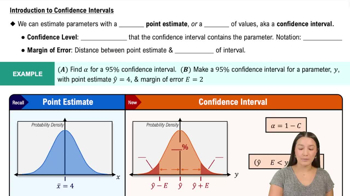
Estimation involves using sample data to infer the value of a population parameter, such as the mean. In the context of the question, we would collect measurements from a sample of Dr. Pepper cans to calculate an estimate of the average amount of soda they contain. This process often involves constructing confidence intervals to express the uncertainty around the estimate.
Recommended video:
06:33
Introduction to Confidence Intervals

Hypothesis Testing

Hypothesis testing is a statistical method used to determine whether there is enough evidence in a sample to support a specific claim about a population parameter. In this scenario, we would formulate a null hypothesis (e.g., the mean amount is 12 oz) and an alternative hypothesis, then use sample data to assess the likelihood of observing the data if the null hypothesis were true, often resulting in a p-value.
Recommended video:
Guided course
06:21
Step 1: Write Hypotheses

Null and Alternative Hypotheses

In hypothesis testing, the null hypothesis represents a statement of no effect or no difference, while the alternative hypothesis represents what we aim to support. For the Dr. Pepper example, the null hypothesis would assert that the mean content is 12 oz, while the alternative might suggest it is not. The outcome of the hypothesis test helps determine whether to reject the null hypothesis based on the sample data.
Recommended video:
Guided course
06:21
Step 1: Write Hypotheses
Related Practice
Textbook Question

Testing Claims About Variation

In Exercises 5–16, test the given claim. Identify the null hypothesis, alternative hypothesis, test statistic, P-value, or critical value(s), then state the conclusion about the null hypothesis, as well as the final conclusion that addresses the original claim. Assume that a simple random sample is selected from a normally distributed population.


Minting of Pennies Data Set 40 “Coin Weights” lists weights (grams) of pennies minted after 1983. Here are the statistics for those weights: n = 37, xbar = 2.49910 g, s = 0.01648 g . Use a 0.05 significance level to test the claim that the sample is from a population of pennies with weights having a standard deviation greater than 0.01000 g.

86
views
Textbook Question

Test Statistic and Critical Value The statistics for the sample data in Exercise 1 are n = 15, x_bar = 6.133333, and s = 8.862978, where the units are millions of dollars. Find the test statistic and critical value(s) for a test of the claim that the salaries are from a population with a mean greater than 5 million dollars. Assume that a 0.05 significance level is used.

252
views
Textbook Question

Lightning Deaths Listed below are the numbers of deaths from lightning strikes in the United States each year for a sequence of recent and consecutive years. Find the values of the indicated statistics.

46 51 44 51 43 32 38 48 45 27 34 29 26 28 23 26 28 40 16 20

f. What important feature of the data is not revealed from an examination of the statistics, and what tool would be helpful in revealing it? What does a quick examination of the data reveal?

251
views
Textbook Question

Final Conclusions

In Exercises 21–24, use a significance level of α = 0.05 and use the given information for the following:


State a conclusion about the null hypothesis. (Reject H0 or fail to reject H0.)

Without using technical terms or symbols, state a final conclusion that addresses the original claim.


Original claim: The mean pulse rate (in beats per minute) of adult males is 72 bpm. The hypothesis test results in a P-value of 0.0095.

184
views
Textbook Question

Discarded Plastic Data Set 42 “Garbage Weight” includes weights (pounds) of discarded plastic from 62 different households. Those 62 weights have a mean of 1.911 pounds and a standard deviation of 1.065 pounds. We want to use a 0.05 level of significance to test the claim that this sample is from a population with a mean less than 2.000 pounds. Identify the null hypothesis and alternative hypothesis.

111
views
Textbook Question

Discarded Plastic The P-value for the hypothesis test described in Exercise 1 is 0.2565.


What should be concluded about the null hypothesis?

What is the final conclusion that addresses the original claim?

82
views