
Ch. 2 - Exploring Data with Tables and Graphs
Triola - Elementary Statistics 14th Edition
Triola14th EditionElementary StatisticsISBN: 9780137366446Not the one you use?Change textbook
Chapter 2, Problem 2.4.14

In Exercises 13–16, write a statement that interprets the P-value and includes a conclusion about linear correlation.


Using the data from Exercise 6 “Airport Data Speeds,” the P-value is 0.003.

Verified step by step guidance
1
Step 1: Understand the P-value. The P-value is a measure of the strength of evidence against the null hypothesis. In the context of linear correlation, the null hypothesis (H₀) typically states that there is no linear correlation between the two variables being analyzed.
Step 2: Compare the P-value to the significance level (α). A common significance level is α = 0.05. If the P-value is less than α, we reject the null hypothesis. In this case, the P-value is 0.003, which is less than 0.05.
Step 3: Interpret the result. Since the P-value is very small (0.003), it provides strong evidence to reject the null hypothesis. This suggests that there is a statistically significant linear correlation between the two variables in the dataset.
Step 4: Write a conclusion about the linear correlation. Based on the P-value, we conclude that there is sufficient evidence to support the claim that a linear correlation exists between the variables in the 'Airport Data Speeds' dataset.
Step 5: Contextualize the conclusion. The result implies that changes in one variable are likely associated with changes in the other variable, and this relationship is unlikely to be due to random chance.

Verified video answer for a similar problem:

This video solution was recommended by our tutors as helpful for the problem above.
Video duration:
1m
Was this helpful?

Key Concepts

Here are the essential concepts you must grasp in order to answer the question correctly.

P-value

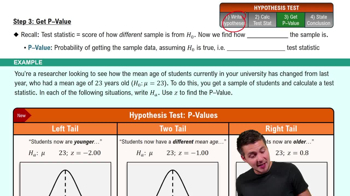
The P-value is a statistical measure that helps determine the significance of results in hypothesis testing. It represents the probability of observing the data, or something more extreme, assuming the null hypothesis is true. A low P-value (typically less than 0.05) indicates strong evidence against the null hypothesis, suggesting that the observed effect is statistically significant.
Recommended video:
Guided course
06:50
Step 3: Get P-Value

Linear Correlation

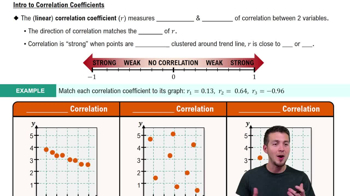
Linear correlation refers to the relationship between two variables that can be described by a straight line. It is quantified using the correlation coefficient, which ranges from -1 to 1. A positive value indicates a direct relationship, while a negative value indicates an inverse relationship. Understanding linear correlation is essential for interpreting how changes in one variable may affect another.
Recommended video:
Guided course
05:43
Correlation Coefficient

Hypothesis Testing

Hypothesis testing is a statistical method used to make inferences about population parameters based on sample data. It involves formulating a null hypothesis (no effect or relationship) and an alternative hypothesis (some effect or relationship). The outcome of the test, often indicated by the P-value, helps determine whether to reject the null hypothesis in favor of the alternative, guiding conclusions about the data.
Recommended video:
Guided course
06:21
Step 1: Write Hypotheses
Related Practice
Textbook Question

Exercises 29–34 involve large sets of data, so technology should be used. Complete lists of the data are not listed in Appendix B, but they can be downloaded from the website TriolaStats.com. Use the indicated data and construct the frequency distribution.


Earthquake Depths Use the depths (km) of the 600 earthquakes included in Data Set 24 “Earthquakes.” Use a class width of 10.0 km and begin with a lower class limit of 0.0 km. Does the frequency distribution appear to be a normal distribution?

116
views
Textbook Question

Tornadoes Listed below are the F-scale intensities of recent tornadoes in the United States. Construct a frequency distribution. Do the intensities appear to have a normal distribution?

201
views
Textbook Question

Exercises 29–34 involve large sets of data, so technology should be used. Complete lists of the data are not listed in Appendix B, but they can be downloaded from the website TriolaStats.com. Use the indicated data and construct the frequency distribution.

Systolic Blood Pressure Use the systolic blood pressures of the 300 subjects included in Data Set 1 “Body Data.” Use a class width of 20 mm Hg and begin with a lower class limit of 80 mm Hg. Does the frequency distribution appear to be a normal distribution?

111
views
Textbook Question

Airport Data Speeds Listed below are the cellular data speeds (Mbps) from Sprint and Verizon measured at nine different airports (based on data from CNN). What would the presence of a correlation suggest about Sprint and Verizon?

123
views
Textbook Question

V and Digital Ads Listed below are amounts (billions of dollars) spent on TV and digital advertising. The amounts are listed in order by year ending with the year 2022. The last few years are projected amounts (based on data from Magna Global). Construct a graph that reveals the story that the data are trying to tell. What story does the graph depict?

TV Ads:

[Image]

105
views
Textbook Question

Cell Phone Radiation If we collect a sample of cell phone radiation amounts much larger than the sample included with Exercise 3, and if our sample includes a single outlier, how will that outlier appear in a histogram?

151
views