What are the two properties that a probability density function must satisfy?
Verified step by step guidance
1
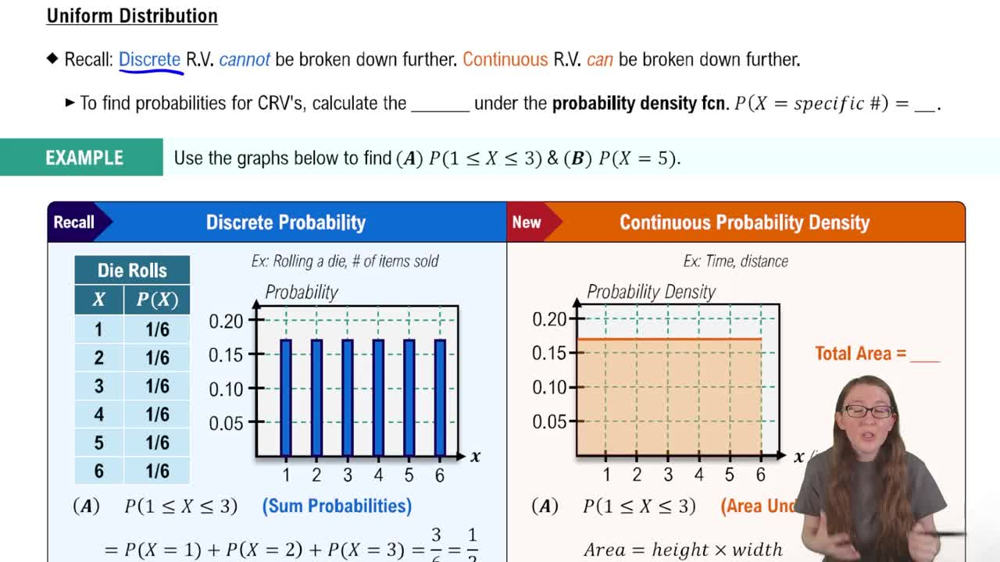
Understand that a probability density function (PDF) describes the likelihood of a continuous random variable taking on a particular value within a range.
The first property of a PDF is that it must be non-negative for all values of the random variable. Mathematically, this means \(f(x) \geq 0\) for all \(x\).
The second property is that the total area under the PDF curve over the entire range of possible values must equal 1, representing the total probability. This is expressed as \(\int_{-\infty}^{\infty} f(x) \, dx = 1\).
These two properties ensure that the PDF is a valid function for describing probabilities of continuous outcomes.
Remember, unlike probability mass functions for discrete variables, the PDF itself does not give probabilities directly but rather densities; probabilities are found by integrating the PDF over an interval.
Verified video answer for a similar problem:
This video solution was recommended by our tutors as helpful for the problem above
Video duration:
1m
Play a video:
0 Comments
Key Concepts
Here are the essential concepts you must grasp in order to answer the question correctly.
Non-negativity of the Probability Density Function
A probability density function (PDF) must be non-negative for all values of the random variable, meaning f(x) ≥ 0 for every x. This ensures that probabilities, which represent frequencies or likelihoods, cannot be negative.
Finding Values of Non-Standard Normal Variables from Probabilities
Total Area Under the PDF Equals One
The integral of the PDF over the entire range of the random variable must equal 1. This property guarantees that the total probability of all possible outcomes sums to 100%, reflecting a complete probability distribution.
Definition and Role of a Probability Density Function
A PDF describes the relative likelihood of a continuous random variable taking on a specific value. Unlike discrete probabilities, the PDF itself is not a probability but a density, and probabilities are found by integrating the PDF over intervals.