A commuter train arrives at a station once every 30 minutes. If a passenger arrives at the station at a random time, what is the probability that the passenger will wait less than 10 minutes?
Table of contents
- 1. Intro to Stats and Collecting Data1h 14m
- 2. Describing Data with Tables and Graphs1h 55m
- 3. Describing Data Numerically2h 5m
- 4. Probability2h 16m
- 5. Binomial Distribution & Discrete Random Variables3h 6m
- 6. Normal Distribution and Continuous Random Variables2h 11m
- 7. Sampling Distributions & Confidence Intervals: Mean3h 23m
- Sampling Distribution of the Sample Mean and Central Limit Theorem19m
- Distribution of Sample Mean - Excel23m
- Introduction to Confidence Intervals15m
- Confidence Intervals for Population Mean1h 18m
- Determining the Minimum Sample Size Required12m
- Finding Probabilities and T Critical Values - Excel28m
- Confidence Intervals for Population Means - Excel25m
- 8. Sampling Distributions & Confidence Intervals: Proportion1h 25m
- 9. Hypothesis Testing for One Sample3h 29m
- 10. Hypothesis Testing for Two Samples4h 50m
- Two Proportions1h 13m
- Two Proportions Hypothesis Test - Excel28m
- Two Means - Unknown, Unequal Variance1h 3m
- Two Means - Unknown Variances Hypothesis Test - Excel12m
- Two Means - Unknown, Equal Variance15m
- Two Means - Unknown, Equal Variances Hypothesis Test - Excel9m
- Two Means - Known Variance12m
- Two Means - Sigma Known Hypothesis Test - Excel21m
- Two Means - Matched Pairs (Dependent Samples)42m
- Matched Pairs Hypothesis Test - Excel12m
- 11. Correlation1h 24m
- 12. Regression1h 50m
- 13. Chi-Square Tests & Goodness of Fit2h 21m
- 14. ANOVA1h 57m
6. Normal Distribution and Continuous Random Variables
Uniform Distribution
Problem 7.R.18a
Textbook Question
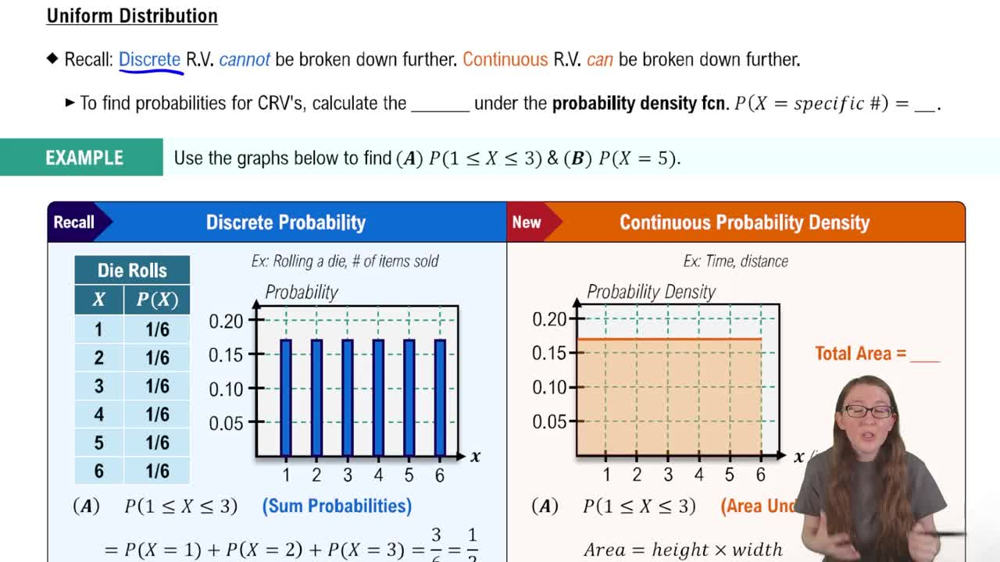
A continuous random variable X is uniformly distributed with 0 ≤ X ≤ 20.
a. Draw a graph of the uniform density function.
Verified step by step guidance1
Recall that for a continuous uniform distribution on the interval \([a, b]\), the probability density function (pdf) is constant and given by \(f(x) = \frac{1}{b - a}\) for \(a \leq x \leq b\), and \(f(x) = 0\) otherwise.
Identify the parameters for this problem: \(a = 0\) and \(b = 20\), so the pdf is \(f(x) = \frac{1}{20 - 0} = \frac{1}{20}\) for \$0 \leq x \leq 20$.
To draw the graph, plot the horizontal axis representing \(x\) from 0 to 20, and the vertical axis representing the density \(f(x)\).
Draw a horizontal line at the height \(f(x) = \frac{1}{20}\) between \(x = 0\) and \(x = 20\), indicating the constant density over this interval.
Outside the interval \([0, 20]\), the density is zero, so the graph should be on the \(x\)-axis (height 0) for \(x < 0\) and \(x > 20\).
Verified video answer for a similar problem:This video solution was recommended by our tutors as helpful for the problem above
Video duration:
1mPlay a video:
Was this helpful?
Key Concepts
Here are the essential concepts you must grasp in order to answer the question correctly.
Uniform Distribution
A uniform distribution describes a continuous random variable where all outcomes in a specified interval are equally likely. For X uniformly distributed between 0 and 20, the probability density function (pdf) is constant over this range and zero elsewhere.
Recommended video:
Uniform Distribution
Probability Density Function (pdf)
The pdf of a continuous random variable shows the relative likelihood of the variable taking on a specific value. For a uniform distribution on [0, 20], the pdf is a horizontal line at height 1/(20-0) = 1/20, representing equal probability density across the interval.
Recommended video:
Introduction to Probability
Graphing the Density Function
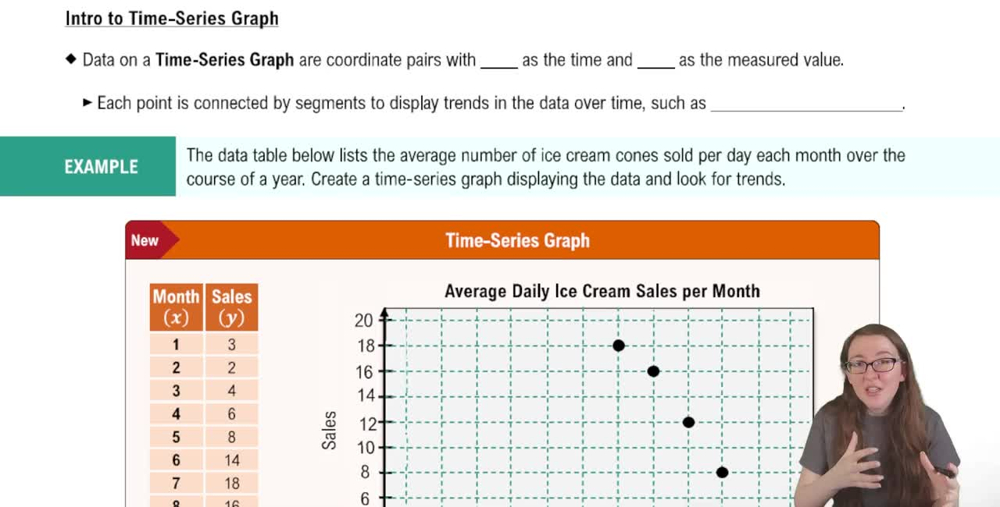
To graph the uniform density function, plot the pdf as a constant horizontal line between 0 and 20 on the x-axis, with height equal to 1/20. Outside this interval, the pdf is zero, so the graph touches the x-axis. This visualizes the equal likelihood of all values in the range.
Recommended video:
Creating Time-Series Graphs
Watch next
Master Uniform Distribution with a bite sized video explanation from Patrick
Start learningRelated Videos
Related Practice
Multiple Choice
104
views
1
rank