A continuous random variable X is uniformly distributed with 0 ≤ X ≤ 20. c. What is P(10 ≤ X ≤ 18)?
Verified step by step guidance
1
Identify the type of distribution: Since X is uniformly distributed between 0 and 20, it means the probability density function (pdf) is constant over this interval.
Write down the pdf for a uniform distribution on [0, 20]: \(f(x) = \frac{1}{20 - 0} = \frac{1}{20}\) for \(0 \leq x \leq 20\).
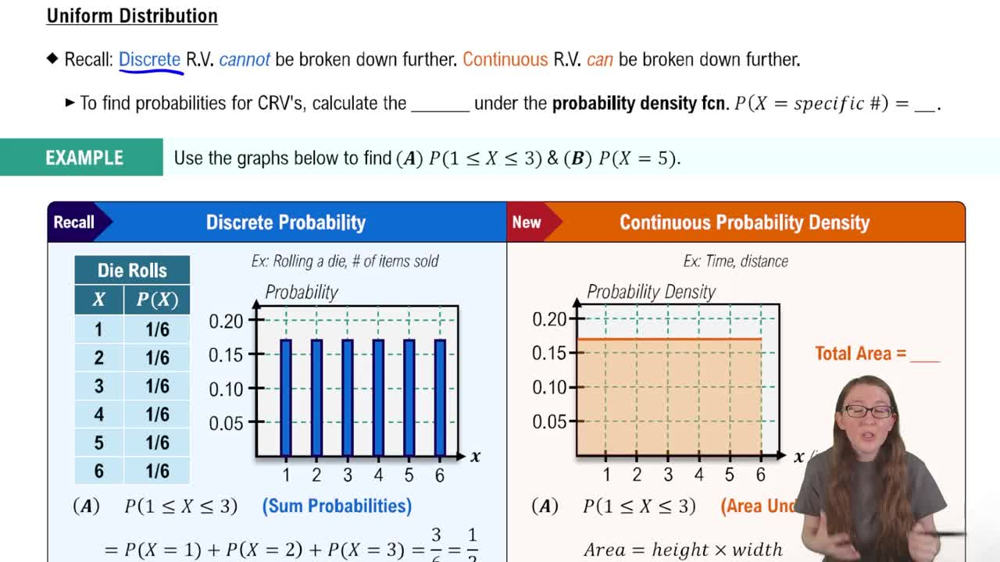
Understand that the probability for an interval in a uniform distribution is the length of the interval times the height of the pdf.
Calculate the length of the interval for which we want the probability: from 10 to 18, so the length is \$18 - 10$.
Multiply the length of the interval by the pdf value to get the probability: \(P(10 \leq X \leq 18) = (18 - 10) \times \frac{1}{20}\).
Verified video answer for a similar problem:
This video solution was recommended by our tutors as helpful for the problem above
Video duration:
1m
Play a video:
0 Comments
Key Concepts
Here are the essential concepts you must grasp in order to answer the question correctly.
Uniform Distribution
A uniform distribution describes a continuous random variable where all outcomes in a given interval are equally likely. For X uniformly distributed between a and b, the probability density function is constant, and the total area under the curve equals 1.
For continuous variables, probabilities are found by calculating the area under the probability density function over the desired interval. Since the uniform distribution has a constant density, this probability is proportional to the length of the interval.
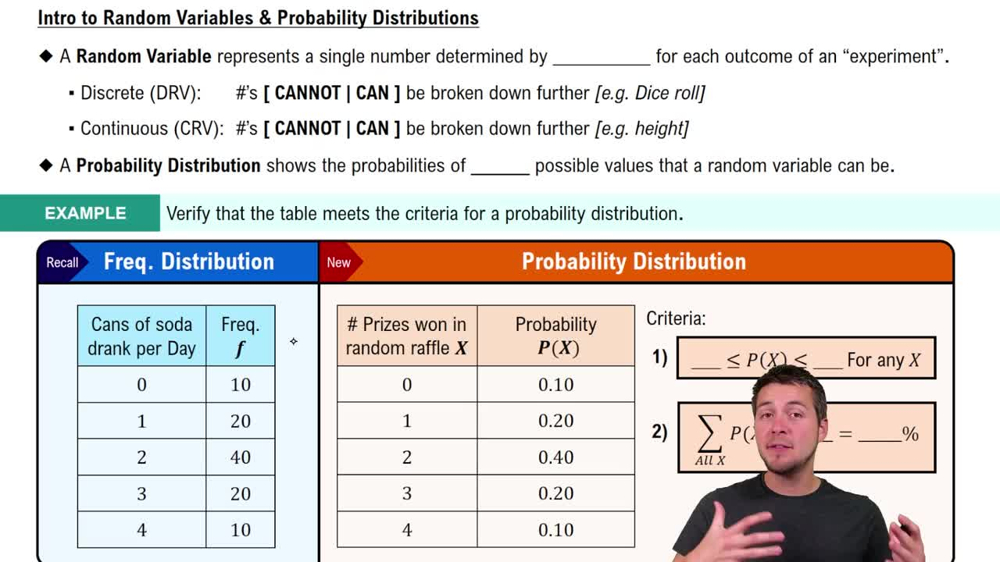
Intro to Random Variables & Probability Distributions
Calculating Probability for an Interval
To find P(c ≤ X ≤ d) for a uniform distribution on [a, b], compute the ratio of the interval length (d - c) to the total length (b - a). This gives the probability that X falls within the specified range.