
Ch. 11 - Goodness-of-Fit and Contingency Tables
Triola - Elementary Statistics 14th Edition
Triola14th EditionElementary StatisticsISBN: 9780137366446Not the one you use?Change textbook
Chapter 11, Problem 11.2.1

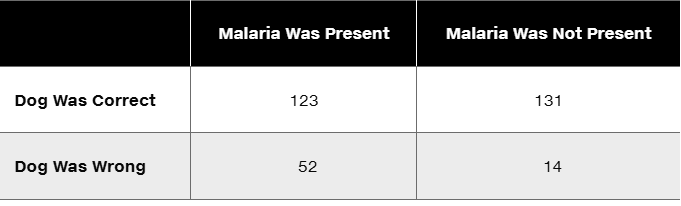
Dogs Detecting Malaria The following table lists results from an experiment designed to test the ability of dogs to use their extraordinary sense of smell to detect malaria in samples of children’s socks (based on data presented at an annual meeting of the American Society of Tropical Medicine, by principal investigator Steve Lindsay). Assuming that the dog being correct is independent of whether malaria is present, find the expected value for the observed frequency of 123.


Table showing results of a study on dogs detecting malaria, with counts of correct and incorrect detections.

Verified step by step guidance
1
Step 1: Calculate the row and column totals for the contingency table. Add the values in each row and column to find the marginal totals. For example, the total for 'Dog Was Correct' is 123 + 131, and the total for 'Malaria Was Present' is 123 + 52.
Step 2: Compute the grand total by summing all the values in the table. This is the sum of all observed frequencies: 123 + 131 + 52 + 14.
Step 3: Use the formula for expected frequency in a contingency table: \( E = \frac{(Row \ Total \times Column \ Total)}{Grand \ Total} \). For the cell corresponding to 'Dog Was Correct' and 'Malaria Was Present', substitute the row total, column total, and grand total into the formula.
Step 4: Perform the multiplication and division as indicated in the formula to calculate the expected frequency for the cell. Do not compute the final numerical value yet.
Step 5: Verify that the expected frequency calculation aligns with the assumption of independence between the dog's correctness and the presence of malaria. Independence implies that the expected frequency is based solely on the marginal totals and grand total.

Verified video answer for a similar problem:

This video solution was recommended by our tutors as helpful for the problem above.
Video duration:
3m
Was this helpful?

Key Concepts

Here are the essential concepts you must grasp in order to answer the question correctly.

Expected Value

Expected value is a fundamental concept in probability and statistics that represents the average outcome of a random variable over numerous trials. It is calculated by multiplying each possible outcome by its probability and summing these products. In the context of the question, the expected value helps determine the anticipated frequency of correct detections by the dog, assuming independence from the actual presence of malaria.
Recommended video:
Guided course
04:14
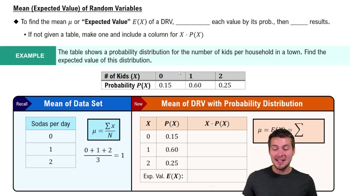
Expected Value (Mean) of Random Variables

Independence

Independence in statistics refers to the scenario where the occurrence of one event does not affect the probability of another event. In this case, the dog's ability to correctly identify malaria is assumed to be independent of whether malaria is actually present. Understanding this concept is crucial for accurately interpreting the results and calculating the expected value, as it influences how we analyze the data.
Recommended video:
Guided course
06:28
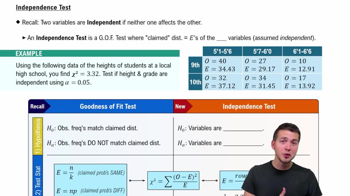
Independence Test

Contingency Table

A contingency table is a type of data representation that displays the frequency distribution of variables, allowing for the analysis of the relationship between them. In the provided table, the rows represent the dog's detection accuracy (correct or wrong), while the columns indicate whether malaria was present or not. This format is essential for calculating probabilities and expected values, as it organizes the data needed for statistical analysis.
Recommended video:
Guided course
08:18
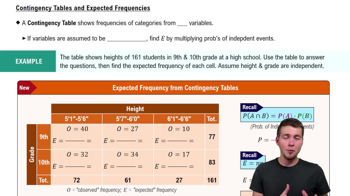
Contingency Tables & Expected Frequencies
Related Practice
Textbook Question

In Exercises 5–20, conduct the hypothesis test and provide the test statistic and the P-value and/or critical value, and state the conclusion.


Heights Measured or Reported? Repeat the preceding exercise using the frequencies in the following table, which summarizes all of the 2784 male heights listed in Data Set 4 “Measured and Reported.” Does the larger data set have much of an effect on the results from Exercise 5?

" style="" width="600">

149
views
Textbook Question

In Exercises 5–20, conduct the hypothesis test and provide the test statistic and the P-value and/or critical value, and state the conclusion.


Bias in Clinical Trials? Researchers investigated the issue of race and equality of access to clinical trials. The following table shows the population distribution and the numbers of participants in clinical trials involving lung cancer (based on data from “Participation in Cancer Clinical Trials,” by Murthy, Krumholz, and Gross, Journal of the American Medical Association, Vol. 291, No. 22). Use a 0.01 significance level to test the claim that the distribution of clinical trial participants fits well with the population distribution. Is there a race/ethnic group that appears to be very underrepresented?


112
views
Textbook Question

Identifying Hypotheses Refer to the data given in Exercise 1 and assume that the requirements are all satisfied and we want to conduct a hypothesis test of independence using the methods of this section. Identify the null and alternative hypotheses.

149
views
Textbook Question

Benford’s Law

According to Benford’s law, a variety of different data sets include numbers with leading (first) digits that follow the distribution shown in the table below. In Exercises 21–24, test for goodness-of-fit with the distribution described by Benford’s law.


Detecting Fraud When working for the Brooklyn district attorney, investigator Robert Burton analyzed the leading digits of the amounts from 784 checks issued by seven suspect companies. The frequencies were found to be 0, 15, 0, 76, 479, 183, 8, 23, and 0, and those digits correspond to the leading digits of 1, 2, 3, 4, 5, 6, 7, 8, and 9, respectively. If the observed frequencies are substantially different from the frequencies expected with Benford’s law, the check amounts appear to result from fraud. Use a 0.01 significance level to test for goodness-of-fit with Benford’s law. Does it appear that the checks are the result of fraud?

216
views
Textbook Question

Equivalent Tests A x^2 test involving a 2 x 2 table is equivalent to the test for the difference between two proportions, as described in Section 9-1. Using Table 11-1 from the Chapter Problem, verify that the x^2 test statistic and the z test statistic (found from the test of equality of two proportions) are related as follows: z^2 = x^2 Also show that the critical values have that same relationship.

157
views
Textbook Question

Clinical Trial of Echinacea In a clinical trial of the effectiveness of echinacea for preventing colds, the results in the table below were obtained (based on data from “An Evaluation of Echinacea Angustifolia in Experimental Rhinovirus Infections,” by Turner et al., New England Journal of Medicine, Vol. 353, No. 4). Use a 0.05 significance level to test the claim that getting a cold is independent of the treatment group. What do the results suggest about the effectiveness of echinacea as a prevention against colds?

162
views