
Textbook Question
In Exercises 37–42, use the Standard Normal Table or technology to find the z-score that corresponds to the cumulative area or percentile.
P85
136
views

 Verified step by step guidance
 06:23
06:23
 04:51
04:51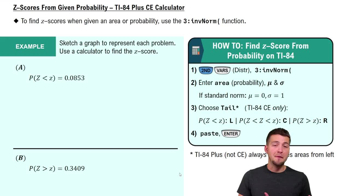 06:31
06:31In Exercises 37–42, use the Standard Normal Table or technology to find the z-score that corresponds to the cumulative area or percentile.
P85
In Exercises 55–60, find the indicated probabilities and interpret the results.
Refer to Exercise 34. A random sample of six days is selected. Find the probability that the mean surface concentration of carbonyl sulfide for the sample is (a) between 5.1 and 15.7 picomoles per liter. Compare your answers with those in Exercise 34.
In Exercises 55–60, find the indicated probabilities and interpret the results.
The mean annual salary for Level 1 actuaries in the United States is about \$72,000. A random sample of 45 Level 1 actuaries is selected. What is the probability that the mean annual salary of the sample is (a) less than \(75,000? Assume sigma = \)11,000.
In Exercises 55–60, find the indicated probabilities and interpret the results.
Refer to Exercise 33. A random sample of 2 years is selected. Find the probability that the mean amount of greenhouse gases for the sample is (a) less than 5500 MMT CO2 eq. Compare your answers with those in Exercise 33.
In Exercises 55–60, find the indicated probabilities and interpret the results.
The mean annual salary for physical therapists in the United States is about \$87,000. A random sample of 50 physical therapists is selected. What is the probability that the mean annual salary of the sample is (a) less than \(84,000? Assume sigma = \)10,500.
In Exercises 55–60, find the indicated probabilities and interpret the results.
The mean MCAT total score in a recent year is 500.9. A random sample of 32 MCAT total scores is selected. What is the probability that the mean score for the sample is (a) less than 503? Assume sigma=10.6.