
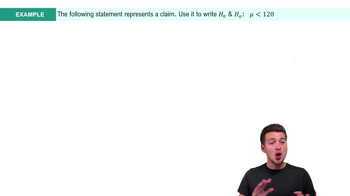
In Exercises 7–10, the statement represents a claim. Write its complement and state which is Ho and which is Ha.
μ≠2.28
Verified step by step guidance
1
Identify the claim in the problem. The claim is μ≠2.28, which is a statement about the population mean (μ). This indicates that the mean is not equal to 2.28.
Understand the complement of the claim. The complement of μ≠2.28 is μ=2.28, which states that the population mean is equal to 2.28.
Determine the null hypothesis (Ho). The null hypothesis always represents the statement of equality, so Ho: μ=2.28.
Determine the alternative hypothesis (Ha). The alternative hypothesis represents the claim being tested, so Ha: μ≠2.28.
Summarize the hypotheses: Ho: μ=2.28 (null hypothesis) and Ha: μ≠2.28 (alternative hypothesis). The alternative hypothesis is the claim, and the null hypothesis is its complement.
Verified video answer for a similar problem:
This video solution was recommended by our tutors as helpful for the problem above
Video duration:
2m
Play a video:
0 Comments
Key Concepts
Here are the essential concepts you must grasp in order to answer the question correctly.
Null Hypothesis (Ho)
The null hypothesis, denoted as Ho, is a statement that indicates no effect or no difference in a statistical test. It serves as the default assumption that any observed effect is due to sampling variability. In this case, the null hypothesis would be that the population mean μ equals 2.28.
The alternative hypothesis, represented as Ha, is a statement that contradicts the null hypothesis. It suggests that there is an effect or a difference. For the given claim μ≠2.28, the alternative hypothesis would be that the population mean μ is not equal to 2.28, indicating a significant deviation from this value.
The complement of a hypothesis refers to the opposite scenario of the original claim. In hypothesis testing, if the null hypothesis states a specific value, the complement would encompass all other possibilities. For the claim μ≠2.28, the complement is μ=2.28, which is the condition under which the null hypothesis holds true.