

No Variation in a Sample An experiment was conducted to test the effects of alcohol. Researchers measured the breath alcohol levels for a treatment group of people who drank ethanol and another group given a placebo. The results are given below (based on data from “Effects of Alcohol Intoxication on Risk Taking, Strategy, and Error Rate in Visuomotor Performance,” by Streufert et al., Journal of Applied Psychology, Vol. 77, No. 4). Use a 0.05 significance level to test the claim that the two sample groups come from populations with the same mean.
Table of contents
- 1. Intro to Stats and Collecting Data1h 14m
- 2. Describing Data with Tables and Graphs1h 55m
- 3. Describing Data Numerically2h 5m
- 4. Probability2h 16m
- 5. Binomial Distribution & Discrete Random Variables3h 6m
- 6. Normal Distribution and Continuous Random Variables2h 11m
- 7. Sampling Distributions & Confidence Intervals: Mean3h 23m
- Sampling Distribution of the Sample Mean and Central Limit Theorem19m
- Distribution of Sample Mean - Excel23m
- Introduction to Confidence Intervals15m
- Confidence Intervals for Population Mean1h 18m
- Determining the Minimum Sample Size Required12m
- Finding Probabilities and T Critical Values - Excel28m
- Confidence Intervals for Population Means - Excel25m
- 8. Sampling Distributions & Confidence Intervals: Proportion1h 25m
- 9. Hypothesis Testing for One Sample3h 29m
- 10. Hypothesis Testing for Two Samples4h 50m
- Two Proportions1h 13m
- Two Proportions Hypothesis Test - Excel28m
- Two Means - Unknown, Unequal Variance1h 3m
- Two Means - Unknown Variances Hypothesis Test - Excel12m
- Two Means - Unknown, Equal Variance15m
- Two Means - Unknown, Equal Variances Hypothesis Test - Excel9m
- Two Means - Known Variance12m
- Two Means - Sigma Known Hypothesis Test - Excel21m
- Two Means - Matched Pairs (Dependent Samples)42m
- Matched Pairs Hypothesis Test - Excel12m
- 11. Correlation1h 24m
- 12. Regression1h 50m
- 13. Chi-Square Tests & Goodness of Fit2h 21m
- 14. ANOVA1h 57m
9. Hypothesis Testing for One Sample
Performing Hypothesis Tests: Means
Problem 9.3.7c
Textbook Question
In Exercises 5–16, use the listed paired sample data, and assume that the samples are simple random samples and that the differences have a distribution that is approximately normal.
The Freshman 15 The “Freshman 15” refers to the belief that college students gain 15 lb (or 6.8 kg) during their freshman year. Listed below are weights (kg) of randomly selected male college freshmen (from Data Set 13 “Freshman 15” in Appendix B). The weights were measured in September and later in April.
c. What do you conclude about the Freshman 15 belief?

Verified step by step guidance1
Step 1: Calculate the differences between the paired weights for September and April. For each individual, subtract the September weight from the April weight to find the change in weight.
Step 2: Compute the mean of the differences. Add all the differences together and divide by the number of paired samples to find the average change in weight.
Step 3: Calculate the standard deviation of the differences. Use the formula for standard deviation: \( \sigma = \sqrt{\frac{\sum (x_i - \bar{x})^2}{n-1}} \), where \( x_i \) are the differences, \( \bar{x} \) is the mean of the differences, and \( n \) is the number of paired samples.
Step 4: Perform a hypothesis test to determine if the mean difference is significantly different from 15 lb (or 6.8 kg). Use a t-test for paired samples, with the null hypothesis \( H_0: \mu = 6.8 \) and the alternative hypothesis \( H_a: \mu \neq 6.8 \). Calculate the t-statistic using \( t = \frac{\bar{x} - \mu}{s / \sqrt{n}} \), where \( \bar{x} \) is the mean difference, \( \mu \) is the hypothesized mean, \( s \) is the standard deviation, and \( n \) is the sample size.
Step 5: Compare the calculated t-statistic to the critical t-value from the t-distribution table at the chosen significance level (e.g., \( \alpha = 0.05 \)). If the t-statistic falls outside the critical range, reject the null hypothesis. Based on the results, draw a conclusion about the validity of the Freshman 15 belief.
Verified video answer for a similar problem:This video solution was recommended by our tutors as helpful for the problem above
Video duration:
8mPlay a video:
Was this helpful?
Key Concepts
Here are the essential concepts you must grasp in order to answer the question correctly.
Paired Sample Data
Paired sample data involves two related groups where measurements are taken from the same subjects at two different times or under two different conditions. In this context, the weights of male college freshmen are measured in September and again in April, allowing for a direct comparison of weight changes over time.
Recommended video:
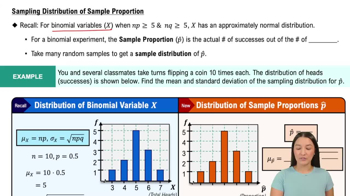
Sampling Distribution of Sample Proportion
Normal Distribution
Normal distribution is a probability distribution that is symmetric about the mean, indicating that data near the mean are more frequent in occurrence than data far from the mean. The assumption that the differences in weights have an approximately normal distribution is crucial for applying statistical tests that rely on this property, such as the paired t-test.
Recommended video:
Guided course
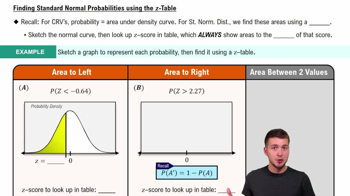
Finding Standard Normal Probabilities using z-Table
Statistical Inference
Statistical inference involves drawing conclusions about a population based on sample data. In this case, the analysis of the weight differences will help determine whether the belief in the 'Freshman 15'—that students gain 15 pounds during their freshman year—is supported by the data collected from the sample of students.
Recommended video:
Guided course
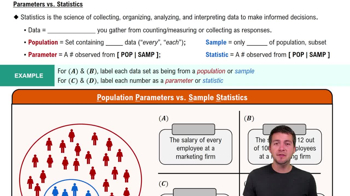
Parameters vs. Statistics
Watch next
Master Standard Deviation (σ) Known with a bite sized video explanation from Patrick
Start learningRelated Videos
Related Practice
Textbook Question
56
views
