Ch. 6 - Confidence Intervals
Larson - Elementary Statistics: Picturing the World 8th Edition
Larson8th EditionElementary Statistics: Picturing the WorldISBN: 9780137493470Not the one you use?Change textbook
Chapter 6, Problem 6.1.5

In Exercises 5–8, find the critical value zc necessary to construct a confidence interval at the level of confidence c.
c = 0.80

Verified step by step guidance
1
Identify the level of confidence, c, which is given as 0.80. This represents the proportion of the area under the standard normal curve that corresponds to the confidence interval.
Calculate the area in the tails of the standard normal distribution. Since the confidence level is 0.80, the remaining area in the tails is 1 - 0.80 = 0.20. Divide this equally between the two tails, so each tail has an area of 0.10.
Determine the cumulative area to the left of the critical value zc. Since the area in the left tail is 0.10, the cumulative area to the left of zc is 0.10 + 0.80 = 0.90.
Use a standard normal distribution table (z-table) or a statistical calculator to find the z-score that corresponds to a cumulative area of 0.90. This z-score is the critical value zc.
Verify the critical value zc by ensuring that the area between -zc and zc under the standard normal curve equals the confidence level, c = 0.80.

Verified video answer for a similar problem:

This video solution was recommended by our tutors as helpful for the problem above.
Video duration:
3m
Was this helpful?

Key Concepts

Here are the essential concepts you must grasp in order to answer the question correctly.

Critical Value (zc)

The critical value, denoted as zc, is a point on the standard normal distribution that corresponds to a specified level of confidence. It defines the boundaries of the confidence interval, indicating how far from the mean we can expect the true population parameter to lie with a certain level of certainty. For example, a confidence level of 80% means that 80% of the distribution lies within zc standard deviations from the mean.
Recommended video:
05:50
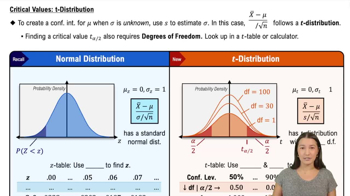
Critical Values: t-Distribution

Confidence Interval

A confidence interval is a range of values, derived from sample statistics, that is likely to contain the true population parameter with a specified level of confidence. It is calculated using the sample mean, the critical value, and the standard error. For instance, an 80% confidence interval suggests that if we were to take many samples, approximately 80% of the calculated intervals would contain the true parameter.
Recommended video:
06:33
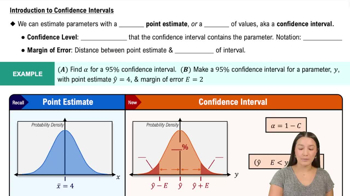
Introduction to Confidence Intervals

Standard Normal Distribution

The standard normal distribution is a probability distribution that has a mean of 0 and a standard deviation of 1. It is used to determine the critical values for various confidence levels. By converting a normal distribution to a standard normal distribution, we can easily find zc values using z-tables or statistical software, which helps in constructing confidence intervals.
Recommended video:
Guided course
09:47
Finding Standard Normal Probabilities using z-Table