The initial pressures for bicycle tires when first filled are normally distributed, with a mean of 70 pounds per square inch (psi) and a standard deviation of 1.2 psi. b. A random sample of 15 tires is drawn from this population. What is the probability that the mean tire pressure of the sample is less than 69 psi?
Verified step by step guidance
1
Step 1: Identify the problem as one involving the sampling distribution of the sample mean. The population mean (μ) is 70 psi, the population standard deviation (σ) is 1.2 psi, and the sample size (n) is 15.
Step 2: Calculate the standard error of the mean (SEM) using the formula: SEM = σ / √n. Substitute the given values for σ and n into the formula.
Step 3: Standardize the sample mean of 69 psi to a z-score using the formula: z = (X̄ - μ) / SEM, where X̄ is the sample mean, μ is the population mean, and SEM is the standard error of the mean. Substitute the values into the formula.
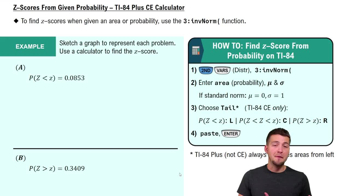
Step 4: Use the z-score obtained in Step 3 to find the cumulative probability from the standard normal distribution table or a statistical software. This cumulative probability represents the probability that the sample mean is less than 69 psi.
Step 5: Interpret the result. The cumulative probability found in Step 4 is the probability that the mean tire pressure of the sample is less than 69 psi.
Verified video answer for a similar problem:
This video solution was recommended by our tutors as helpful for the problem above
Video duration:
2m
Play a video:
0 Comments
Key Concepts
Here are the essential concepts you must grasp in order to answer the question correctly.
Normal Distribution
Normal distribution is a probability distribution that is symmetric about the mean, showing that data near the mean are more frequent in occurrence than data far from the mean. In this context, the tire pressures are normally distributed with a specified mean and standard deviation, which allows us to use the properties of the normal distribution to calculate probabilities.
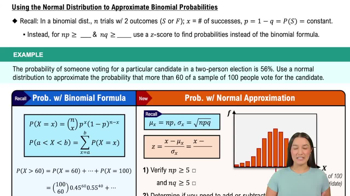
Using the Normal Distribution to Approximate Binomial Probabilities
Central Limit Theorem
The Central Limit Theorem states that the sampling distribution of the sample mean will be normally distributed, regardless of the shape of the population distribution, provided the sample size is sufficiently large (typically n > 30). In this case, since the sample size is 15, we can still apply the theorem to approximate the distribution of the sample mean, given that the population is normally distributed.
A Z-score is a statistical measurement that describes a value's relationship to the mean of a group of values, expressed in terms of standard deviations. It is calculated by subtracting the mean from the value and dividing by the standard deviation. In this problem, calculating the Z-score for the sample mean will help determine the probability that the mean tire pressure is less than 69 psi.