Given the end results of the two types of division, why is it necessary for homologs to pair during meiosis and not desirable for them to pair during mitosis?
Table of contents
- 1. Introduction to Genetics51m
- 2. Mendel's Laws of Inheritance3h 37m
- 3. Extensions to Mendelian Inheritance2h 41m
- 4. Genetic Mapping and Linkage2h 28m
- 5. Genetics of Bacteria and Viruses1h 21m
- 6. Chromosomal Variation1h 48m
- 7. DNA and Chromosome Structure56m
- 8. DNA Replication1h 10m
- 9. Mitosis and Meiosis1h 34m
- 10. Transcription1h 0m
- 11. Translation58m
- 12. Gene Regulation in Prokaryotes1h 19m
- 13. Gene Regulation in Eukaryotes44m
- 14. Genetic Control of Development44m
- 15. Genomes and Genomics1h 50m
- 16. Transposable Elements47m
- 17. Mutation, Repair, and Recombination1h 6m
- 18. Molecular Genetic Tools19m
- 19. Cancer Genetics29m
- 20. Quantitative Genetics1h 26m
- 21. Population Genetics50m
- 22. Evolutionary Genetics29m
9. Mitosis and Meiosis
Meiosis
Problem 24b
Textbook Question
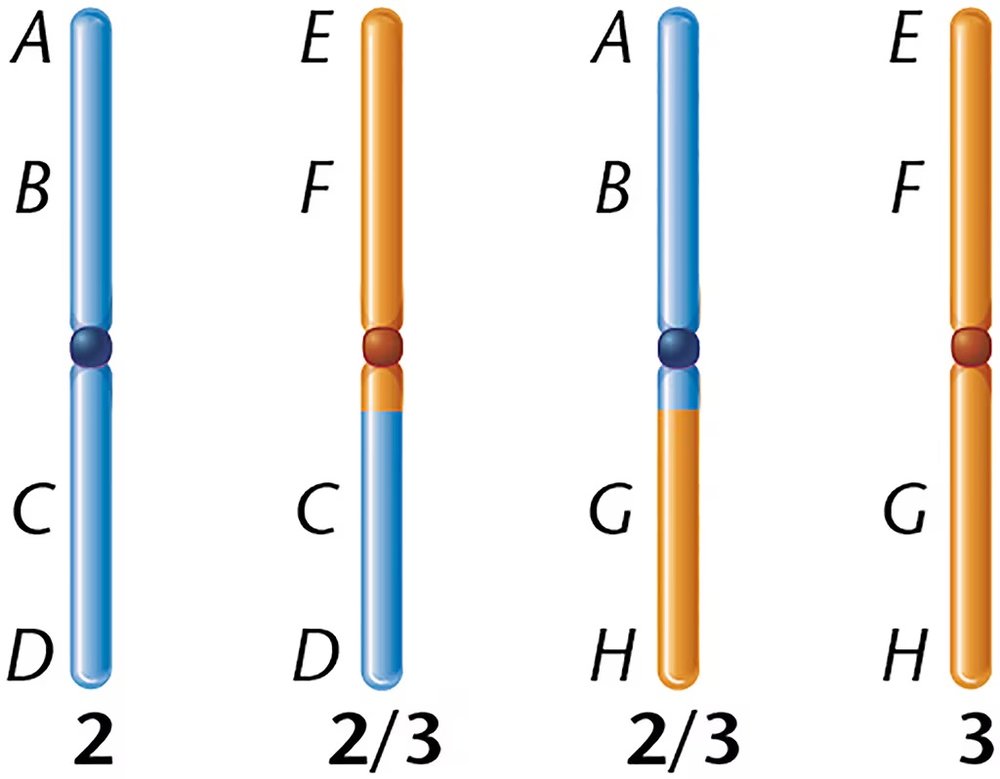
A woman who sought genetic counseling is found to be heterozygous for a chromosomal rearrangement between the second and third chromosomes. Her chromosomes, compared to those in a normal karyotype, are diagrammed to the right.

Using a drawing, demonstrate how these chromosomes would pair during meiosis. Be sure to label the different segments of the chromosomes.
Verified step by step guidance1
Step 1: Identify the normal chromosomes and the rearranged chromosomes. The normal chromosome 2 has segments labeled A, B, C, D, and the normal chromosome 3 has segments E, F, G, H. The rearranged chromosomes show a translocation between chromosomes 2 and 3, where segments C and D from chromosome 2 are swapped with segments G and H from chromosome 3.
Step 2: Understand that during meiosis, homologous chromosomes pair by aligning their similar segments. Because of the translocation, the chromosomes cannot pair linearly as usual. Instead, they form a cross-shaped structure (a quadrivalent) to allow homologous regions to align properly.
Step 3: Draw the pairing structure by placing the normal chromosome 2 and the rearranged chromosome 2/3 opposite each other, and the normal chromosome 3 and the rearranged chromosome 2/3 opposite each other, forming a cross. Label each segment (A, B, C, D, E, F, G, H) on the respective chromosomes to show which segments align with each other.
Step 4: In the cross structure, ensure that segments A and B on the normal chromosome 2 align with A and B on the rearranged chromosome, segments C and D on the normal chromosome 2 align with C and D on the rearranged chromosome 2/3, and similarly for segments E, F, G, H on chromosome 3 and the rearranged chromosome 2/3.
Step 5: This cross-shaped pairing allows for proper synapsis during meiosis despite the rearrangement, and it is important to label the centromeres and segments clearly to visualize how the chromosomes align and segregate.
Verified video answer for a similar problem:This video solution was recommended by our tutors as helpful for the problem above
Video duration:
1mPlay a video:
Was this helpful?
Key Concepts
Here are the essential concepts you must grasp in order to answer the question correctly.
Chromosomal Rearrangements
Chromosomal rearrangements involve structural changes in chromosomes, such as translocations, inversions, deletions, or duplications. In this case, a rearrangement between chromosomes 2 and 3 results in a hybrid chromosome containing segments from both. Understanding these rearrangements is crucial for predicting how chromosomes pair and segregate during meiosis.
Recommended video:
Guided course
Rearrangement Overview
Meiotic Pairing of Homologous Chromosomes
During meiosis, homologous chromosomes pair to ensure proper segregation. When a heterozygous rearrangement is present, chromosomes form complex pairing structures (e.g., loops or cross-shaped configurations) to align homologous segments. This pairing is essential to maintain genetic balance and avoid gametes with duplications or deletions.
Recommended video:
Guided course
Chromosome Structure
Karyotype and Chromosome Segment Labeling
Karyotyping visually represents chromosomes and their segments, labeled here as A-H, to identify structural differences. Labeling helps track which chromosome parts correspond between normal and rearranged chromosomes, facilitating the understanding of pairing behavior and genetic consequences during meiosis.
Recommended video:
Guided course
Human Sex Chromosomes
Related Videos
Related Practice
Textbook Question
446
views
