
Ch. 02 - Describing Motion: Kinematics in One Dimension
Giancoli Douglas - Physics for Scientists and Engineers 5th edition
Giancoli Douglas5th editionPhysics for Scientists and EngineersISBN: 9780137488179Not the one you use?Change textbook
Chapter 2, Problem 64c

A rocket rises vertically, from rest, with an acceleration of 3.2 m/s² until it runs out of fuel at an altitude of 725 m. After this point, its acceleration is that of gravity, downward. What maximum altitude does the rocket reach?

Verified step by step guidance
1
Determine the velocity of the rocket at the moment it runs out of fuel. Use the kinematic equation: v^2 = v_0^2 + 2a d, where v_0 = 0 (initial velocity), a = 3.2 \(\text{ m/s}\)^2 (acceleration), and d = 725 \(\text{ m}\) (distance traveled while fuel is burning). Solve for v.
Once the rocket runs out of fuel, it continues to move upward due to its velocity at that point. Its motion is now under the influence of gravity alone, with an acceleration of a = -9.8 \(\text{ m/s}\)^2. Use the kinematic equation v^2 = v_0^2 + 2a d again, where v = 0 (velocity at the maximum altitude), v_0 is the velocity calculated in step 1, and a = -9.8 \(\text{ m/s}\)^2. Solve for d, which represents the additional height the rocket travels after running out of fuel.
Add the altitude at which the rocket runs out of fuel (725 \(\text{ m}\)) to the additional height calculated in step 2 to find the maximum altitude reached by the rocket.
Verify the units and ensure all calculations are consistent with the SI system. Double-check the signs of acceleration and velocity to ensure they align with the direction of motion.
Summarize the process: The maximum altitude is the sum of the altitude at fuel exhaustion and the additional height gained while decelerating under gravity. This ensures a clear understanding of the problem-solving approach.

Verified video answer for a similar problem:

This video solution was recommended by our tutors as helpful for the problem above.
Was this helpful?

Key Concepts

Here are the essential concepts you must grasp in order to answer the question correctly.

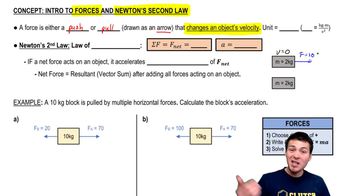
Newton's Second Law of Motion

Newton's Second Law states that the acceleration of an object is directly proportional to the net force acting on it and inversely proportional to its mass. This principle is crucial for understanding how the rocket accelerates upward due to the thrust generated by its engines until it runs out of fuel.
Recommended video:
Guided course
06:54
Intro to Forces & Newton's Second Law

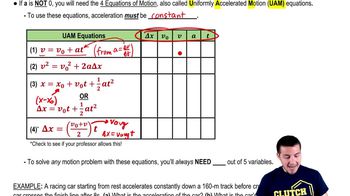
Kinematic Equations

Kinematic equations describe the motion of objects under constant acceleration. In this scenario, we can use these equations to calculate the rocket's velocity at the moment it runs out of fuel and subsequently determine its maximum altitude by considering the motion under the influence of gravity alone.
Recommended video:
Guided course
08:25
Kinematics Equations

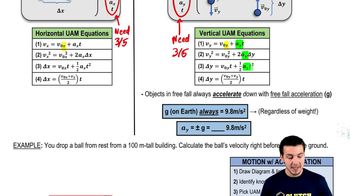
Free Fall and Gravity

Once the rocket runs out of fuel, it enters free fall, where the only force acting on it is gravity, which accelerates it downward at approximately 9.81 m/s². Understanding free fall is essential for calculating how high the rocket ascends after it exhausts its fuel and begins to decelerate until it reaches its peak altitude.
Recommended video:
Guided course
08:36
Vertical Motion & Free Fall
Related Practice
Textbook Question

A baseball pitcher throws a baseball with a speed of 43 m/s. Estimate the average acceleration of the ball during the throwing motion. In throwing the baseball, the pitcher accelerates it through a displacement of about 3.5 m, from behind the body to the point where it is released (Fig. 2–44).

<IMAGE>

1556
views
Textbook Question

For an object falling freely from rest, show that the distance traveled during each successive second increases in the ratio of successive odd integers (1, 3, 5, etc.). (This was first shown by Galileo.) See Figs. 2–27 and 2–30.

1230
views
Textbook Question

A baseball is seen to pass upward by a window with a vertical speed of 13 m/s. If the ball was thrown by a person 18 m below on the street, when was it thrown?

1720
views
Textbook Question

A car traveling 85 km/h slows down at a constant 0.50 m/s² just by 'letting up on the gas.' Calculate the distance it travels during the first and fifth seconds.

1745
views
Textbook Question

Roger sees water balloons fall past his window. He notices that each balloon strikes the sidewalk 0.83 s after passing his window, 15 m above the sidewalk. Assuming the balloons are being released from rest, from what height are they being released?

1353
views
Textbook Question

A helicopter is ascending vertically with a constant speed of 6.40 m/s. At a height of 105 m above the Earth, a package is dropped from the helicopter. How much time does it take for the package to reach the ground? [Hint: What is v₀ for the package?]

1876
views